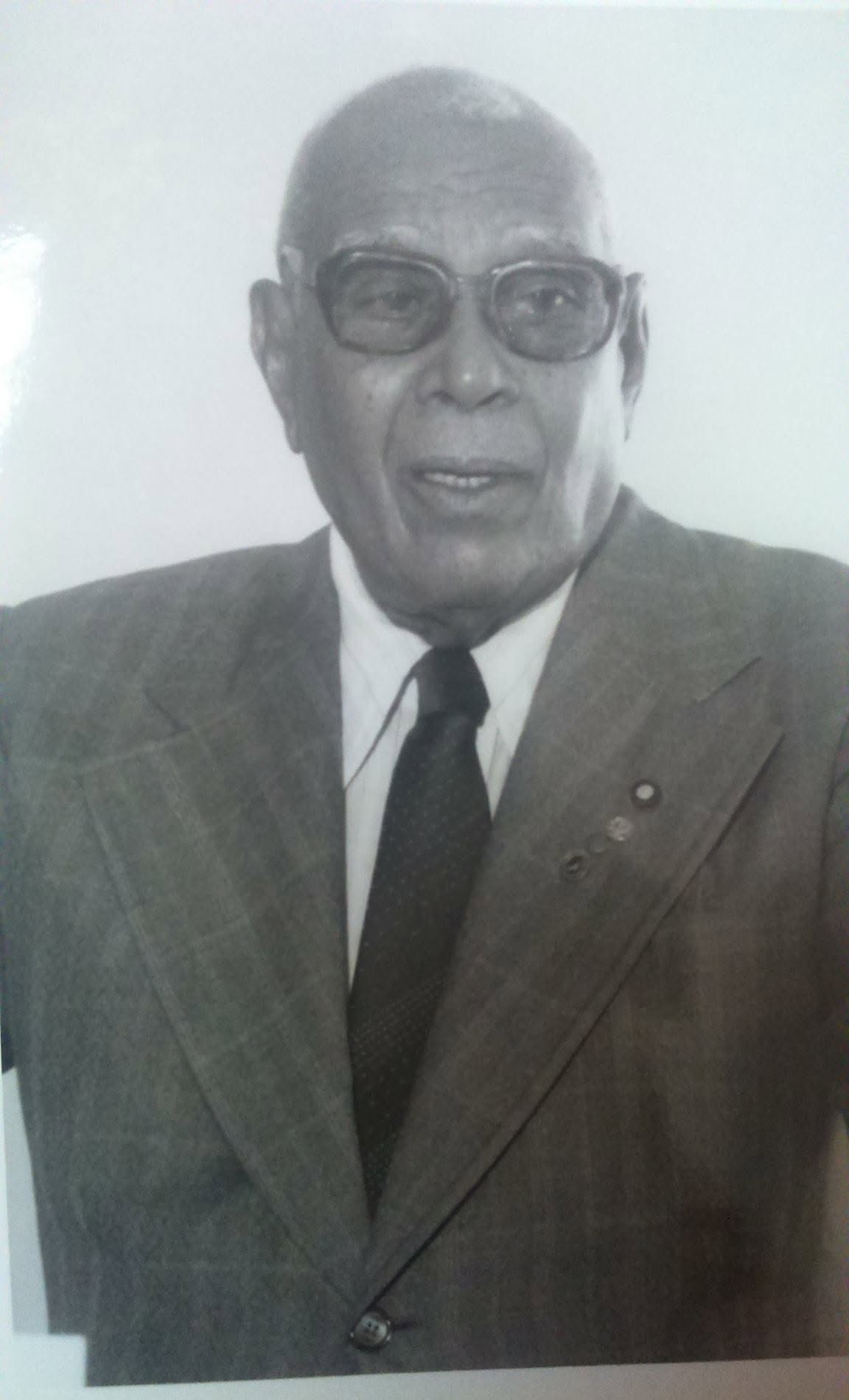
Ramón Emilio “Tito” Mella Martí (1907–1991)
Ramón Emilio “Tito” Mella Martí (1907–1991) was a Dominican shipping magnate. He founded AMCO (Agencia Marítima y Comercial) in 1930 and owned the Compañía Naviera Dominicana, a Dominican shipping line.Oral tradition / family recordTradición oral / registro familiar
Ramón Emilio «Tito» Mella Martí (1907–1991) fue un magnate naviero dominicano. Fundó AMCO (Agencia Marítima y Comercial) en 1930 y fue dueño de la Compañía Naviera Dominicana, una naviera dominicana.Oral tradition / family recordTradición oral / registro familiar
The nine clippings below are the documented part of the story. In 1942, German U-boats sank Dominican steamers in the Caribbean and shipping between the United States and Puerto Rico fell into a critical shortage. That December, the United States government signed a wartime agreement with the Compañía Naviera Dominicana to carry food to Puerto Rico. The company helped meet the shortage by building wooden motor schooners, among them the Inoa, launched in 1944. By late 1949, the SS Nuevo Dominicano was sailing between Miami, Kingston, Montego Bay, and Ciudad Trujillo. Each clipping is printed with the newspaper and the date that carried it.DocumentedDocumentado
Los nueve recortes que siguen son la parte documentada de la historia. En 1942, los submarinos alemanes hundieron vapores dominicanos en el Caribe y el transporte marítimo entre Estados Unidos y Puerto Rico cayó en una escasez crítica. Ese diciembre, el gobierno de Estados Unidos firmó un acuerdo de guerra con la Compañía Naviera Dominicana para llevar alimentos a Puerto Rico. La compañía ayudó a enfrentar la escasez construyendo goletas de madera a motor, entre ellas la Inoa, botada en 1944. A finales de 1949, el vapor SS Nuevo Dominicano navegaba entre Miami, Kingston, Montego Bay y Ciudad Trujillo. Cada recorte se imprime con el periódico y la fecha que lo publicó.DocumentedDocumentado
Two kinds of knowing. Where this site states something beyond the articles themselves, it says which kind of knowledge it is. Documented means a primary source backs it and is cited. Oral tradition means it comes from family or community memory: valued, printed as it was told, and possibly not exact. The label travels with the claim, so a careful reader always knows what they are standing on.
Dos maneras de saber. Cuando este sitio afirma algo más allá de los propios artículos, dice de qué clase de conocimiento se trata. Lo documentado significa que una fuente primaria lo respalda y se cita. Tradición oral significa que viene de la memoria familiar o comunitaria: se valora, se imprime tal como se contó y puede no ser exacto. La etiqueta acompaña a la afirmación, para que un lector cuidadoso sepa siempre sobre qué está parado.
On this pageEn esta página
The life the clippings belong to.La vida a la que pertenecen los recortes.
A cabin boy learns the trade on the dock.Un grumete aprende el oficio en el muelle.
The agency of 1930, its building, its timeline.La agencia de 1930, su edificio, su línea de tiempo.
The national line, the San Rafael, the shipping schools.La línea nacional, el San Rafael, las escuelas navieras.
“A millionaire in friends”: sayings, family, honors.«Millonario de amigos»: frases, familia y honores.
Eight records of his route, 1936–1962.Ocho registros de su ruta, 1936–1962.
January 26, 1991, and the avenue with his name.26 de enero de 1991, y la avenida con su nombre.
The Foundation and the Maritime Library.La Fundación y la Biblioteca Marítima.
The album: documents, photographs and memory.El álbum: documentos, fotografías y memoria.
Nine American newspapers, as printed.Nueve periódicos norteamericanos, tal como se imprimieron.
What is confirmed, what is disputed, the sources.Lo confirmado, lo disputado, las fuentes.
The album's photographs, gathered in one place.Las fotografías del álbum, reunidas en un solo lugar.
The chronicle of a lifeLa crónica de una vida
The clippings further down this page are the documented exhibits. This chronicle is the life they belong to, drawn from the family research dossier of October 27, 2026 and from the family page “Tito Mella: Empresario Naviero.” Where a statement rests on a document, the dossier names it; where it rests on family memory, it is printed as memory. The last two sections of the page say plainly what the archive confirms and what it still does not.
Los recortes que aparecen más abajo en esta página son las piezas documentadas. Esta crónica es la vida a la que pertenecen, tomada del dossier de investigación familiar del 27 de octubre de 2026 y de la página familiar «Tito Mella: Empresario Naviero». Cuando una afirmación descansa en un documento, el dossier lo nombra; cuando descansa en la memoria familiar, se imprime como memoria. Las dos últimas secciones de la página dicen con claridad lo que el archivo confirma y lo que aún calla.
Summary · The essential factsSumario · Los datos esenciales
Name: Ramón Emilio Mella Martí, “Don Tito.”
Nombre: Ramón Emilio Mella Martí, «Don Tito».
Birth: March 27, 1907 (family date), Samaná. His 1962 documents say April 27; his company says Sabana de la Mar, 1906. The baptism record, still to be read, decides.
Nacimiento: 27 de marzo de 1907 (fecha familiar), Samaná. Sus documentos de 1962 dicen 27 de abril; su empresa, Sabana de la Mar, 1906. El bautismo, aún por leer, decide.
Parents: Francisco Mella and Cecilia (her surname and origin unresolved).
Padres: Francisco Mella y Cecilia (apellido y origen de ella, sin resolver).
Work: Founder in 1930 of the Agencia Mella, later AMCO, today AMARIT.
Obra: Fundador en 1930 de la Agencia Mella, luego AMCO, hoy AMARIT.
Death: January 26, 1991, at the Gómez Patiño clinic. Buried in the cemetery on Máximo Gómez avenue.
Muerte: 26 de enero de 1991, en la clínica Gómez Patiño. Sepultado en el cementerio de la avenida Máximo Gómez.
Honors: Honorary doctorates from UNPHU and from O&M; an avenue bears his name (2007).
Honores: Doctorados Honoris Causa de la UNPHU y de la O&M; una avenida con su nombre (2007).
I · Samaná and the dockI · Samaná y el muelle
Ramón Emilio Mella Martí was born in Samaná in 1907, the son of Francisco Mella and Cecilia Martí. Some say he was born in Sabana de la Mar; his 1936 passenger record, the document closest to his own hand that this research holds, declares Samaná.
Ramón Emilio Mella Martí nació en Samaná en 1907, hijo de Francisco Mella y de Cecilia Martí. Algunos dicen que vio la luz en Sabana de la Mar; su registro de pasajero de 1936, el documento más cercano a su mano que guarda esta investigación, declara Samaná.
The family moved to San Pedro de Macorís, the sugar port on the Higuamo river. There he completed his primary studies and found his destiny among bales, cranes and schooner hulls. His first job came as a teenager, in the office of Rafael Dalmau, who trusted him.
La familia se trasladó a San Pedro de Macorís, el puerto azucarero del río Higuamo. Allí cursó sus estudios primarios y encontró su destino entre fardos, grúas y cascos de goleta. Su primer empleo lo obtuvo siendo adolescente, en la oficina de Rafael Dalmau, que confió en él.
On the dock he was not only a laborer: he was the intermediary between the workers and the ships, the man who knew where every cargo was. His company's official history confirms it: in the 1920s he began “not only as a laborer but also as an intermediary between the laborers and the ships.”
En el muelle no fue solo obrero: fue intermediario entre los trabajadores y los buques, el hombre que sabía dónde estaba cada carga. La historia oficial de su empresa lo confirma: en los años veinte se inició «no solo como obrero sino también como intermediario entre los obreros y los buques».
From there he went to the capital as a messenger for the Santo Domingo Customs, and in 1930 he is recorded as a stevedore for schooners and smaller vessels. That year he began formally as an official stevedore, and came to represent those ships as their official local agent. He was twenty-three years old, with no capital but his name.
De allí pasó a la capital como mensajero de la Aduana de Santo Domingo, y en 1930 consta como estibador de goletas y barcos menores. Ese año comenzó formalmente como estibador oficial, y llegó a representar aquellos navíos como agente local oficial. Tenía veintitrés años y ningún capital que no fuera su nombre.
II · The House of MellaII · La Casa Mella
The Agencia Mella was born in 1930 and grew with the port. As Agencia Marítima y Comercial, AMCO, it represented first-rank houses in the country: the Comco Line, the Picor Line, Surinam Shipping Ltd., Antillean Marine Shipping Corp. and the Grace Line, among others. Since 1930 the house has worked the loading and unloading of vehicles, steel and containers.
La Agencia Mella nació en 1930 y creció con el puerto. Como Agencia Marítima y Comercial, AMCO, representó en el país a casas de primer orden: la Comco Line, la Picor Line, Surinam Shipping Ltd., Antillean Marine Shipping Corp. y la Grace Line, entre otras. Desde 1930 la casa trabaja la carga y descarga de vehículos, acero y contenedores.
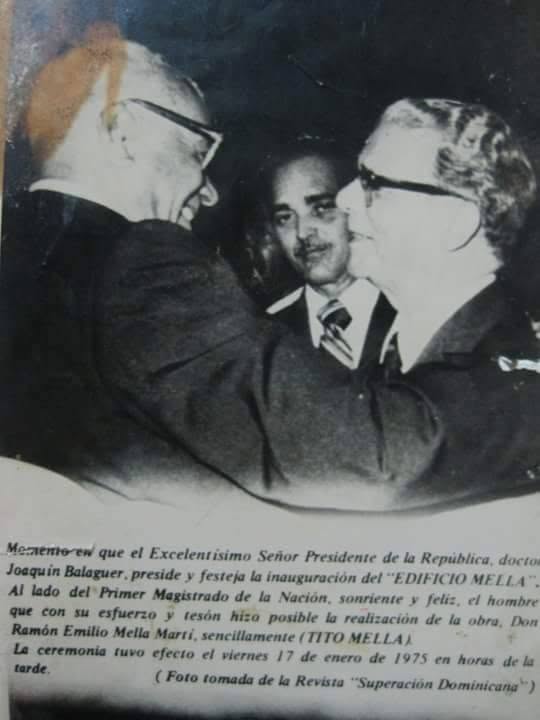
Its founding president received visitors at the Edificio Mella, inaugurated on January 17, 1975 on Cambronal street at the Malecón of San Pedro de Macorís, with underground parking that still stands. There he received the dignitaries and the personalities the shipping business puts in one's path.
Su presidente fundador atendía en el Edificio Mella, inaugurado el 17 de enero de 1975 en la calle Cambronal esquina Malecón de San Pedro de Macorís, con parqueo soterrado que aún se mantiene. Allí recibía a dignatarios y a las personalidades que el negocio naviero pone en el camino.
He was an adviser to the Flota Mercante Dominicana. He was among the founders of the Club Náutico de Santo Domingo, whose member plaques keep his name and that of his son Vinicio.
Fue asesor de la Flota Mercante Dominicana. Estuvo entre los fundadores del Club Náutico de Santo Domingo, cuyas placas de socio conservan su nombre y el de su hijo Vinicio.
Without academic training, he took part in the founding of two universities, the Universidad Nacional Pedro Henríquez Ureña and the O&M, and both granted him honorary doctorates; the UNPHU certificate, from 1985, is in the family album. He also funded scholarships for students without the means to pay for their studies.
Sin formación académica, participó en el surgimiento de dos universidades, la Nacional Pedro Henríquez Ureña y la O&M, y ambas le otorgaron doctorados Honoris Causa; el certificado de la UNPHU, de 1985, figura en el álbum familiar. Becó además a estudiantes sin recursos para costear sus estudios.
The house through timeLa casa en el tiempo
The Agencia Marítima Comercial is formed. Its first years were spent making itself known in every port in the country.
Se forma la Agencia Marítima Comercial. Sus primeros años fueron de darse a conocer en todos los puertos del país.
Ships of much greater capacity begin to arrive, from the world's best-known lines. The agency is already a large enterprise.
Comienzan a recibirse barcos de mucho mayor capacidad y de las líneas más reconocidas del mundo. La agencia es ya una gran empresa.
The initials AMCO become AMARIT. Major investments in the ports of Caucedo and Río Haina.
Las siglas AMCO pasan a ser AMARIT. Inversiones importantes en los puertos de Caucedo y Río Haina.
The company is acquired in its majority by the Puerto Rican shipowner Néstor González, joined by Don Tito's descendants Héctor Vinicio Mella Jr. and José Máximo Mella, and Liana Peña.
La empresa es adquirida en su mayor parte por el naviero puertorriqueño Néstor González, a quien se unen los descendientes de Don Tito, Héctor Vinicio Mella Jr. y José Máximo Mella, y Liana Peña.
The AMARIT Logistics division is born, with contracts and alliances with shipping lines, agents and warehouses.
Nace la división AMARIT Logistics, con contratos y alianzas con navieras, agentes y almacenes.
The house continues as an integral supplier of sea, air and land transport; its board brings together Néstor González, Vinicio Mella, José M. Mella and Liana G. Peña. The timeline is the company's own (amarit.com.do), whose founder page gives him born in Sabana de la Mar in 1906, a version that coexists, without prevailing, with the family tradition (Samaná, 1907) and his 1936 record.
La casa continúa como suplidor integral de transporte naval, aéreo y terrestre; su consejo reúne a Néstor González, Vinicio Mella, José M. Mella y Liana G. Peña. La línea es la de la propia empresa (amarit.com.do), cuya página del fundador lo da nacido en Sabana de la Mar en 1906, versión que convive sin imponerse con la tradición familiar (Samaná, 1907) y su registro de 1936.
III · The national shipping line and the warIII · La naviera nacional y la guerra
According to the Foundation's biographical report, compiled from the national press of his time, the government of Rafael Trujillo commissioned Mella Martí to open the national shipping line, with the purpose of carrying Dominican produce to the different Caribbean ports. The family attribution that Don Tito owned the company reads, in light of that fact, as the memory of an effective direction; the mercantile document that would fix it as ownership is one of the pieces this research still pursues.
Según el reportaje biográfico de la Fundación, compilado de la prensa nacional de su tiempo, el gobierno de Rafael Trujillo comisionó a Mella Martí para abrir la naviera nacional, con el propósito de transportar los frutos dominicanos a los diferentes puertos caribeños. La atribución familiar de que Don Tito fue dueño de la compañía se lee, a la luz de ese dato, como la memoria de una dirección efectiva; el documento mercantil que la fije en propiedad es una de las piezas que esta investigación aún persigue.
The maritime history of Miguel Reyes Sánchez gives the context: the Empresa Naviera Dominicana was born in 1938 around the steamer San Rafael, formerly the Mayan, of 4,600 tons, a former Grace Line ship donated to the government by Félix Benítez Rexach. The San Rafael was torpedoed by the German submarine U-125 on May 3, 1942, on the Tampa to Kingston run: the war reached the Dominican flag as well. The wartime agreement of December 1942 and the launching of the schooner Inoa are documented in the clippings further down this page.
La historia marítima de Miguel Reyes Sánchez da el contexto: la Empresa Naviera Dominicana nació en 1938 alrededor del vapor San Rafael, antes Mayan, de 4.600 toneladas, antiguo buque de la Grace Line donado al gobierno por Félix Benítez Rexach. El San Rafael fue torpedeado por el submarino alemán U-125 el 3 de mayo de 1942, en travesía de Tampa a Kingston: la guerra llegó también a la bandera dominicana. El acuerdo de guerra de diciembre de 1942 y la botadura de la goleta Inoa están documentados en los recortes que siguen en esta página.
The shipping schoolsLas escuelas navieras
Reyes Sánchez's history calls the Flota Mercante Dominicana and the Naviera Dominicana the country's principal “shipping schools,” where shipping executives, officers and sailors were trained, and names Ramón Emilio Mella Martí first on its list. Between them, the two companies employed some 250 people.
La historia de Reyes Sánchez llama a la Flota Mercante Dominicana y a la Naviera Dominicana las principales «escuelas navieras» del país, donde se formaron ejecutivos navieros, oficiales y marineros, y cita en primer lugar de su lista a Ramón Emilio Mella Martí. Entre ambas empresas sumaban unos 250 empleados.
The Flota Mercante was created in 1952, the first fleet lost, with large merchant ships, several baptized with names from the Trujillo family. It began with a weekly service to New York that extended to the whole east coast of the United States. For it a small passenger cruiser was later acquired, the Nuevo Dominicano, agented by Frank L. Fraser, an executive of the Dominican Fruit & Steamship Co., on a Jamaica, Port-au-Prince, Miami and Nassau route.
La Flota Mercante se creó en 1952, perdida la primera flota, con buques mercantes de gran porte, varios bautizados con nombres de la familia Trujillo. Contaba al inicio con un servicio semanal a Nueva York que se extendió a toda la costa este de los Estados Unidos. Para ella se adquirió después un pequeño crucero de pasajeros, el Nuevo Dominicano, agenciado por Frank L. Fraser, ejecutivo de la Dominican Fruit & Steamship Co., con ruta Jamaica, Puerto Príncipe, Miami y Nassau.
At Trujillo's fall, the state company did not survive: in 1966 the government sold its ships, and from its ranks came the new private shipping lines. Don Tito's agency survived the regime and the century: the dock apprentice ended up teaching the trade to the country.
A la caída de Trujillo, la empresa estatal no sobrevivió: en 1966 el gobierno vendió sus buques, y de sus filas salieron las nuevas navieras privadas. La agencia de Don Tito sobrevivió al régimen y al siglo: el alumno del muelle terminó enseñando el oficio al país.
IV · The man: sayings, honors and familyIV · El hombre: frases, honores y familia
Those who dealt with him describe him as humble, simple and cheerful, with a natural intelligence exercised on the dock. At his death, José Diego Pérez wrote in the Listín Diario that “his life was always a climbing toward higher goals,” and the broadcaster Danilo Arzeno read a posthumous note that defined him with three adjectives: honest, hardworking, humane.
Los que lo trataron lo describen humilde, sencillo y alegre, y de una inteligencia natural ejercitada en el muelle. Al morir, José Diego Pérez escribió en el Listín Diario que «su vida fue siempre un escalar hacia metas superiores», y el locutor Danilo Arzeno leyó una nota póstuma que lo definía con tres adjetivos: honrado, trabajador, humanitario.
“I am only a millionaire in friends.”«Yo solo soy millonario de amigos».
A saying of Don Tito, gathered by the press at his deathFrase de Don Tito, recogida por la prensa a su muerte
He left sayings of his own coinage. When he sent his children abroad to study, he would exclaim: “You are going to learn at university what I learned on the dock.” The anecdote family tradition attributes to him with the great shipowners of his century, among them Aristotle Onassis, is kept as what it is: period color, with no document behind it. Oral tradition / family recordTradición oral / registro familiar
Dejó frases de su cosecha. Cuando enviaba a sus hijos a estudiar al extranjero, exclamaba: «Van a estudiar a la universidad lo que yo aprendí en el muelle». La anécdota que la tradición le atribuye con los grandes armadores de su siglo, entre ellos Aristóteles Onassis, se conserva como lo que es: color de época, sin documento que lo respalde. Oral tradition / family recordTradición oral / registro familiar
V · Passenger movementsV · Movimiento de pasajeros
Eight records draw his route through the Caribbean between 1936 and 1962. The ages on the manifests are inexact; each record is reproduced as it reads.
Ocho registros dibujan su ruta por el Caribe entre 1936 y 1962. Las edades de los manifiestos son inexactas; se reproduce lo que cada registro dice.
29 years old, born about 1907 in Samaná; resident in Ciudad Trujillo; married; 5 feet 10 inches, dark complexion, black eyes and hair.
29 años, nacido hacia 1907 en Samaná; residente en Ciudad Trujillo; casado; 5 pies 10 pulgadas, tez oscura, ojos y cabellos negros.
39 years old, born about 1907; married.
39 años, nacido hacia 1907; casado.
40 years old, born about 1908.
40 años, nacido hacia 1908.
42 years old, born about 1906.
42 años, nacido hacia 1906.
42 years old, born about 1907.
42 años, nacido hacia 1907.
February 24, May 4 and September 12; on the last two, at 55 years old, he declares his birth exactly: April 27, 1907.
24 de febrero, 4 de mayo y 12 de septiembre; en las dos últimas, con 55 años, declara su nacimiento con exactitud: 27 de abril de 1907.
VI · Death and memoryVI · Muerte y memoria
Ramón Emilio died on January 26, 1991, after a brief stay at the Gómez Patiño clinic. His remains were buried in the cemetery on Máximo Gómez avenue, where his plaque names him with the dates 1907 and 1991. The family keeps the date with anniversary fidelity: the twenty-third in 2014, the twenty-fifth in 2016.
Ramón Emilio falleció el 26 de enero de 1991, tras un breve internamiento en la clínica Gómez Patiño. Sus restos fueron sepultados en el cementerio de la avenida Máximo Gómez, donde su tarja lo nombra con las fechas 1907 y 1991. La familia guarda la fecha con fidelidad de aniversario: el vigésimo tercero en 2014, el vigésimo quinto en 2016.
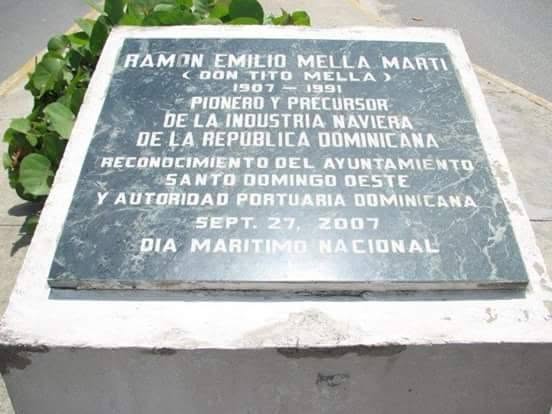
On February 2, 2007, the Santo Domingo Oeste city council gave his name to a stretch of the 30 de Mayo highway, the one ending at the Haina dock; the avenue was inaugurated two years later, with the unveiling of a plaque. Inaugurating it, Juan Periche Vidal recalled that his attraction to the maritime world came from childhood: the dock, once more, as first and last school.
El 2 de febrero de 2007, el ayuntamiento de Santo Domingo Oeste designó con su nombre un tramo de la autopista 30 de Mayo, el que termina en el muelle de Haina; la avenida se inauguró dos años después, con el descubrimiento de una tarja. Al inaugurarla, Juan Periche Vidal recordó que su atracción por el entorno marítimo venía de niño: el muelle, una vez más, como primera y última escuela.
A note for archivists: another pen is preparing his biography. The journalist Cándida Ortega is writing “Vida y obra de un viejo lobo de mar” in his honor, according to the 2023 press. Her materials write “Martín” and date the death January 16, 1991: a variant recorded without adopting it, because the family commemoration fixes the 26th.
Nota para archiveros: otra pluma prepara su biografía. La periodista Cándida Ortega escribe «Vida y obra de un viejo lobo de mar» en su homenaje, según la prensa de 2023. Sus materiales escriben «Martín» y fechan la muerte el 16 de enero de 1991: variante registrada sin adoptar, pues la conmemoración familiar manda el 26.
VII · The legacy: the FoundationVII · El legado: la Fundación
In 2010, his descendants created the Fundación Ramón E. Mella (Don Tito), a nonprofit, to continue his work in the maritime and port sector: to promote maritime law, maritime administration, fishing and natural resources, and to train at every level.
En 2010, sus descendientes crearon la Fundación Ramón E. Mella (Don Tito), sin fines de lucro, para continuar su obra en el sector marítimo y portuario: promover el derecho marítimo, la administración marítima, la pesca y los recursos naturales, y capacitar a todos los niveles.
With Universidad APEC it signed an agreement on April 3, 2013, from which were born the country's first Master's in Maritime Law and a singular jewel: the Biblioteca Marítima Fundación Tito Mella, inaugurated at UNAPEC in October 2017, the first in the country, with free access. Its initial holdings: 265 pieces of international jurisprudence with the most relevant maritime cases from the United States federal courts, contributed by the firm Montgomery McCracken Walker & Rhoads.
Con la Universidad APEC firmó un acuerdo el 3 de abril de 2013, del que nacieron la primera Maestría en Derecho Marítimo del país y una joya singular: la Biblioteca Marítima Fundación Tito Mella, inaugurada en la UNAPEC en octubre de 2017, la primera del país, de libre acceso. Su fondo inicial: 265 piezas de jurisprudencia internacional con los casos marítimos más relevantes de las cortes federales estadounidenses, aportadas por la firma Montgomery McCracken Walker & Rhoads.
The Foundation was then presided over by his grandson Héctor Vinicio Mella Garrido, who in 2022 signed an agreement with the diplomatic institute INESDYC. The Foundation has also published a compendium of maritime essays in his honor: the surname remains among books and ships.
Presidía entonces la Fundación su nieto Héctor Vinicio Mella Garrido, quien en 2022 firmó un acuerdo con el instituto diplomático INESDYC. La Fundación ha publicado además un compendio de ensayos marítimos en su homenaje: el apellido sigue entre libros y buques.
From the family pageDe la página familiar
The family page “Tito Mella: Empresario Naviero” on Facebook keeps the memory in public: 22 posts between 2014 and 2025, and for the twenty-fifth anniversary of his death an album of 62 photographs published in January and February 2016. The page was extracted in full on October 24, 2026; what follows is what it adds to this chronicle. Oral tradition / family recordTradición oral / registro familiar
La página familiar «Tito Mella: Empresario Naviero» en Facebook guarda la memoria en público: 22 publicaciones entre 2014 y 2025 y, por el vigésimo quinto aniversario de su muerte, un álbum de 62 fotografías publicado en enero y febrero de 2016. La página fue extraída por completo el 24 de octubre de 2026; lo que sigue es lo que aporta a esta crónica. Oral tradition / family recordTradición oral / registro familiar
The anniversary posts are the family's own calendar: the twenty-third anniversary of his death on January 26, 2014, the twenty-fifth in 2016, the thirty-fourth in 2025, always on January 26; and the birthday posts celebrate March 27 (he would have turned 108 in 2015, 111 in 2018). That arithmetic is what settles the death date, January 26, 1991, against the secondary source that gives the 16th.
Las publicaciones de aniversario son el calendario de la propia familia: el vigésimo tercer aniversario de su muerte el 26 de enero de 2014, el vigésimo quinto en 2016, el trigésimo cuarto en 2025, siempre el 26 de enero; y las de cumpleaños celebran el 27 de marzo (habría cumplido 108 años en 2015, 111 en 2018). Esa aritmética es la que fija la fecha de muerte, 26 de enero de 1991, frente a la fuente secundaria que da el 16.
The album is also a document chest: it preserves photographs of the papers of a life. The principal pieces:
El álbum es también un arca de documentos: conserva fotografías de los papeles de una vida. Las piezas principales:
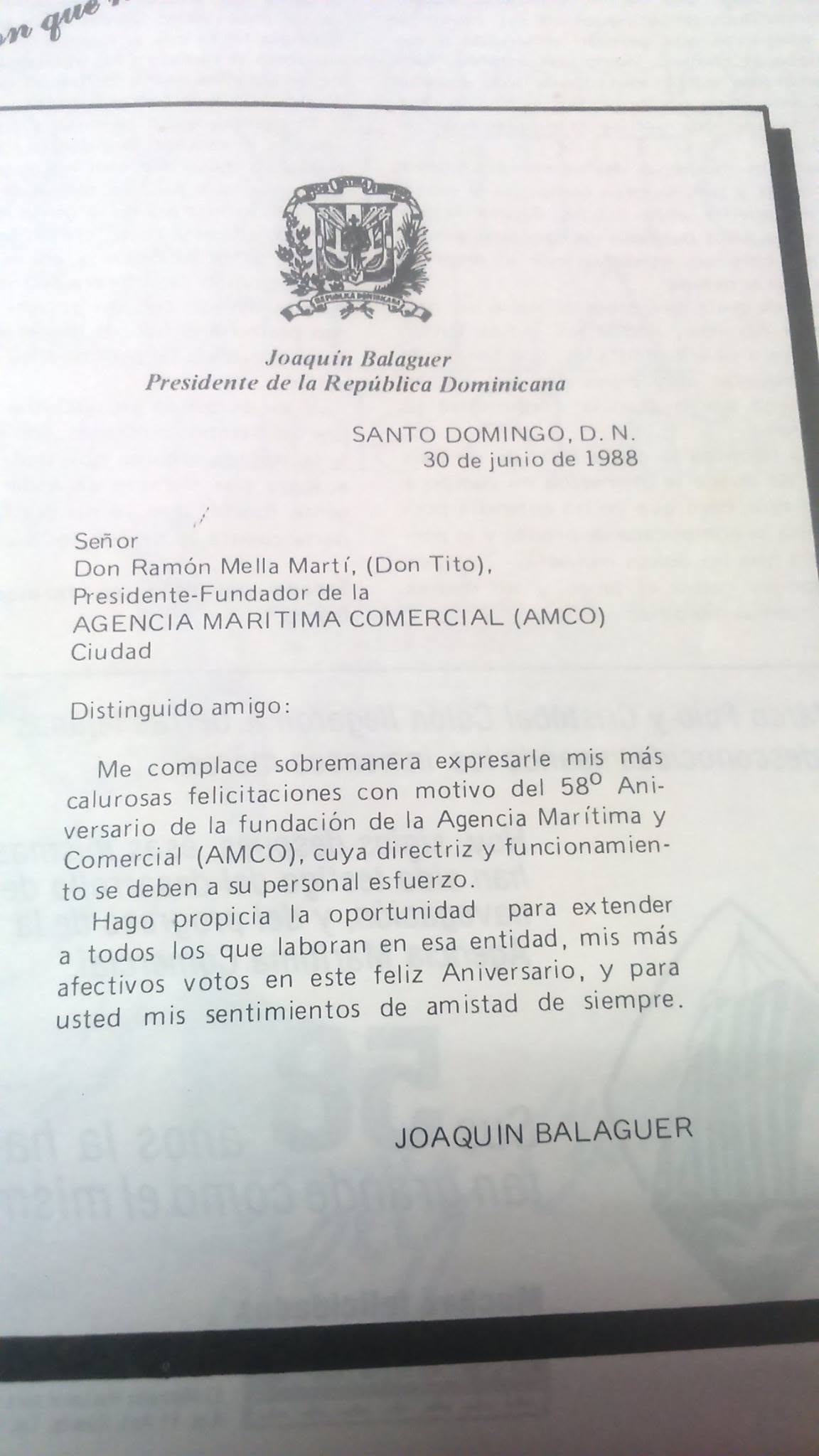
June 30, 1988. Congratulations for the 58th anniversary of AMCO.
30 de junio de 1988. Felicitación por el 58 aniversario de AMCO.
Congratulatory letters from the ambassadors of Costa Rica, Chile and Mexico.
Cartas de felicitación de los embajadores de Costa Rica, Chile y México.
January 17, 1975. Photograph of the inauguration, with President Balaguer present.
17 de enero de 1975. Fotografía de la inauguración, con el presidente Balaguer presente.
June 21, 1985. It names him Asesor Perpétuo of the university.
21 de junio de 1985. Lo nombra Asesor Perpétuo de la universidad.
The condecoration conferred by President Antonio Guzmán.
La condecoración conferida por el presidente Antonio Guzmán.
The founder plates of the Club Náutico de Santo Domingo keep his name.
Las placas de fundadores del Club Náutico de Santo Domingo conservan su nombre.
“Ramón Emilio Mella Martí (Don Tito Mella) 1907–1991, pioneer and precursor of the shipping industry of the Dominican Republic.” An homage of the Santo Domingo Oeste council and the Dominican Port Authority for National Maritime Day, September 27, 2007.
«Ramón Emilio Mella Martí (Don Tito Mella) 1907–1991, pionero y precursor de la industria naviera de la República Dominicana». Homenaje del ayuntamiento de Santo Domingo Oeste y la Autoridad Portuaria Dominicana por el Día Marítimo Nacional, 27 de septiembre de 2007.
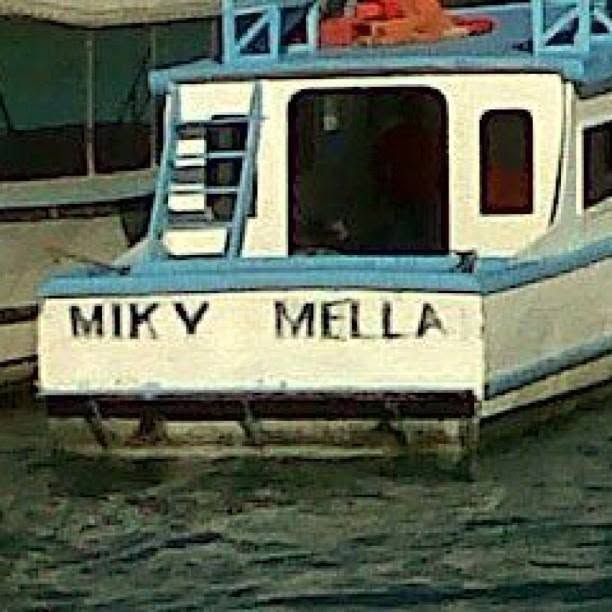
The album's board listings resolve a confusion of names: H. Vinicio Mella E., the son, appears as executive president and H. Vinicio Mella Jr., the grandson, as secretary; a July 2025 post presents the grandson as the one who now leads the Foundation. The three eldest sons are named in a caption: Vinicio, Papucho and Máximo. And the memory is also maritime: a photograph of the boat Miky Mella drew the recollection of a passenger who rode her from Sabana de la Mar to Samaná, and a 2019 comment remembers Don Tito's boats crossing the Bay of Samaná between the two towns. An homage caption in the album sums up the arc: “from cabin boy of a schooner he rose to captain of a great enterprise.” In April 2017 the page shared a poem dedicated to him by Manuel M. Rodríguez Fiol.
Los directorios del álbum resuelven una confusión de nombres: H. Vinicio Mella E., el hijo, figura como presidente ejecutivo y H. Vinicio Mella Jr., el nieto, como secretario; una publicación de julio de 2025 presenta al nieto como quien hoy dirige la Fundación. Los tres hijos mayores se nombran en una leyenda: Vinicio, Papucho y Máximo. Y la memoria es también marítima: una fotografía del bote Miky Mella trajo el recuerdo de un pasajero que viajó en él de Sabana de la Mar a Samaná, y un comentario de 2019 recuerda los barcos de Don Tito cruzando la bahía de Samaná entre los dos pueblos. Una leyenda de homenaje del álbum resume el arco: «desde grumete de una goleta llegó a capitán de una gran empresa». En abril de 2017 la página compartió una poesía dedicada a él por Manuel M. Rodríguez Fiol.
The rest of the album's photographs — the young agent of 25, the ceremonies, the Edificio Mella drawing, the Club Náutico plaques — are gathered in the page's photo gallery.
El resto de las fotografías del álbum — el joven agente de 25 años, las ceremonias, el dibujo del Edificio Mella, las placas del Club Náutico — está reunido en la galería de fotos de esta página.
The album also carries the open genealogical dispute, unresolved there as here. Two screenshots of a family tree («Árbol Genealógico de Tito Mella», from the site Familias de Samaná, Sabana de la Mar y Sánchez) give his mother as Cecilia Marte (Martir) (Marty), his birth as April 28, 1907 in Samaná, and cite as their source the Samaná baptism book, book 10, page 20, number 79, the same record the dossier names as arbiter. A 2023 comment on those very screenshots disputes the tree: it holds that his death record names his mother “Cecilia Marti de Vidal,” whose own parents were Luis Marty Hernandez and Lucia Barrett, the Martys from Curaçao. Three accounts of Cecilia stand, and none is adopted on this page; the baptism book decides.
El álbum carga también la disputa genealógica abierta, sin resolver allí como aquí. Dos capturas de un árbol familiar («Árbol Genealógico de Tito Mella», del sitio Familias de Samaná, Sabana de la Mar y Sánchez) dan a su madre como Cecilia Marte (Martir) (Marty), su nacimiento el 28 de abril de 1907 en Samaná, y citan como fuente el libro de bautismos de Samaná, libro 10, página 20, número 79, el mismo registro que el dossier nombra como árbitro. Un comentario de 2023 sobre esas mismas capturas disputa el árbol: sostiene que el acta de defunción lo nombra hijo de «Cecilia Marti de Vidal», cuyos padres fueron Luis Marty Hernandez y Lucia Barrett, los Marty de Curazao. Tres relatos sobre Cecilia conviven, y ninguno se adopta en esta página; el libro de bautismos decide.
The clippings, 1942–1949Los recortes, 1942–1949
Dominican Ship Sunk by U-Boat

United Press dispatch from Ciudad Trujillo reporting that a German U-boat sank the Dominican steamer San Rafael (1,972 tons, built at Bremerhaven in 1905), with only 8 of 40 crew members known saved.
Despacho de United Press desde Ciudad Trujillo informando que un submarino alemán hundió el vapor dominicano San Rafael (1,972 toneladas, construido en Bremerhaven en 1905), con solo 8 sobrevivientes confirmados de 40 tripulantes.
Research note: Part of the May–June 1942 Caribbean U-boat offensive that decimated Dominican steam tonnage and created the wartime shipping crisis later answered by Tito Mella's Compañía Naviera Dominicana schooner program.
Nota de investigación: Parte de la ofensiva de submarinos alemanes en el Caribe (mayo-junio de 1942) que diezmó el tonelaje a vapor dominicano y provocó la escasez naviera que luego enfrentaría el programa de goletas de la Compañía Naviera Dominicana de Tito Mella.
The text as printedEl texto tal como se imprimió
The words of the item, transcribed from the clipping.Las palabras del texto, transcritas del recorte.
Cuidad Trujillo, Dominican Republic (UP) — The Secretary of War and Marine announced today that a German submarine had sunk the Dominican steamer San Rafael and that only eight of its 40 crew members were known to have been saved. The announcement caused great indignation throughout this capital. (Lloyd's register lists the San Rafael as a 1,972-ton vessel built at Bremerhaven, Germany, in 1905.)
Dominican Ship U-Boat Victim

Associated Press dispatch on the San Rafael sinking: torpedoed while returning from Tampa, Florida via Kingston, Jamaica. Eight survivors reached Cayman Brac in a lifeboat while air patrols searched the Caribbean for the 30 missing crewmen.
Despacho de Associated Press sobre el hundimiento del San Rafael: torpedeado cuando regresaba de Tampa, Florida, vía Kingston, Jamaica. Ocho sobrevivientes llegaron a Cayman Brac en bote salvavidas mientras patrullas aéreas buscaban a los 30 desaparecidos.
Research note: AP lists net/registered tonnage (1,161 tons) while UP cites gross tonnage from Lloyd's Register (1,972 tons).
Nota de investigación: AP registra el tonelaje neto (1,161 toneladas) mientras que UP cita el tonelaje bruto del Lloyd's Register (1,972 toneladas).
The text as printedEl texto tal como se imprimió
The words of the item, transcribed from the clipping.Las palabras del texto, transcritas del recorte.
CIUDAD TRUJILLO, Dominican Republic (AP) — The Dominican Republic steamship San Rafael, 1,161 tons, was torpedoed recently by an enemy U-boat while en route home from Tampa, Fla., by way of Kingston, Jamaica, it was learned from official sources last night. Eight survivors arrived in a lifeboat at Cayman Brac, an island northwest of Jamaica, and declared the entire crew had taken to lifeboats when the ship was attacked. Thirty crewmen, including the captain, were missing but the boats were well supplied and the survivors were hopeful that they would be found by an air patrol which set out searching the Caribbean.
Sub Makes Dominican Ship Destroy Cargo

AP dispatch from Willemstad, Curaçao: a German U-boat intercepted a Dominican vessel, forced it to dump its cargo into the sea, and placed aboard the crew of a previously sunk Dominican ship whose 17-ton cargo had been raided for submarine supplies.
Despacho de AP desde Willemstad, Curazao: un submarino alemán interceptó un buque dominicano, obligó a arrojar su carga al mar y puso a bordo a la tripulación de otro barco dominicano previamente hundido.
Research note: Illustrates how U-boats operated against small Dominican inter-island schooners and coasters in June 1942.
Nota de investigación: Ilustra las tácticas de los submarinos alemanes contra las goletas y buques de cabotaje dominicanos en junio de 1942.
The text as printedEl texto tal como se imprimió
The words of the item, transcribed from the clipping.Las palabras del texto, transcritas del recorte.
WILLEMSTAD, Curacao, June 20 (AP) — A Dominican ship has reached port with a double crew but no freight as a result of an encounter with a submarine, the newspaper Beurs En Nieuws Berichten said today. The craft was overtaken en route here. The U-boat captain demanded that its cargo be dumped into the sea and the crew of a previously sunk Dominican ship was put aboard. The submarine had seized part of the 17-ton cargo of the first ship for supplies.
Additional Cargo Space Available to Puerto Rico

Washington AP announcement: the U.S. State Department and Agricultural Marketing Administration signed a formal wartime agreement with Tito Mella's Compañía Naviera Dominicana to supply cargo space for food shipments to Puerto Rico.
Anuncio de AP desde Washington: el Departamento de Estado y la Administración de Comercialización Agrícola de EE. UU. firmaron un acuerdo con la Compañía Naviera Dominicana de Tito Mella para proveer espacio de carga de alimentos hacia Puerto Rico.
Research note: Compañía Naviera Dominicana and AMCO (Agencia Marítima y Comercial, founded 1930) were owned by Dominican shipping magnate Ramón Emilio 'Tito' Mella Martí (1907–1991). Oral tradition / family recordTradición oral / registro familiar
Nota de investigación: La Compañía Naviera Dominicana y AMCO (Agencia Marítima y Comercial, fundada en 1930) eran propiedad del empresario naviero dominicano Ramón Emilio 'Tito' Mella Martí (1907–1991). Oral tradition / family recordTradición oral / registro familiar
The text as printedEl texto tal como se imprimió
The words of the item, transcribed from the clipping.Las palabras del texto, transcritas del recorte.
WASHINGTON, Dec. 7 (AP) — The Agriculture Department announced today an agreement between the State Department, Agriculture Marketing Administration and the Naviera Dominicana Company of the Dominican Republic whereby additional cargo space will be made available for shipment of food to Puerto Rico.
Office of War Information: Agreement with Naviera Dominicana Company

Full Office of War Information (OWI) bulletin in the New Orleans Daily Shipping Guide detailing the U.S. government contract with Tito Mella's Compañía Naviera Dominicana, explaining that pre-war Puerto Rico food ships had been diverted to carry Allied munitions.
Boletín completo de la Oficina de Información de Guerra (OWI) en el Daily Shipping Guide de Nueva Orleans detallando el contrato del gobierno de EE. UU. con la Compañía Naviera Dominicana de Tito Mella, explicando que los buques de preguerra habían sido desviados al transporte de municiones aliadas.
Research note: Recovered visually from the top-left V-for-Victory column of the New Orleans Daily Shipping Guide (missed by automated OCR due to 6-point tabular type).
Nota de investigación: Recuperado visualmente de la columna superior izquierda del Daily Shipping Guide de Nueva Orleans (omitido por el OCR automático debido a la tipografía de 6 puntos).
The text as printedEl texto tal como se imprimió
The words of the item, transcribed from the clipping.Las palabras del texto, transcritas del recorte.
OFFICE OF WAR INFORMATION — Washington, D. C. — Additional cargo space will become available for shipping food to Puerto Rico through a recent agreement with the Naviera Dominicana Company of the Dominican Republic the Department of Agriculture announced. The new arrangement will augment the present shipping space and alleviate to some extent the critical shortage of shipping facilities between the United States and Puerto Rico. Essential food, and other supplies provided by the Agricultural Marketing Administration, are shipped to Puerto Rico. During the month of November AMA shipped Puerto Rico rice, lard, beans, flour, cornmeal, dried fruits, pickled meats and fish, poultry and dairy feed, laundry soap, and fertilizer. Because of the difficulties of shipping and the severely limited space, only essential cargoes are being sent to the Puerto Rican Islands. Ships that before the war carried huge quantities of foodstuffs to Puerto Rico are now supplying the armies of the United States and the United Nations with munitions, equipment and food.
More Food to Puerto Rico

Detailed trade notice on the U.S.–Naviera Dominicana food pact, noting that the agreement alleviated the critical wartime shortage of shipping facilities to Puerto Rico for staples including rice, lard, beans, flour, and fertilizer.
Nota comercial detallada sobre el pacto alimentario entre EE. UU. y la Naviera Dominicana, señalando que el acuerdo aliviaba la crítica escasez de transporte marítimo hacia Puerto Rico para arroz, manteca, frijoles, harina y fertilizantes.
Research note: Corroborates the Dec 1942 USDA / AMA contract with Tito Mella's shipping line.
Nota de investigación: Corrobora el contrato de diciembre de 1942 entre el USDA / AMA y la naviera de Tito Mella.
The text as printedEl texto tal como se imprimió
The words of the item, transcribed from the clipping.Las palabras del texto, transcritas del recorte.
Additional cargo space will become available for shipping food to Puerto Rico through a recent agreement with the Naviera Dominicana Company of the Dominican Republic executed by the United States Departments of State and Agricultural Marketing Administration has announced. The new arrangement will alleviate to some extend the critical shortage of shipping facilities between the United States and Puerto Rico. In November, the AMA shipped Puerto Rico rice, lard, beans, flour, cornmeal, dried fruits, pickled meats and fish, poultry and dairy feed, laundry soap and fertilizer.
Fourth of Six Dominican Schooners Launched: The Inoa

Maritime intelligence report confirming that Tito Mella's Compañía Naviera Dominicana launched the 132-ton net wooden motor-driven schooner Inoa at a shipyard near Ciudad Trujillo — the fourth of six schooners built for wartime Caribbean inter-island trade.
Informe de inteligencia marítima que confirma que la Compañía Naviera Dominicana de Tito Mella botó la goleta de madera a motor Inoa (132 toneladas netas) en un astillero cerca de Ciudad Trujillo, cuarta de seis goletas construidas para el comercio interinsular.
Research note: Primary documentation of the Inoa (132 tons net) and Naviera Dominicana's six-vessel wooden motor-schooner shipbuilding program.
Nota de investigación: Documentación primaria de la goleta Inoa (132 toneladas netas) y del programa de construcción de seis goletas a motor de la Naviera Dominicana.
The text as printedEl texto tal como se imprimió
The words of the item, transcribed from the clipping.Las palabras del texto, transcritas del recorte.
The fourth of six schooners ordered in the Dominican Republic has been launched at a shipyard near Cuidad Trujillo by the Compania Naviera Dominicana. The vessel, named Inoa, 132 tons net, is one of a new fleet of wooden motor-driven schooners constructed to help meet the wartime shipping shortage in the Caribbean inter-island trade.
Schooner Inoa Raises Naviera Dominicana Fleet to Four

Follow-up shipping item recording that the launch of the 132-ton schooner Inoa in Ciudad Trujillo brought the total number of vessels built by Compañía Naviera Dominicana to four.
Nota naviera de seguimiento registrando que la botadura de la goleta Inoa de 132 toneladas en Ciudad Trujillo elevó a cuatro el número de embarcaciones construidas por la Compañía Naviera Dominicana.
Research note: Second independent notice in the Sydney Daily Commercial News and Shipping List tracking Naviera Dominicana's shipyard output.
Nota de investigación: Segunda nota en el Daily Commercial News and Shipping List sobre la producción del astillero de la Naviera Dominicana.
The text as printedEl texto tal como se imprimió
The words of the item, transcribed from the clipping.Las palabras del texto, transcritas del recorte.
The schooner Inoa, of 132 tons net, was launched recently in Ciudad Trujillo in the Dominican Republic, raising the number of vessels constructed by the Compania Naviera Dominicana to four.
The Nuevo Dominicano — Formerly the New Northland

Display advertisement revealing the identity and route of the SS Nuevo Dominicano: formerly the SS New Northland, refitted for 177 passengers, sailing fortnightly between Miami, Kingston, Montego Bay, and Ciudad Trujillo ($240 round trip), plus Nassau runs.
Anuncio desplegado que revela la identidad y ruta del SS Nuevo Dominicano: anteriormente el SS New Northland, reacondicionado para 177 pasajeros, navegando cada dos semanas entre Miami, Kingston, Montego Bay y Ciudad Trujillo (240 dólares ida y vuelta).
Research note: Tito Mella repeatedly arrived in New York aboard the SS Nuevo Dominicano in 1948–1949; by December 1949 the 177-passenger steamer was placed on the Miami–Jamaica–Ciudad Trujillo cruise schedule through Eastern Shipping Corporation. Oral tradition / family recordTradición oral / registro familiar
Nota de investigación: Tito Mella llegó repetidamente a Nueva York a bordo del SS Nuevo Dominicano en 1948–1949; hacia diciembre de 1949 el vapor de 177 pasajeros pasó a cubrir la ruta Miami–Jamaica–Ciudad Trujillo. Oral tradition / family recordTradición oral / registro familiar
The text as printedEl texto tal como se imprimió
The words of the item, transcribed from the clipping.Las palabras del texto, transcritas del recorte.
Once more the glamorous, sun-kissed islands of the Caribbean Sea can be visited on a luxurious cruise ship. The Nuevo Dominicano — Formerly the New Northland. THE NUEVO DOMINICANO is spic and span and has been refitted for Caribbean comforts and all modern services. 177 passengers can be accommodated. Beginning January 21, 1950 the NUEVO DOMINICANO will sail from Miami every two weeks, stopping at Kingston and Montego Bay, Jamaica, B.W.I. and Ciudad Trujillo, Dominican Republic. 12 DAYS AFLOAT and ASHORE. Your round trip fare of $240 plus tax includes transportation and entertainment asea and ashore. Special round trip cruises are also offered to Nassau. Leaving January 19th The Nuevo Dominicano will depart at 6 P.M. and every two weeks thereafter. Round trip fare with stop-over privileges $55 plus tax. One-way fare $30 plus tax. ... EASTERN SHIPPING CORPORATION, 28 S.W. 4th Street, Miami, Fla.
What the archive confirms, and what it still does not sayLo que el archivo confirma y lo que aún calla
ConfirmedConfirmado DocumentedDocumentado
- His identity and his life years, from documents of his own house, President Balaguer's letter of 1988 and his plaque.Su identidad y sus años de vida, por documentos de su casa, la carta del presidente Balaguer de 1988 y su tarja.
- His birth in Samaná, from his own passenger record of 1936.Su nacimiento en Samaná, por su propio registro de pasajero de 1936.
- Married before March 1936; founder of his agency in 1930; the travel itinerary from 1936 to 1962.Casado antes de marzo de 1936; fundador de su agencia en 1930; el itinerario de viajes de 1936 a 1962.
- His formation in the country's “shipping schools” and his advisory role to the merchant fleet, from Reyes Sánchez's maritime history and from his own company.Su formación en las «escuelas navieras» del país y su asesoría a la flota mercante, por la historia marítima de Reyes Sánchez y por su propia empresa.
- The war work of the Naviera Dominicana, from the contemporary press reproduced on this page.La obra de guerra de la Naviera Dominicana, por la prensa contemporánea reproducida en esta página.
- His death on January 26, 1991, from the family commemoration and the Listín Diario notice.Su muerte el 26 de enero de 1991, por la conmemoración familiar y la reseña del Listín Diario.
In dispute or without a documentEn disputa o sin documento
- Birth date and place: March 27, 1907 in Samaná (family), April 27, 1907 (his documents of 1962), Sabana de la Mar in 1906 (his company). The Samaná baptism, book 10, page 20, number 79, is the arbiter.Fecha y lugar de nacimiento: 27 de marzo de 1907 en Samaná (familia), 27 de abril de 1907 (sus documentos de 1962), Sabana de la Mar en 1906 (su empresa). El bautismo de Samaná, libro 10, página 20, número 79, es el árbitro.
- His mother: three accounts dispute Cecilia's surname and origin. None is adopted.Su madre: tres relatos se disputan el apellido y el origen de Cecilia. Ninguno está adoptado.
- The steamer Nuevo Dominicano: the maritime history describes her as a small cruiser of the Flota Mercante Dominicana (created in 1952), agented by Frank L. Fraser, on the Jamaica, Port-au-Prince, Miami and Nassau route. Don Tito's manifests carry him to New York aboard her already in 1948 and 1949: either there was an earlier ship of the same name, or the chronology is loose. Unresolved.El vapor Nuevo Dominicano: la historia marítima lo describe como un pequeño crucero de la Flota Mercante Dominicana (creada en 1952), agenciado por Frank L. Fraser, en ruta Jamaica, Puerto Príncipe, Miami y Nassau. Los manifiestos de Don Tito lo llevan a Nueva York ya en 1948 y 1949: o hubo un buque anterior del mismo nombre, o la cronología es laxa. Sin resolver.
SourcesFuentes
- The family dossier: “La Crónica del Puerto,” family research dossier, October 27, 2026, with its companion volume “La genealogía Mella: informe de hallazgos” — the chronicle's narrative base.El dossier familiar: «La Crónica del Puerto», dossier de investigación familiar, 27 de octubre de 2026, con su volumen compañero «La genealogía Mella: informe de hallazgos»: la base narrativa de la crónica.
- The family page: “Tito Mella: Empresario Naviero”, extracted in full on October 24, 2026 — 22 posts and the 25th-anniversary album, piece by piece: the documents, the photographs and the family memory.La página familiar: «Tito Mella: Empresario Naviero», extracción completa del 24 de octubre de 2026: 22 publicaciones y el álbum del 25 aniversario, pieza a pieza: los documentos, las fotografías y la memoria familiar.
- The house today: the biographical report at titomella.com and the company history and timeline at amarit.com.do — AMCO's successor, AMARIT.La casa hoy: el reportaje biográfico en titomella.com y la historia y línea de tiempo de la empresa en amarit.com.do: AMARIT, sucesora de AMCO.
- The maritime history: Miguel Reyes Sánchez, “Historia de la Marina Mercante en la República Dominicana,” from Océanos de Tinta y Papel, adapted by the Plan LEA of the Listín Diario — the shipping schools and the national fleet.La historia marítima: Miguel Reyes Sánchez, «Historia de la Marina Mercante en la República Dominicana», de Océanos de Tinta y Papel, adaptada por el Plan LEA del Listín Diario: las escuelas navieras y la flota nacional.
- The passenger records: eight arrivals and departures, 1936–1962 — his route, and the birth data as he declared them, in his own hand's trail.Los registros de pasajeros: ocho llegadas y salidas, 1936–1962: su ruta y los datos de nacimiento tal como él los declaró, en su propio rastro.
- The contemporary press: the nine clippings reproduced on this page (via newspapers.com); Tulsa Daily Legal News and Daily Shipping Guide, December 12, 1942; Daily Commercial News (Sydney), April 26 and May 3, 1944.La prensa contemporánea: los nueve recortes reproducidos en esta página (vía newspapers.com); Tulsa Daily Legal News y Daily Shipping Guide, 12 de diciembre de 1942; Daily Commercial News (Sídney), 26 de abril y 3 de mayo de 1944.
- The legacy in print: InformadorRD and ¿QuéMásHago?, 2017 (the Biblioteca Marítima); Tu Sol Caribe, 2022 (INESDYC); revista Clío No. 192.El legado en prensa: InformadorRD y ¿QuéMásHago?, 2017 (la Biblioteca Marítima); Tu Sol Caribe, 2022 (INESDYC); revista Clío No. 192.
Statements without a document are identified as such in the text, under this house's rule: a claim is not a fact until a record sustains it.
Las afirmaciones sin documento se identifican como tales en el texto, conforme a la regla de esta casa: una afirmación no es un hecho hasta que un registro la sostiene.