The Dominican Resolution.La resolución dominicana.
The New York Herald · New York [N.Y.] · January 11, 1871 · Page 4The New York Herald · New York [N.Y.] · 11 de enero de 1871 · Página 4 View the originalVer el original
 See the full pageVer la página completa
- Adoption of the St. Domingo Resolution in the House.Adopción de la Resolución de Santo Domingo en la Cámara.
- Discussion Upon the Additional Amendment in the Senate.Discusión sobre la enmienda adicional en el Senado.
- Senator Sumner's Speech.El discurso del senador Sumner.
The report covers the debate in both chambers on the joint resolution to appoint commissioners to Dominica. In the Senate, Senator Sumner protested against the whole measure as involving a bloody lawsuit, presented General Cabral's proclamation as evidence of civil war in the country, and proposed that the commissioners be required to inquire into that war and into the relations between Dominica and Hayti. In the House, Mr. Cox of New York denounced the scheme as a private, corrupt job, saying the annexation would be that of husks, because the kernels had already gone to private parties. Mr. Hoar of Massachusetts said he did not concur in the idea that respect for the President required them to support the measure, while Mr. Stevenson of Ohio favored acquiring Dominica for its minerals, harbors and fertile soil. A dispatch was read announcing that the Indiana Senate had instructed its senators, and requested its representatives, to vote against annexation. The House agreed to Mr. Ambler's amendment, declaring that nothing in the resolution committed the government to annexation, and then passed the resolution, 123 to 63.El informe cubre el debate en ambas cámaras sobre la resolución conjunta para nombrar comisionados a Dominica. En el Senado, el senador Sumner protestó contra toda la medida por entrañar un pleito sangriento, presentó la proclama del general Cabral como prueba de la guerra civil en el país y propuso que se requiriera a los comisionados investigar esa guerra y las relaciones entre Dominica y Haití. En la Cámara de Representantes, el Sr. Cox, de Nueva York, denunció el plan como un negocio privado y corrupto, diciendo que la anexión sería de cáscaras, porque el grano ya había ido a parar a manos privadas. El Sr. Hoar, de Massachusetts, dijo que no compartía la idea de que el respeto al Presidente exigiera apoyar la medida, mientras que el Sr. Stevenson, de Ohio, favoreció adquirir Dominica por sus minerales, puertos y suelo fértil. Se leyó un despacho que anunciaba que el Senado de Indiana había instruido a sus senadores, y solicitado a sus representantes, votar contra la anexión. La Cámara aprobó la enmienda del Sr. Ambler, que declaraba que nada en la resolución comprometía al gobierno con la anexión, y luego aprobó la resolución, por 123 votos contra 63.
FULL TEXT:TEXTO COMPLETO:
The New York Herald January 11, 187111 de enero de 1871
Senate · Washington, Jan. 10, 1871Senado · Washington, 10 de enero de 1871
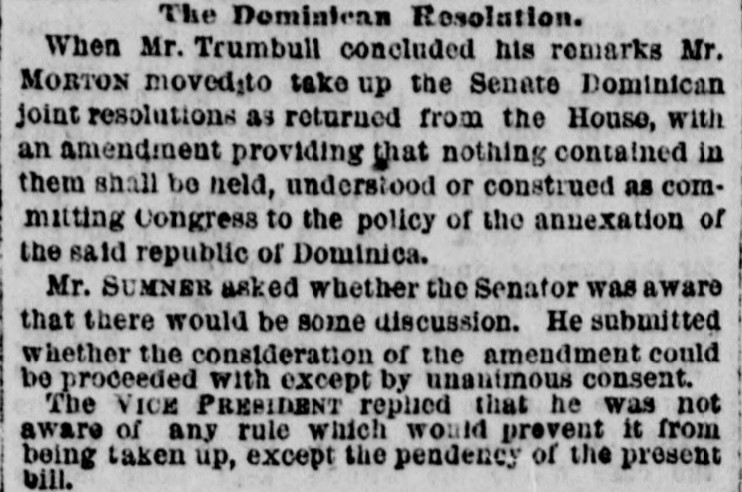
When Mr. Trumbull concluded his remarks, Mr. Morton moved to take up the Senate Dominican joint resolutions as returned from the House, with an amendment providing that nothing contained in them shall be held, understood or construed as committing Congress to the policy of the annexation of the said republic of Dominica.Cuando el Sr. Trumbull concluyó sus observaciones, el Sr. Morton propuso que se tomaran en consideración las resoluciones conjuntas del Senado sobre Dominica, tal como habían vuelto de la Cámara, con una enmienda que disponía que nada de lo contenido en ellas se tendría, entendería o interpretaría como un compromiso del Congreso con la política de anexión de la dicha república de Dominica.
Mr. Sumner asked whether the Senator was aware that there would be some discussion. He submitted whether the consideration of the amendment could be proceeded with except by unanimous consent.El Sr. Sumner preguntó si el senador sabía que habría algún debate. Planteó si la consideración de la enmienda podía proseguir de otro modo que no fuera por consentimiento unánime.
The Vice President replied that he was not aware of any rule which would prevent it from being taken up, except the pendency of the present bill.El Vicepresidente respondió que no conocía ninguna regla que impidiera tomarla en consideración, salvo la pendencia del proyecto de ley en curso.
Mr. Morton's motion was then agreed to, yeas 26, nays 16.La moción del Sr. Morton fue entonces aprobada: síes 26, noes 16.
The House amendment to the Senate resolution was read, when Mr. Morton moved that the Senate concur.Se leyó la enmienda de la Cámara a la resolución del Senado, y el Sr. Morton propuso que el Senado la aprobara.
Mr. Sumner asked for the yeas and nays. He knew not if Senators were aware of the painful news received since the debate on this subject, showing more than ever why we should hesitate in this business. It might be remembered that he protested against the whole measure as involving a bloody lawsuit. As prudent citizens we should not buy a lawsuit, especially one flowing with blood. Since the last discussion a proclamation of General Cabral had been received. He held in his hand an original copy in Spanish, printed on the island, against the usurper Baez, who, he had once said, was retained in power by the republic of the United States, a republic standing before the world to maintain the power of a pretender. Truly a sad part for a republic to play. The proclamation commenced with the words “God, country and liberty,” and was signed “Cabral, General of a division of the army,” in which he states “that the South was still in arms; that lately the enemy was beaten and routed; that reinforcements had reached the advanced posts, and without waiting for the infantry he vigorously attacked and defeated the foe,” &c. The proclamation is dated November 15, 1870. Mr. Sumner asked whether he was wrong when he called this a bloody lawsuit? This opened a melancholy picture; it was a picture of civil war. Here was a chief in the mountains, and another chief on the seashore, the latter sustained in power by the United States, and we were asked to proceed still further in this business. Better say with Macbeth, “I'll proceed no further in this business.” When this subject was formerly before the Senate he (Mr. Sumner) discussed the character of the President's Message as a menace to the people of Hayti. He did not then so soon anticipate a report from that republic; he did not at that time know how promptly he would be confirmed in his fears. He had before him a paper which, for its news, had not its superior in the country, the New York Herald. It was a paper known to be in no respect in sympathy with him or his conclusions. He thought proper to present this paper, bearing date January 5, 1871, as it gave news direct from Hayti. The letter is dated “Port au Prince, December 22, 1870,” with the heading:El Sr. Sumner pidió la votación nominal. Dijo no saber si los senadores estaban al tanto de las dolorosas noticias recibidas desde el debate sobre este asunto, que mostraban más que nunca por qué debíamos vacilar en este negocio. Cabía recordar que él había protestado contra toda la medida por entrañar un pleito sangriento. Como ciudadanos prudentes no debíamos comprar un pleito, especialmente uno que mana sangre. Desde la última discusión se había recibido una proclama del general Cabral. Tenía en la mano un ejemplar original en español, impreso en la isla, contra el usurpador Báez, quien, había dicho una vez, se mantenía en el poder por la república de los Estados Unidos, una república que se presentaba ante el mundo a sostener el poder de un pretendiente. ¡Triste papel, en verdad, el que le tocaba representar a una república! La proclama comenzaba con las palabras «Dios, patria y libertad», y estaba firmada «Cabral, general de una división del ejército», y en ella afirma «que el Sur seguía en armas; que últimamente el enemigo había sido batido y puesto en fuga; que habían llegado refuerzos a los puestos avanzados, y que sin esperar a la infantería atacó vigorosamente y derrotó al enemigo», &c. La proclama está fechada el 15 de noviembre de 1870. El Sr. Sumner preguntó si se había equivocado al llamar a esto un pleito sangriento. Aquello abría un cuadro melancólico; era un cuadro de guerra civil. Había un caudillo en las montañas y otro caudillo en la costa, sostenido este último en el poder por los Estados Unidos, y se nos pedía seguir avanzando en este negocio. Mejor decir con Macbeth: «No seguiré adelante en este negocio». Cuando este asunto estuvo antes ante el Senado, él (el Sr. Sumner) había examinado el carácter del Mensaje del Presidente como una amenaza para el pueblo de Hayti. No anticipó entonces que tan pronto llegaría un informe de aquella república; no sabía en aquel momento con qué prontitud se verían confirmados sus temores. Tenía ante sí un periódico que, por sus noticias, no tenía superior en el país: el New York Herald. Era un periódico conocido por no simpatizar en modo alguno con él ni con sus conclusiones. Consideró apropiado presentar ese periódico, de fecha 5 de enero de 1871, por cuanto traía noticias directas de Hayti. La carta está fechada «Puerto Príncipe, 22 de diciembre de 1870», con el encabezado:
Hayti—How the Haytiens receive the annexation news—Intense excitement on receipt of President Grant's Message—A guerilla warfare to be carried on—The Haytiens will fight to the death in support of their independence, and they threaten to burn the towns and then to take to the mountains—Demands on the government.Hayti: cómo reciben los haitianos la noticia de la anexión. Intensa excitación al recibirse el Mensaje del presidente Grant. Se llevará a cabo una guerra de guerrillas. Los haitianos pelearán hasta la muerte en defensa de su independencia, y amenazan con quemar las poblaciones y luego retirarse a las montañas. Demandas al gobierno.
Mr. Sumner said that Senators smiled. He read it from an important newspaper, differing from him in sentiment. It did not seem unnatural that there was in the human heart a love of independence. When our independence is assailed we are aroused. He could not complain of the humble Haytiens, because their independence is assailed. It was a painful matter to think that this great country of ours, which should be a benediction, should become a terror and violence.El Sr. Sumner dijo que los senadores sonreían. Lo leía de un periódico importante, que difería de él en sentimientos. No parecía antinatural que en el corazón humano hubiera un amor a la independencia. Cuando se ataca nuestra independencia, nos sublevamos. No podía quejarse de los humildes haitianos porque se atacara su independencia. Era doloroso pensar que este gran país nuestro, que debiera ser una bendición, se convirtiera en terror y violencia.
Mr. Pomeroy asked the Senator to yield the floor, so that he might suggest, by unanimous consent, that a vote be taken at two or three o'clock to-morrow.El Sr. Pomeroy pidió al senador que le cediera la palabra, para poder sugerir, por consentimiento unánime, que la votación se efectuara mañana a las dos o a las tres.
Mr. Morton asked whether it would not be better to take a recess until this evening.El Sr. Morton preguntó si no sería mejor declarar un receso hasta esta noche.
Mr. Sumner wished to offer an amendment to the resolution by adding at the end that the commissioners shall inquire specially of the alleged pendency of civil war in Dominica, the extent of the territory occupied by the respective parties; also the relations existing between Dominica and Hayti, and the claims of the latter on the former, and if there is a war or a menace of war between these countries.El Sr. Sumner quiso ofrecer una enmienda a la resolución, añadiendo al final que los comisionados indagarán especialmente sobre la presunta existencia de una guerra civil en Dominica, la extensión del territorio ocupado por las respectivas partes; también las relaciones existentes entre Dominica y Hayti, y los reclamos de esta última contra la primera, y si existe una guerra o una amenaza de guerra entre estos países.
Mr. Wilson wanted to adjourn and take up the subject to-morrow.El Sr. Wilson quería levantar la sesión y retomar el asunto mañana.
Mr. Trumbull hoped there would be no more excitement. If they should go into discussion now the session would be protracted. It would be better for them all to adjourn until to-morrow, and resume the matter at one o'clock. There was at this moment no attempt to prevent the action of the Senate. Should such an attempt be made to-morrow he trusted that every Senator would sit it out. He should not expect any Senator to try to prolong the proceedings.El Sr. Trumbull esperaba que no hubiera más excitación. Si entraran ahora en discusión, la sesión se prolongaría. Sería mejor para todos levantar la sesión hasta mañana y reanudar el asunto a la una. En este momento no había intento alguno de impedir la acción del Senado. Si tal intento se hiciera mañana, confiaba en que cada senador lo resistiría hasta el fin. No esperaba que ningún senador tratara de prolongar las deliberaciones.
Mr. Conkling asked Mr. Trumbull whether, after the measure had been once fully debated in the Senate and came back with an amendment tending to dilute it, an intention to reopen the whole subject afforded evidence to his mind of a factious opposition and a desire to delay and procrastinate.El Sr. Conkling preguntó al Sr. Trumbull si, después de que la medida había sido debatida ya plenamente en el Senado y volvía con una enmienda tendiente a diluirla, la intención de reabrir todo el asunto le parecía evidencia de una oposición facciosa y de un deseo de demorar y procrastinar.
Mr. Trumbull replied he never entered into an enterprise of that kind. He hoped the time would never come when he would enter into a factious opposition.El Sr. Trumbull respondió que nunca se había embarcado en una empresa de esa índole. Esperaba que nunca llegara el momento en que entrara en una oposición facciosa.
Mr. Stewart remarked that on a former occasion he stayed there all night; if he remembered correctly, the Senator relieved himself by going home. If this thing was to be repeated he would rather stay here to-night than any other night.El Sr. Stewart observó que en una ocasión anterior él se había quedado allí toda la noche; si recordaba correctamente, el senador se había aliviado yéndose a casa. Si aquello había de repetirse, prefería quedarse aquí esta noche que cualquier otra noche.
Mr. Warner sincerely trusted that no difficulty would arise. He thought the friends of the resolution would be glad to agree that the vote on the question should be taken at three or four o'clock to-morrow.El Sr. Warner confiaba sinceramente en que no surgiera dificultad alguna. Creía que los amigos de la resolución estarían gustosos de acordar que la votación de la cuestión se efectuara mañana a las tres o a las cuatro.
Mr. Pomeroy said he should be glad if the Senate by unanimous consent would agree to vote on the question to-morrow at four o'clock.El Sr. Pomeroy dijo que se alegraría si el Senado, por consentimiento unánime, acordara votar la cuestión mañana a las cuatro.
Mr. Saulsbury objected to the introduction, in effect, of the previous question by fixing an hour for the termination of the debate and taking a vote. Heretofore discussion was freely allowed. There never had been a more serious and important question than this. For the first time the Senator from Massachusetts is right. (Laughter.) He hoped the Senate would therefore allow the fullest discussion.El Sr. Saulsbury se opuso a la introducción, en efecto, de la cuestión previa mediante la fijación de una hora para terminar el debate y efectuar la votación. Hasta ahora la discusión había sido libremente permitida. Nunca había habido una cuestión más seria e importante que esta. Por primera vez el senador de Massachusetts tiene razón. (Risas.) Esperaba, por tanto, que el Senado permitiera la más plena discusión.
The Senate agreed to close the discussion at four o'clock to-morrow, when, at a quarter to five o'clock, an adjournment took place.El Senado acordó cerrar la discusión mañana a las cuatro, y a las cinco menos cuarto se levantó la sesión.
House of Representatives · Washington, Jan. 10, 1871Cámara de Representantes · Washington, 10 de enero de 1871
St. DomingoSanto Domingo
The House resumed the consideration of the joint resolution for the appointment of commissioners to Dominica.La Cámara reanudó la consideración de la resolución conjunta para el nombramiento de comisionados para Dominica.
Mr. Willard (rep.) of Vt., a member of the Committee on Foreign Affairs, explained why he was found voting yesterday with so few of his republican colleagues against taking the resolution from the Speaker's table. He was opposed to the acquisition of the republic of Dominica by treaty or by joint resolution, and therefore he was opposed to taking any step looking to that acquisition. He was unwilling to authorize the friends of acquisition in working this machinery in aid of their scheme. It was charged, and not denied, that the commission was to return to Washington in time for Congress to act on its report at this session. What opportunity, then, would the Commission have for obtaining the information directed? Were the commissioners to inquire only from Fabens or Baez or Cazneau, or were they to traverse the republic and ascertain facts for themselves? If the latter they would require not two weeks, but six months or a year. The scope of the investigation was so broad that the idea that the commission was to bring back any plausible information was absurd. It was impossible for the commissioners to report anything from their own observation, but a report would be made and would be given to the country as the report of the commissioners.El Sr. Willard (rep.) de Vermont, miembro de la Comisión de Relaciones Exteriores, explicó por qué se le había visto votar ayer con tan pocos de sus colegas republicanos en contra de retirar la resolución de la mesa del Presidente de la Cámara. Se oponía a la adquisición de la república de Dominica por tratado o por resolución conjunta, y por tanto se oponía a dar cualquier paso encaminado a esa adquisición. No estaba dispuesto a autorizar a los amigos de la adquisición a poner en marcha esta maquinaria en ayuda de su proyecto. Se había afirmado, y no desmentido, que la comisión debía volver a Washington a tiempo para que el Congreso actuara sobre su informe en esta misma sesión. ¿Qué oportunidad, entonces, tendría la Comisión de obtener la información indicada? ¿Indagarían los comisionados solo de Fabens o de Báez o de Cazneau, o recorrerían la república y averiguarían los hechos por sí mismos? Si lo segundo, necesitarían no dos semanas, sino seis meses o un año. El alcance de la investigación era tan amplio que la idea de que la comisión pudiera traer alguna información plausible era absurda. Era imposible que los comisionados informaran nada a partir de su propia observación, pero se haría un informe y se le daría al país como el informe de los comisionados.
Mr. Cox (dem.) of N.Y. opposed the joint resolution. After discussing the details of the measure he said the proviso of Mr. Ambler may not pass. It is sugar-coating. This measure is a pretence for information. It is annexation, in fact. If annexation is accomplished there is no need of this commission. If it is not to be accomplished what need is there, then? The information is already here, all we want. It was sent in last night late. Let us print and read what we have. It is voluminous; but does it give the list of grants and jobs attached to the treaty? I assert there is such a list; it was not sent to the Senate. It was called for by a resolution I drew last session. The annexation will be that of husks. The kernels are already gone to private parties. What do you want the annexation for—a port for commerce? Had you not better first revive commerce? How our phantom ships and ghostly steamers will sail into Samana! Oh, but it is Manifest Destiny! Democrats are invited to our old policy and charged with inconsistency by those who always opposed us. So you radicals are copying the despised democracy, are you? Is Saul also among the prophets? Remember that no one but Prince Arthur could wield the prince's magic sword. I am not against this scheme because it adds territory, but because it is a private, wicked scheme. Jefferson was for extended empire, but, as he said, “with self-government.” We are departing in many ways from the Jeffersonian standard and policies. I find but one precedent for this, and that hardly analogous. Not the Puritan way of taking the land of the Pequods, but Joshua sending spies to go over Jordan and search out the land. They went into Jericho and kept bad company. Is Baez your Rahab? I do not object because the territory is not coterminous. It is as near as California was. And because we swallow 200,000 colored people, after taking in 4,000,000, we can digest a few. The man who swallowed a pumpkin worried down a peach. I oppose the scheme because it is a specious, prearranged, corrupt job, and no commission can deodorize its putrescence. It is not to be compared to the achievements of the democracy in their expanding policy. When the democracy obtain power they will take care of the Monroe doctrine and territorial expansion.El Sr. Cox (dem.) de Nueva York se opuso a la resolución conjunta. Después de discutir los detalles de la medida, dijo que la salvedad del Sr. Ambler puede que no se apruebe. Es un revestimiento azucarado. Esta medida es una pretensión de información. Es anexión, de hecho. Si la anexión se consuma, no hay necesidad de esta comisión. Si no ha de consumarse, ¿qué necesidad hay, entonces? La información ya está aquí, toda la que queremos. Llegó anoche, tarde. Imprimamos y leamos lo que tenemos. Es voluminoso; pero ¿trae la lista de concesiones y empleos vinculados al tratado? Afirmo que existe tal lista; no fue enviada al Senado. Fue pedida por una resolución que yo redacté en la sesión pasada. La anexión será la de las cáscaras. Los granos ya han ido a parar a manos privadas. ¿Para qué quieren la anexión: para un puerto de comercio? ¿No sería mejor que primero reavivaran el comercio? ¡Cómo navegarán nuestros buques fantasma y vapores espectrales hacia Samaná! ¡Ah, pero es el Destino Manifiesto! Se invita a los demócratas a volver a su vieja política y se les acusa de inconsecuencia por quienes siempre se nos opusieron. ¿Así que ustedes, los radicales, están copiando a la despreciada democracia? ¿También Saúl está entre los profetas? Recuerden que nadie más que el príncipe Arturo podía blandir la espada mágica del príncipe. No estoy contra este proyecto porque añada territorio, sino porque es un plan privado y perverso. Jefferson era partidario de un imperio extenso, pero, como él dijo, «con autogobierno». Nos estamos apartando en muchos sentidos de la norma y las políticas jeffersonianas. Encuentro un solo precedente para esto, y apenas análogo. No la manera puritana de tomar la tierra de los pequot, sino Josué enviando espías a cruzar el Jordán y reconocer la tierra. Entraron en Jericó y anduvieron en mala compañía. ¿Es Báez su Rahab? No me opongo porque el territorio no sea contiguo. Está tan cerca como lo estaba California. Y porque nos traguemos a 200,000 personas de color, después de haber admitido a 4,000,000, bien podemos digerir a unos pocos. El hombre que se tragó una calabaza se las vio con un melocotón. Me opongo al plan porque es un negocio especioso, prearreglado y corrupto, y ninguna comisión puede desodorizar su putrescencia. No es comparable a las hazañas de la democracia en su política expansionista. Cuando la democracia obtenga el poder, velará por la doctrina Monroe y la expansión territorial.
Mr. Hoar (rep.) of Mass. explained the reasons which led him to differ from the majority of his colleagues. He did not concur in the idea that respect for the President of the United States required them to support this measure. The Committee on Foreign Affairs had refused to report a proposition for the appointment of commissioners to form a treaty, but instead of that had reported a proposition for the perpetration of a farce as great as had ever been enacted on such a subject. He was not willing to annex to a self-governing republic an island which would be filled with the scum of the tropics, the adventurers of all lands, who would come to influence the government of this country. In eleven States there was a rebellious element striking hands with Tammany Hall and striving to obtain possession of the government for the next four years. He was not willing to do anything to add to that danger.El Sr. Hoar (rep.) de Massachusetts explicó las razones que lo llevaron a diferir de la mayoría de sus colegas. No compartía la idea de que el respeto al Presidente de los Estados Unidos exigiera de ellos apoyar esta medida. La Comisión de Relaciones Exteriores se había negado a informar una proposición para el nombramiento de comisionados que formaran un tratado, pero en lugar de ello había informado una proposición para la perpetración de una farsa tan grande como cuantas se hayan representado sobre asunto alguno. No estaba dispuesto a anexar a una república autogobernada una isla que se llenaría de la escoria de los trópicos, los aventureros de todas las tierras, que vendrían a influir en el gobierno de este país. En once estados había un elemento rebelde dándose la mano con Tammany Hall y esforzándose por adueñarse del gobierno durante los próximos cuatro años. No estaba dispuesto a hacer nada que añadiera a ese peligro.
Mr. Stevenson (rep.) of Ohio spoke in favor of the acquisition of Dominica and of its admission as one of the Territories of the Union. He did not want any information about the island. He found it crystallized in books. He found the island was rich in mines of gold and silver, copper, iron and coal. He found that it was rich in bays and harbors, one of which was the key of the Gulf. He found that the climate, though tropical, was less unwholesome than elsewhere in the West Indies. Its soil was exceedingly fertile, producing sugar, coffee, cotton and tropical fruits, and he found that its political constitution was modelled after that of the United States.El Sr. Stevenson (rep.) de Ohio habló a favor de la adquisición de Dominica y de su admisión como uno de los Territorios de la Unión. Dijo que no quería información alguna sobre la isla. La había encontrado cristalizada en los libros. Había encontrado que la isla era rica en minas de oro y plata, cobre, hierro y carbón. Había encontrado que era rica en bahías y puertos, uno de los cuales era la llave del Golfo. Había encontrado que el clima, aunque tropical, era menos insalubre que en otras partes de las Indias Occidentales. Su suelo era sumamente fértil, productor de azúcar, café, algodón y frutas tropicales, y había encontrado que su constitución política estaba modelada según la de los Estados Unidos.
Mr. Voorhees (dem.) of Ind. sent to the Clerk's desk and had read a telegraphic despatch, stating that the Senate of Indiana had just passed a joint resolution instructing the Senators and requesting the Representatives from that State to vote against the annexation of St. Domingo. (Laughter.)El Sr. Voorhees (dem.) de Indiana hizo llegar a la mesa de la Secretaría y mandó leer un despacho telegráfico que afirmaba que el Senado de Indiana acababa de aprobar una resolución conjunta instruyendo a los senadores y solicitando a los representantes de ese estado que votaran contra la anexión de Santo Domingo. (Risas.)
Mr. Orth (rep.) of Ind. remarked that those who knew how the democratic party in Indiana had obtained control of the Senate would not be surprised at the action of that body.El Sr. Orth (rep.) de Indiana observó que quienes sabían cómo el partido demócrata de Indiana se había hecho con el control del Senado no se sorprenderían de la acción de ese cuerpo.
Mr. Potter (dem.) of N.Y. spoke against the acquisition of Dominica.El Sr. Potter (dem.) de Nueva York habló en contra de la adquisición de Dominica.
Mr. Swann (dem.) of Md., a member of the Committee on Foreign Affairs, also spoke against the joint resolution. He regarded the vote about to be taken as one involving important and vital issues. They all knew that before the making of the treaty oppressed Cuba was knocking at the doors of the American republic, but that the President of the United States, by his power and influence, defeated the proposition of the Committee on Foreign Affairs in aid of Cuba. He would not assail the President of the United States, but he would ask why did the President manifest such interest in this matter? Why did they see Senators and Cabinet officers lobbying in the House in favor of this measure? If the Postmaster General had no more influence in the House than he had in his own State of Maryland he should have been kept in his department attending to its business, which was sadly in need of attention, instead of coming to the House to try to influence its legislation.El Sr. Swann (dem.) de Maryland, miembro de la Comisión de Relaciones Exteriores, también habló contra la resolución conjunta. Consideraba que la votación a punto de efectuarse entrañaba cuestiones importantes y vitales. Todos sabían que antes de la celebración del tratado, la oprimida Cuba llamaba a las puertas de la república americana, pero que el Presidente de los Estados Unidos, con su poder e influencia, había derrotado la proposición de la Comisión de Relaciones Exteriores en ayuda de Cuba. No atacaría al Presidente de los Estados Unidos, pero preguntaría: ¿por qué manifestó el Presidente tanto interés en este asunto? ¿Por qué veían a senadores y a miembros del Gabinete cabildeando en la Cámara a favor de esta medida? Si el Director General de Correos no tenía más influencia en la Cámara que la que tenía en su propio estado de Maryland, se le debió haber mantenido en su departamento atendiendo sus asuntos, que harto necesitaban atención, en lugar de venir a la Cámara a tratar de influir en su legislación.
Mr. Fitch (rep.) of Nev. said that he should vote for the pending resolution and against the eviscerating amendment of the gentleman from Ohio (Mr. Ambler). He should vote for it because he believed it would be followed by the annexation of Dominica, and then of Hayti and Cuba. He should have preferred to vote directly for a joint resolution of annexation.El Sr. Fitch (rep.) de Nevada dijo que votaría a favor de la resolución pendiente y en contra de la enmienda eviscerante del caballero de Ohio (el Sr. Ambler). Votaría a favor porque creía que a ella seguiría la anexión de Dominica, y luego la de Hayti y Cuba. Hubiera preferido votar directamente por una resolución conjunta de anexión.
Mr. Ela (rep.) of N.H. opposed the joint resolution as one tending to entangling alliances with a foreign people having no common interest with the people of the United States, who have already in their midst enough of conflicting elements. It meant the expenditure of vast sums of money for fortifications, navy yards and ships-of-war. He believed that the policy would end in disaster, and therefore he opposed it.El Sr. Ela (rep.) de Nuevo Hampshire se opuso a la resolución conjunta por tender a alianzas enredosas con un pueblo extranjero sin intereses comunes con el pueblo de los Estados Unidos, que ya tiene en su seno bastantes elementos en conflicto. Significaba el gasto de vastas sumas de dinero en fortificaciones, arsenales navales y buques de guerra. Creía que la política terminaría en desastre, y por tanto se oponía.
Mr. Farnsworth (rep.) of Ill. declared that he was opposed to the annexation of Dominica; that his constituents were opposed to it, and that, in his belief, nine-tenths of the constituents of every member were opposed to it. He was not so much of a manifest destiny man as his friend from Nevada (Mr. Fitch). He believed that the wings of the American Eagle might be spread too much, to the injury of that national bird. He would rather wait and people the territory already possessed. He would rather wait until Nevada got some population. (Laughter.) If the amendment offered by Mr. Ambler was agreed to he would vote for the joint resolution; but otherwise he would vote against it.El Sr. Farnsworth (rep.) de Illinois declaró que se oponía a la anexión de Dominica; que sus electores se oponían a ella, y que, a su juicio, las nueve décimas partes de los electores de cada miembro se oponían a ella. No era tan partidario del destino manifiesto como su amigo de Nevada (el Sr. Fitch). Creía que las alas del Águila Americana podían extenderse demasiado, en perjuicio de esa ave nacional. Prefería esperar y poblar el territorio ya poseído. Prefería esperar hasta que Nevada tuviera algo de población. (Risas.) Si se aprobaba la enmienda ofrecida por el Sr. Ambler, votaría a favor de la resolución conjunta; pero en caso contrario votaría en contra.
Mr. Butler (rep.) of Mass. sustained the joint resolution, and opposed the amendment of Mr. Ambler as only tending to produce delay, and thus kill the investigation.El Sr. Butler (rep.) de Massachusetts sostuvo la resolución conjunta y se opuso a la enmienda del Sr. Ambler por tender solo a producir demora, y así matar la investigación.
Mr. Ambler (rep.) of Ohio denied having offered the amendment with any such intention.El Sr. Ambler (rep.) de Ohio negó haber ofrecido la enmienda con intención semejante.
Mr. Butler accepted the statement, but always attributed to a man's act its natural consequences.El Sr. Butler aceptó la declaración, pero siempre atribuía al acto de un hombre sus consecuencias naturales.
Mr. Dawes (rep.) of Mass. asked him if the subject would not stand debate.El Sr. Dawes (rep.) de Massachusetts le preguntó si el asunto no resistiría el debate.
Mr. Butler replied that it would stand debate even from the false friend of the party. He had heard many painful things, but none more painful than the telegraphic despatch from Indiana, not that the Senate, organized through fraud, should send such a message, but that it should have been sent to the honored and revered Senator from Massachusetts (Mr. Sumner).El Sr. Butler respondió que resistiría el debate incluso del falso amigo del partido. Había oído muchas cosas dolorosas, pero ninguna más dolorosa que el despacho telegráfico de Indiana; no porque el Senado, organizado mediante fraude, enviara tal mensaje, sino porque hubiera sido enviado al honrado y reverenciado senador de Massachusetts (el Sr. Sumner).
Since he's misnamed the Morning Star,
Nor man nor fiend hath fallen so far.Pues ha errado al dar nombre a la Estrella de la Mañana,
ni hombre ni demonio ha caído tan bajo.
Mr. Voorhees remarked that a majority of republicans had been elected to the Indiana Senate, but that enough of them had been disgusted by the course of the party in Congress to induce them to vote as they did.El Sr. Voorhees observó que se había elegido una mayoría de republicanos para el Senado de Indiana, pero que bastantes de ellos se habían disgustado con la conducta del partido en el Congreso como para inducirlos a votar como votaron.
Mr. Butler went on to say that the political party which would set itself up against annexation of territory would come to naught. It was the doctrine of Jefferson, of Jackson, of Polk and of every democratic administration, and had now come to be accepted as the doctrine of the country.El Sr. Butler continuó diciendo que el partido político que se alzara contra la anexión de territorio vendría a parar en nada. Era la doctrina de Jefferson, de Jackson, de Polk y de toda administración demócrata, y ahora había llegado a ser aceptada como la doctrina del país.
Mr. Bingham (rep.) of Ohio sustained the joint resolution and opposed Mr. Ambler's resolution as unnecessary and only tending to promote delay. He pointed with pride to the vast acquisition of territory by this government in the past, and to the emigration from the north of Europe promoted by that territorial expansion. He was for an honorable acquisition of Dominica if it could be made and it were for the interest of the people, and it was to ascertain the facts that these commissioners were to be sent out. The only way to obtain knowledge of the facts was by inquiry. The resolution proposed an inquiry. He was for the resolution without the amendment.El Sr. Bingham (rep.) de Ohio sostuvo la resolución conjunta y se opuso a la resolución del Sr. Ambler por innecesaria y por tender solo a promover la demora. Señaló con orgullo la vasta adquisición de territorio por este gobierno en el pasado, y la emigración desde el norte de Europa promovida por esa expansión territorial. Estaba por una adquisición honorable de Dominica si podía hacerse y fuera en interés del pueblo, y era para averiguar los hechos que debían enviarse a estos comisionados. La única manera de obtener conocimiento de los hechos era mediante la indagación. La resolución proponía una indagación. Estaba por la resolución sin la enmienda.
At the conclusion of Mr. Bingham's remarks Mr. Garfield (rep.) of Ohio proposed a further extension of fifteen minutes of the time allowed for discussion.Al concluir las observaciones del Sr. Bingham, el Sr. Garfield (rep.) de Ohio propuso una nueva extensión de quince minutos del tiempo permitido para la discusión.
Mr. Butler objected.El Sr. Butler: Me opongo.
Mr. Garfield: Listen to the gentleman who cracks a whip objecting to debate! (Excitement.)El Sr. Garfield: ¡Escuchen al caballero que blande el látigo oponiéndose al debate! (Excitación.)
Mr. Butler: And listen to the man whose back smarts! (Laughter.)El Sr. Butler: ¡Y escuchen al hombre al que le escuece la espalda! (Risas.)
Mr. Garfield: The gentleman's lash can hurt nothing but the cause in which he wields it.El Sr. Garfield: El látigo del caballero no puede dañar nada más que la causa en la que lo blande.
Mr. Morgan (dem.) of Ohio: The House is under the domination of a whip-cracker.El Sr. Morgan (dem.) de Ohio: La Cámara está bajo la dominación de un blandelátigos.
Mr. Shanks (rep.) of Ind. supported the resolution as one which proposed to obtain information which would show the false position in which its opponents placed themselves and which would furnish an answer to the Senator from Indiana.El Sr. Shanks (rep.) de Indiana apoyó la resolución por proponer obtener información que mostraría la falsa posición en que se colocaron sus oponentes y que daría una respuesta al senador de Indiana.
Mr. Poland (rep.) of Vt. also supported the resolution and opposed the amendment.El Sr. Poland (rep.) de Vermont también apoyó la resolución y se opuso a la enmienda.
Mr. Kellogg (rep.) of Conn. said he would vote for the resolution and against the amendment.El Sr. Kellogg (rep.) de Connecticut dijo que votaría a favor de la resolución y en contra de la enmienda.
The discussion was closed by Mr. Orth in support of the resolution. He declared that nothing could be discovered in the resolution, when honestly examined, which could deter any member, much less a member of his own side of the House, from giving it his support. It contained but the single proposition that the President of the United States, a man in whom a large majority of the House had confidence, should appoint three commissioners to proceed to the island of St. Domingo, and there acquire certain information to be laid before the American Congress and the American people. He knew nothing about the character of those commissioners, but he entertained no doubt as to the result of their report on the acquisition of that island. There was nothing in the resolution which committed the government to the rejection or acceptance of the report. If he had been honored by a seat in the next Congress he would not consider himself bound to vote for the adoption of the report which the commission would make to the next Congress, for he had no hope that the commission could proceed to its destination and accomplish its object in time for action at this Congress. He opposed the amendment offered by Mr. Ambler as one which would only cause delay and reopen in the Senate a quarrel which no friend of the union and harmony of the republican party would desire to see reopened. The adoption of the resolution, pure and simple, was due to the President, who had been unjustly assailed by political enemies and by political friends.La discusión fue cerrada por el Sr. Orth en apoyo de la resolución. Declaró que nada podía descubrirse en la resolución, examinada honestamente, que pudiera disuadir a miembro alguno, y mucho menos a un miembro de su propio lado de la Cámara, de darle su apoyo. Contenía una única proposición: que el Presidente de los Estados Unidos, un hombre en quien una gran mayoría de la Cámara tenía confianza, nombrara tres comisionados que se trasladaran a la isla de Santo Domingo y allí adquirieran cierta información que se presentaría ante el Congreso americano y el pueblo americano. Nada sabía del carácter de esos comisionados, pero no abrigaba duda alguna sobre el resultado de su informe en cuanto a la adquisición de aquella isla. Nada había en la resolución que comprometiera al gobierno a rechazar o aceptar el informe. Si hubiera sido honrado con un asiento en el próximo Congreso, no se consideraría obligado a votar por la adopción del informe que la comisión presentara al próximo Congreso, pues no tenía esperanza alguna de que la comisión pudiera llegar a su destino y cumplir su objeto a tiempo para que este Congreso actuara. Se oponía a la enmienda ofrecida por el Sr. Ambler por ser de las que solo causarían demora y reabrirían en el Senado una querella que ningún amigo de la unión y la armonía del partido republicano desearía ver reabierta. La adopción de la resolución, pura y simple, se le debía al Presidente, que había sido injustamente atacado por enemigos políticos y por amigos políticos.
Mr. Brooks (dem.) of N.Y. asked Mr. Orth to allow him to offer an amendment that the Commissioners be appointed by the Speaker of the House and the President of the Senate.El Sr. Brooks (dem.) de Nueva York pidió al Sr. Orth que le permitiera ofrecer una enmienda para que los Comisionados fueran nombrados por el Presidente de la Cámara y el Presidente del Senado.
Mr. Orth declined to do so.El Sr. Orth se negó a hacerlo.
Mr. Brooks reminded him of his promise to allow it to be offered at some time during the session.El Sr. Brooks le recordó su promesa de permitir que se ofreciera en algún momento de la sesión.
Mr. Orth replied that the promise meant at some time during the present session. (Laughter.)El Sr. Orth respondió que la promesa significaba en algún momento de la presente sesión. (Risas.)
The House then proceeded to vote on Mr. Ambler's amendment, declaring that nothing in the resolution was to be construed as committing the government to the annexation of Dominica.La Cámara procedió entonces a votar la enmienda del Sr. Ambler, que declaraba que nada en la resolución debía interpretarse como un compromiso del gobierno con la anexión de Dominica.
The amendment was agreed to, yeas 106, nays 76.La enmienda fue aprobada: síes 106, noes 76.
The joint resolution as amended was then passed, yeas 123, nays 63. The democrats voted solidly in the negative, and the following named republicans also voted no: Messrs. Beatty, Boyd, Finkelnburg, Hoar, Peters and Willard.La resolución conjunta, ya enmendada, fue entonces aprobada: síes 123, noes 63. Los demócratas votaron sólidamente en contra, y también votaron no los siguientes republicanos: los Sres. Beatty, Boyd, Finkelnburg, Hoar, Peters y Willard.
The joint resolution goes back to the Senate for action on the amendment.La resolución conjunta vuelve al Senado para que actúe sobre la enmienda.
Throughout the debate, the speakers call the country 'Dominica.' They mean the Dominican Republic, not the island of Dominica.Durante todo el debate, los oradores llaman al país «Dominica». Se refieren a la República Dominicana, no a la isla de Dominica.