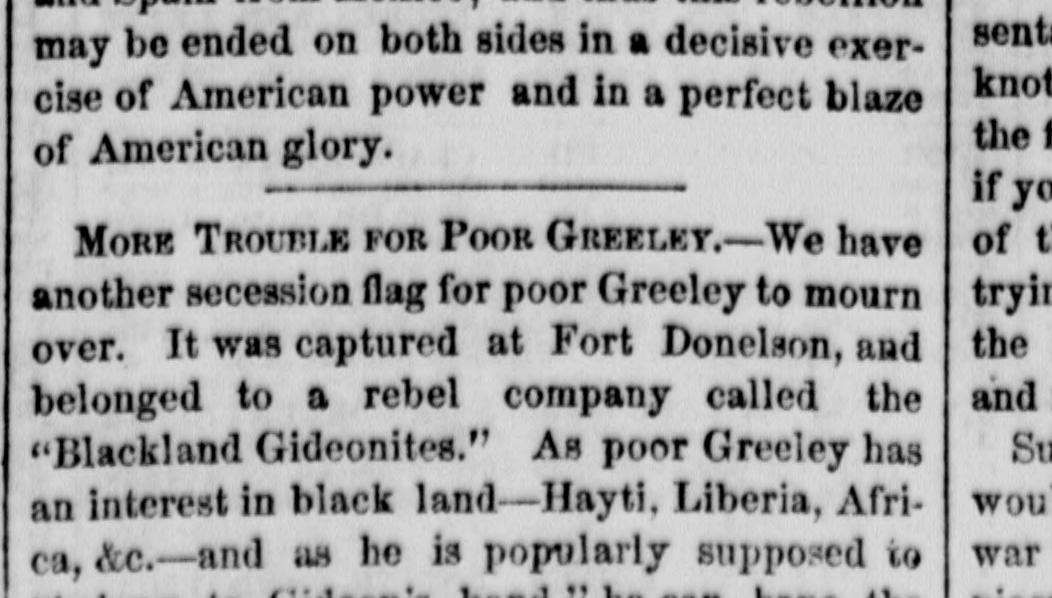
It was captured at Fort Donelson, and belonged to a rebelFue capturado en Fort Donelson, y pertenecía a un rebelde
The New York Herald · New York [N.Y.] · February 25, 1862 · Page 4The New York Herald · New York [N.Y.] · 25 de febrero de 1862 · Página 4 View the originalVer el original
 See the full pageVer la página completa
The New York Herald February 25, 186225 de febrero de 1862
The New York Herald mentions "black land—Hayti, Liberia, Africa" in a satirical remark regarding a captured secessionist flag from Fort Donelson called the "Blackland Gideonites" and mocks a figure identified as "poor Greeley." The excerpt also discusses President Lincoln's stated objective in issuing his April proclamation to preserve the Constitution and execute the laws of the Union against the rebellion.A tenor del extracto, The New York Herald alude a «tierras de negros: Haití, Liberia, África» en una nota satírica sobre una bandera secesionista capturada en Fort Donelson denominada «Blackland Gideonites» y se mofa de una figura identificada como el «pobre Greeley». El texto analiza asimismo el objetivo declarado por el presidente Lincoln al promulgar su proclama de abril para preservar la Constitución y hacer cumplir las leyes de la Unión frente a la rebelión.
Under constructionEn construcción
This article's full text is scheduled for improvement. The summary above is our current best reading. You can help: compare it with the original page at the Library of Congress and send us a correction.El texto completo de este artículo está programado para mejoras. El resumen anterior es nuestra mejor lectura actual. Usted puede ayudar: compárelo con la página original en la Biblioteca del Congreso y envíenos una corrección.
While the archive is under construction, a link or search result may occasionally lead to the wrong page. If that happens, please let us know.Mientras el archivo está en construcción, un enlace o resultado de búsqueda puede llevar ocasionalmente a la página equivocada. Si eso sucede, por favor avísenos.
The correction opens as an email already addressed to the editor, with this article's reference included. Mark the kind of problem at the top. It has an optional line for your X handle — only if you want public credit; leave it blank to contribute anonymously.La corrección se abre como un correo ya dirigido al editor, con la referencia de este artículo. Marque el tipo de problema al inicio. Tiene una línea opcional para su usuario de X — solo si desea crédito público; déjela en blanco para contribuir anónimamente.