The Madrid correspondent of the Independance Belge, writing on theEl corresponsal en Madrid del Independance Belge, escribiendo sobre el
The New York Herald · New York [N.Y.] · April 25, 1862 · Page 4The New York Herald · New York [N.Y.] · 25 de abril de 1862 · Página 4 View the originalVer el original
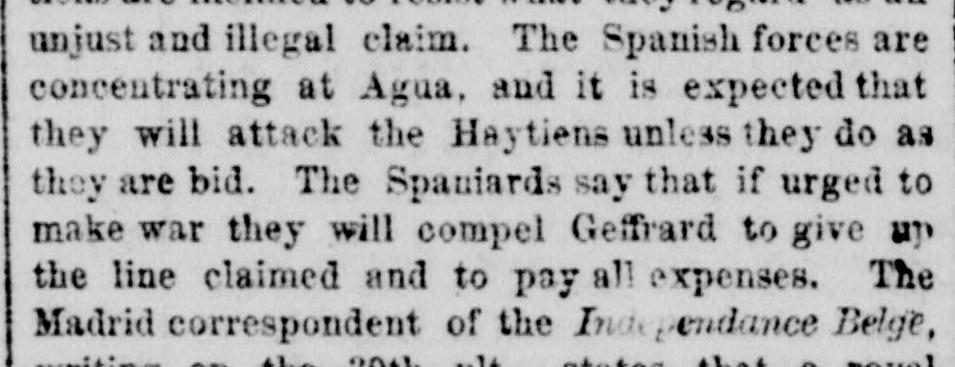
The newspaper reported that Spanish forces were concentrating at Agua to potentially attack the Haitians and compel Geffrard to concede a claimed line and pay expenses. Additionally, a Madrid correspondent stated that the Queen of Spain issued a royal decree naming Santana—who sold St. Domingo to Spain—the "Marquis de las Carreras." The excerpt also noted various Venezuelan government victories against rebel forces led by Falcon and others, as well as the arrival of the prize schooner Dixie in Philadelphia.El periódico informó que tropas españolas se concentraban en Azua para un eventual ataque contra los haitianos con el fin de obligar a Geffrard a ceder una línea fronteriza reclamada y sufragar los gastos incurridos. Además, un corresponsal en Madrid comunicó que la reina de España expidió un real decreto nombrando a Santana —quien entregó Santo Domingo a España— «marqués de las Carreras». La crónica reseñó también varias victorias del gobierno venezolano frente a fuerzas rebeldes comandadas por Falcón y otros cabecillas, así como la llegada a Filadelfia de la goleta apresada Dixie.
FULL TEXT:TEXTO COMPLETO:
The New York Herald April 25, 186225 de abril de 1862
Original in English.Original en inglés.
From St. Domingo we learn that there is a prospect of a misunderstanding between the Spanish and Haytien governments, concerning the old question of the boundary line. Spain is determined to have the old limits established; but the Haytiens are inclined to resist what they regard as an unjust and illegal claim. The Spanish forces are concentrating at Agua, and it is expected that they will attack the Haytiens unless they do as they are bid. The Spaniards say that if urged to make war they will compel Geffrard to give up the line claimed and to pay all expenses. The Madrid correspondent of the Independance Belge, writing on the 30th ult., states that a royal decree, signed by the Queen of Spain, has created the famous Santana, who sold St. Domingo to the Spanish government, the "Marquis de las Carreras," this being the name of the place where the Haytiens and Dominicans met in combat some years ago.Desde Santo Domingo nos enteramos de que existe la perspectiva de un malentendido entre los gobiernos español y haitiano, en relación con la antigua cuestión de la línea fronteriza. España está decidida a que se establezcan los antiguos límites; pero los haitianos se inclinan a resistir lo que consideran una reclamación injusta e ilegal. Las fuerzas españolas se están concentrando en Agua, y se espera que ataquen a los haitianos a menos que hagan lo que se les ordena. Los españoles dicen que si se ven obligados a hacer la guerra, forzarán a Geffrard a ceder la línea reclamada y a pagar todos los gastos. El corresponsal en Madrid de la Independance Belge, escribiendo el 30 del mes pasado, afirma que un real decreto, firmado por la Reina de España, ha nombrado al famoso Santana, quien vendió Santo Domingo al gobierno español, «Marqués de las Carreras», siendo este el nombre del lugar donde los haitianos y dominicanos se enfrentaron en combate hace algunos años.