Preaident Huerreaux said today that the real cause of the troubleEl presidente Heureaux dijo hoy que la verdadera causa de la dificultad
Evening Star · Washington, D.C. · August 25, 1890 · Page 6Evening Star · Washington, D.C. · 25 de agosto de 1890 · Página 6 View the originalVer el original
 See the full pageVer la página completa
The Evening Star reported that Dominican President Heureaux attributed escalating border disputes to Haiti's default on the commercial and boundary treaties of 1874–1875. Under the agreement, Haiti leased Dominican territory for $150,000 annually and granted tariff exemptions to Dominican imports, accumulating over $2,000,000 in unpaid dues while complaining of Dominican rum smuggling. Dominican consular officials in New York acknowledged simmering diplomatic frictions but had received no official confirmation of armed border clashes.El Evening Star informó que el presidente dominicano Heureaux atribuyó la escalada de disputas fronterizas al incumplimiento de Haití de los tratados comerciales y de límites de 1874–1875. En virtud del acuerdo, Haití arrendaba territorio dominicano por 150.000 dólares anuales y otorgaba exenciones arancelarias a las importaciones dominicanas, acumulando más de 2.000.000 de dólares en cuotas impagadas mientras se quejaba del contrabando de ron dominicano. Funcionarios consulares dominicanos en Nueva York reconocieron las latentes fricciones diplomáticas, pero no habían recibido confirmación oficial de enfrentamientos fronterizos armados.
FULL TEXT:TEXTO COMPLETO:
Evening Star August 25, 189025 de agosto de 1890
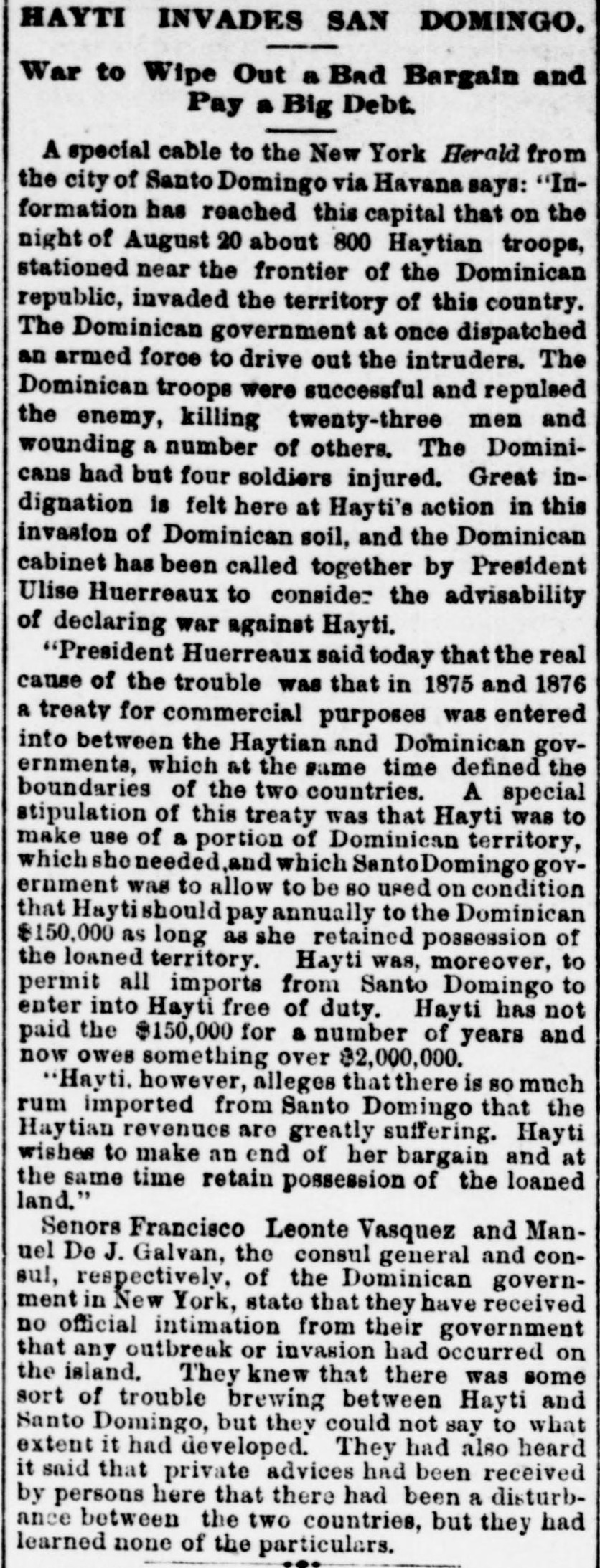
HAYTI INVADES SAN DOMINGO.HAITÍ INVADE SANTO DOMINGO.
War to Wipe Out a Bad Bargain and Pay a Big Debt.Guerra para borrar un mal trato y pagar una gran deuda.
A special cable to the New York Herald from the city of Santo Domingo via Havana says: "Information has reached this capital that on the night of August 20 about 800 Haytian troops, stationed near the frontier of the Dominican Republic, invaded the territory of this country. The Dominican government at once dispatched an armed force to drive out the intruders. The Dominican troops were successful and repulsed the enemy, killing twenty-three men and wounding a number of others. The Dominicans had but four soldiers injured. Great indignation is felt here at Hayti's action in this invasion of Dominican soil, and the Dominican cabinet has been called together by President Ulise Huerreaux to consider the advisability of declaring war against Hayti.Un cable especial al New York Herald desde la ciudad de Santo Domingo vía La Habana dice: «Información ha llegado a esta capital de que en la noche del 20 de agosto unos 800 soldados haitianos, estacionados cerca de la frontera de la República Dominicana, invadieron el territorio de este país. El gobierno dominicano despachó de inmediato una fuerza armada para expulsar a los intrusos. Las tropas dominicanas tuvieron éxito y repelieron al enemigo, matando a veintitrés hombres e hiriendo a un número de otros. Los dominicanos tuvieron solo cuatro soldados heridos. Gran indignación se siente aquí por la acción de Haití en esta invasión de suelo dominicano, y el gabinete dominicano ha sido convocado por el presidente Ulise Huerreaux para considerar la conveniencia de declarar la guerra contra Haití.
"President Huerreaux said today that the real cause of the trouble was that in 1875 and 1876 a treaty for commercial purposes was entered into between the Haytian and Dominican governments, which at the same time defined the boundaries of the two countries. A special stipulation of this treaty was that Hayti was to make use of a portion of Dominican territory, which she needed, and which Santo Domingo government was to allow to be so used on condition that Hayti should pay annually to the Dominican $150,000 as long as she retained possession of the loaned territory. Hayti was, moreover, to permit all imports from Santo Domingo to enter into Hayti free of duty. Hayti has not paid the $150,000 for a number of years and now owes something over $2,000,000.«El presidente Huerreaux dijo hoy que la causa real del problema fue que en 1875 y 1876 se entró en un tratado con fines comerciales entre los gobiernos haitiano y dominicano, que al mismo tiempo definió los límites de los dos países. Una estipulación especial de este tratado fue que Haití había de hacer uso de una porción de territorio dominicano, que necesitaba, y que el gobierno de Santo Domingo había de permitir que fuera así usado con la condición de que Haití pagara anualmente a los dominicanos $150,000 mientras retuviera la posesión del territorio prestado. Haití había, además, de permitir que todas las importaciones desde Santo Domingo entraran en Haití libres de derechos. Haití no ha pagado los $150,000 por un número de años y ahora debe algo más de $2,000,000.
"Hayti, however, alleges that there is so much rum imported from Santo Domingo that the Haytian revenues are greatly suffering. Hayti wishes to make an end of her bargain and at the same time retain possession of the loaned land."«Haití, sin embargo, alega que hay tanto ron importado desde Santo Domingo que las rentas haitianas están sufriendo grandemente. Haití desea poner fin a su trato y al mismo tiempo retener la posesión de la tierra prestada.»
Senors Francisco Leonte Vasquez and Manuel De J. Galvan, the consul general and consul, respectively, of the Dominican government in New York, state that they have received no official intimation from their government that any outbreak or invasion had occurred on the island. They knew that there was some sort of trouble brewing between Hayti and Santo Domingo, but they could not say to what extent it had developed. They had also heard it said that private advices had been received by persons here that there had been a disturbance between the two countries, but they had learned none of the particulars.Los señores Francisco Leonte Vasquez y Manuel De J. Galvan, el cónsul general y el cónsul, respectivamente, del gobierno dominicano en Nueva York, declaran que no han recibido intimación oficial alguna de su gobierno de que ningún estallido o invasión hubiera ocurrido en la isla. Sabían que había alguna clase de problema preparándose entre Haití y Santo Domingo, pero no podían decir hasta qué punto se había desarrollado. También habían oído decir que noticias privadas habían sido recibidas por personas aquí de que había habido una perturbación entre los dos países, pero no habían sabido ninguno de los particulares.