The American EmpireEl imperio americano
The Mirror · Stillwater, Minn. · May 18, 1922 · Page 1The Mirror · Stillwater, Minn. · 18 de mayo de 1922 · Página 1 View the originalVer el original
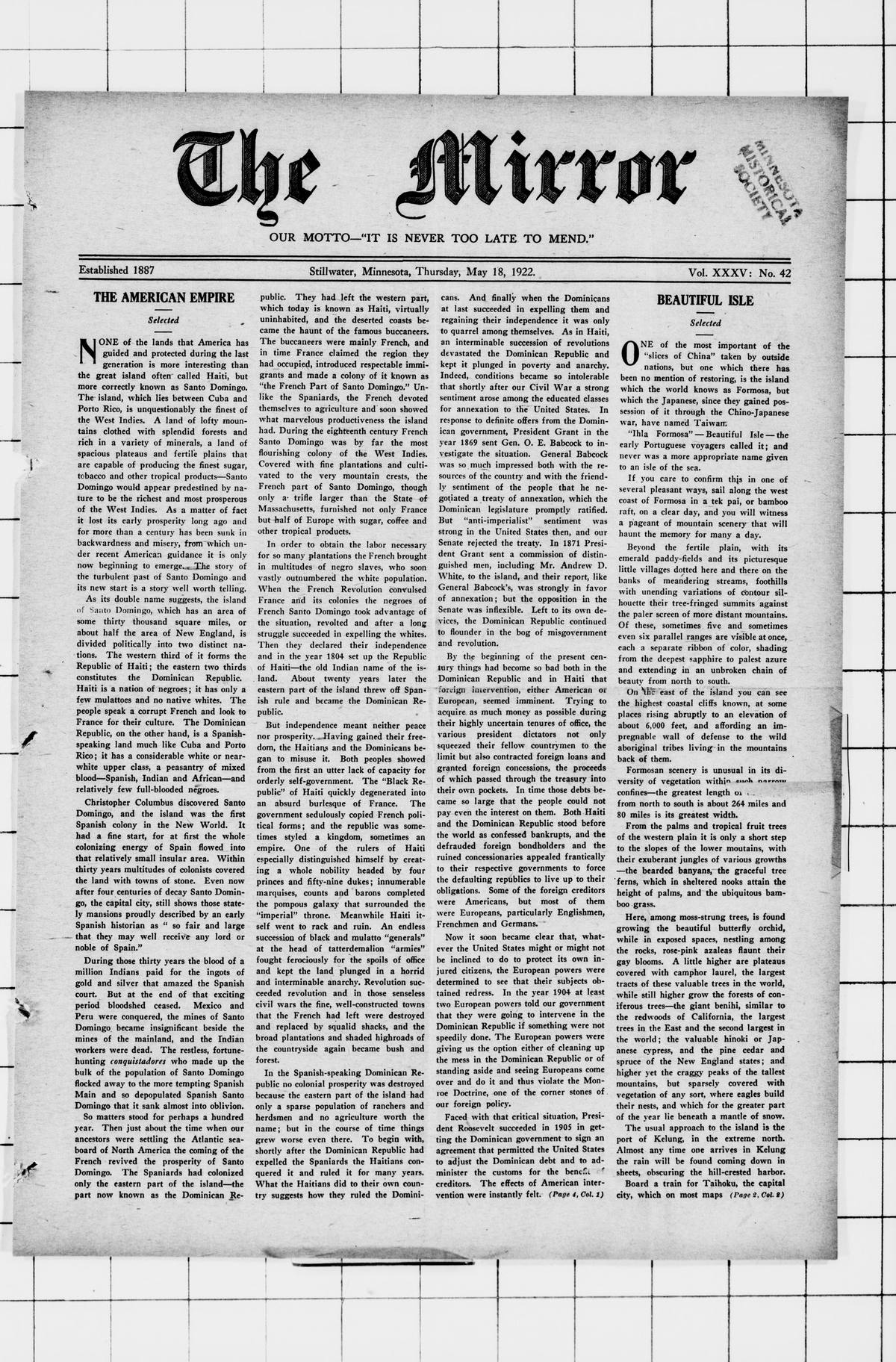
The mirror published a historical critique of Hispaniola, asserting that neither Haiti nor the Dominican Republic had demonstrated capacity for stable self-government after independence. The article depicted Haiti's post-colonial history as an imitation of French royalty plagued by endless civil wars that destroyed colonial plantations and towns. It added that conditions also deteriorated in the Dominican Republic after Spanish rule ended, particularly during subsequent decades of Haitian conquest and domination.El mirror publicó una crítica histórica sobre La Española, sosteniendo que ni Haití ni la República Dominicana habían demostrado capacidad para un autogobierno estable tras su independencia. El artículo retrató la historia poscolonial de Haití como una imitación de la realeza francesa asolada por interminables guerras civiles que arruinaron plantaciones y pueblos coloniales. Agregó que las condiciones también se deterioraron en la República Dominicana tras el fin del dominio español, en particular durante las décadas posteriores de ocupación y dominación haitiana.
FULL TEXT:TEXTO COMPLETO:
The Mirror May 18, 192218 de mayo de 1922
THE AMERICAN EMPIREEL IMPERIO ESTADOUNIDENSE
[Selected][Seleccionado]
In none of the lands that America has guided and protected during the last generation is more interesting than the great island often called Haiti, but more correctly known as Santo Domingo—the island which lies between Cuba and Porto Rico. It is unquestionably the finest of the West Indies—a land of lofty mountains clothed with splendid forests and a rich variety of minerals; a land of spacious plateaus and fertile plains that are capable of producing the finest of sugar, tobacco and other tropical products. Santo Domingo would appear predestined by nature to be the richest and most prosperous of the West Indies. As a matter of fact it lost its early prosperity long ago, and for more than a century has been sunk in a backwardness and misery from which, under recent American guidance, it is only now beginning to emerge. The story of the turbulent past of Santo Domingo and of its new start is a story well worth telling.En ninguna de las tierras que América ha guiado y protegido durante la última generación es más interesante que la gran isla a menudo llamada Haití, pero más correctamente conocida como Santo Domingo—la isla que yace entre Cuba y Puerto Rico. Es incuestionablemente la más fina de las Indias Occidentales—una tierra de montañas elevadas vestidas con espléndidos bosques y una rica variedad de minerales; una tierra de espaciosas mesetas y llanuras fértiles que son capaces de producir el más fino azúcar, tabaco y otros productos tropicales. Santo Domingo parecería predestinado por la naturaleza a ser la más rica y próspera de las Indias Occidentales. Como cuestión de hecho perdió su prosperidad temprana hace mucho, y por más de un siglo ha estado sumida en un atraso y miseria de los que, bajo la reciente guía estadounidense, solo ahora está comenzando a emerger. La historia del turbulento pasado de Santo Domingo y de su nuevo comienzo es una historia que bien vale la pena contar.
As its double name suggests, the island of Santo Domingo, which has an area of some thirty thousand square miles (about half the area of New England), is divided politically into two distinct nations. The western third forms the republic of Haiti; the eastern two-thirds constitutes the Dominican Republic. Haiti is a nation of Negroes; it has only a few mulattoes and no native whites. The people speak a corrupt French and look to France for their culture. The Dominican Republic, on the other hand, is a Spanish-speaking land, much like Cuba and Porto Rico. It has a considerable white or near-white upper class, a peasantry of mixed blood (Indian, white and African) and relatively few full-blooded Negroes.Como su doble nombre sugiere, la isla de Santo Domingo, que tiene un área de unas treinta mil millas cuadradas (cerca de la mitad del área de Nueva Inglaterra), está dividida políticamente en dos naciones distintas. El tercio occidental forma la república de Haití; los dos tercios orientales constituyen la República Dominicana. Haití es una nación de Negros; tiene solo unos pocos mulatos y ningún blanco nativo. El pueblo habla un francés corrupto y mira a Francia por su cultura. La República Dominicana, por otro lado, es una tierra de habla española, muy parecida a Cuba y Puerto Rico. Tiene una considerable clase alta blanca o casi blanca, un campesinado de sangre mezclada (india, blanca y africana) y relativamente pocos Negros de sangre pura.
Christopher Columbus discovered Santo Domingo, and the island was the first Spanish colony in the New World. It had a fine start, for at first the whole colonizing energy of Spain flowed into that relatively small insular area. Within thirty years multitudes of colonists had covered the land with towns of stone. Even now, after four centuries of decay, Santo Domingo, the capital city, still shows those stately mansions proudly described by an early Spanish historian as “so fair and large that they may well receive any lord or noble of Spain.”Cristóbal Colón descubrió Santo Domingo, y la isla fue la primera colonia española en el Nuevo Mundo. Tuvo un comienzo fino, pues al principio toda la energía colonizadora de España fluyó a esa relativamente pequeña área insular. Dentro de treinta años multitudes de colonos habían cubierto la tierra con pueblos de piedra. Aun ahora, después de cuatro siglos de decadencia, Santo Domingo, la ciudad capital, todavía muestra esas mansiones señoriales orgullosamente descritas por un historiador español temprano como «tan hermosas y grandes que bien pueden recibir a cualquier señor o noble de España».
During those thirty years the blood of a million Indians paid for the ingots of gold and silver that amazed the Spanish court. But at the end of that exciting period the bloodshed ceased. Mexico and Peru were conquered, the mines of Santo Domingo became insignificant beside the mines of the mainland, and the Indian workers were dead. The restless, fortune-hunting conquistadores who had made up the bulk of the population of Santo Domingo flocked away to the more tempting Spanish Main; and depopulated Spanish Santo Domingo almost sank into oblivion.Durante esos treinta años la sangre de un millón de indios pagó por los lingotes de oro y plata que asombraron a la corte española. Pero al final de ese emocionante período el derramamiento de sangre cesó. México y Perú fueron conquistados, las minas de Santo Domingo se volvieron insignificantes junto a las minas del continente, y los trabajadores indios estaban muertos. Los inquietos conquistadores cazadores de fortuna que habían compuesto la mayor parte de la población de Santo Domingo se alejaron en tropel hacia el más tentador Continente Español; y la despoblada Santo Domingo española casi se hundió en el olvido.
So matters stood for perhaps a hundred years. Then, just about the time when our ancestors were settling the Atlantic seaboard of North America, the coming of the French revived the prosperity of Santo Domingo. The Spaniards had colonized only the eastern part of the island—the part now known as the Dominican Republic; they had left the western part, which is today known as Haiti, virtually uninhabited, and the deserted coasts became the haunt of the famous buccaneers. The buccaneers were mainly French, and in time France claimed the region they had occupied, introduced respectable immigrants and made it a colony known as the French part of Santo Domingo. Like the Spaniards, the French devoted themselves to agriculture, and soon showed what marvelous productiveness the island had. During the eighteenth century French Santo Domingo was by far the most flourishing colony in the West Indies. Covered with fine plantations and cultivated to the very mountain crests, the French part of Santo Domingo, though only a trifle larger than the state of Massachusetts, furnished not only France but half Europe with sugar, coffee and other tropical products.Así estuvieron las cosas por quizás cien años. Entonces, justo por el tiempo en que nuestros ancestros estaban poblando la costa Atlántica de América del Norte, la venida de los franceses revivió la prosperidad de Santo Domingo. Los españoles habían colonizado solo la parte oriental de la isla—la parte ahora conocida como la República Dominicana; habían dejado la parte occidental, que hoy es conocida como Haití, virtualmente deshabitada, y las costas desiertas se convirtieron en guarida de los famosos bucaneros. Los bucaneros eran principalmente franceses, y con el tiempo Francia reclamó la región que habían ocupado, introdujo inmigrantes respetables y la hizo una colonia conocida como la parte francesa de Santo Domingo. Como los españoles, los franceses se dedicaron a la agricultura, y pronto mostraron qué maravillosa productividad tenía la isla. Durante el siglo dieciocho Santo Domingo francés fue por mucho la colonia más floreciente en las Indias Occidentales. Cubierta de finas plantaciones y cultivada hasta las mismas crestas de las montañas, la parte francesa de Santo Domingo, aunque solo un poco más grande que el estado de Massachusetts, suministró no solo a Francia sino a media Europa con azúcar, café y otros productos tropicales.
In order to obtain the labor necessary for so many plantations the French brought in multitudes of Negro slaves, who soon vastly outnumbered the white population. When the French Revolution convulsed France and its colonies, the Negroes of French Santo Domingo took advantage of the situation, revolted and after a long struggle succeeded in expelling the whites. Then they declared their independence, and in the year 1804 set up the republic of Haiti, the old Indian name for the land. About twenty years later the eastern part of the island threw off Spanish rule and became the Dominican Republic.A fin de obtener el trabajo necesario para tantas plantaciones los franceses trajeron multitudes de esclavos Negros, que pronto superaron vastamente en número a la población blanca. Cuando la Revolución Francesa convulsionó a Francia y sus colonias, los Negros de Santo Domingo francés aprovecharon la situación, se rebelaron y después de una larga lucha lograron expulsar a los blancos. Entonces declararon su independencia, y en el año 1804 establecieron la república de Haití, el viejo nombre indio para la tierra. Unos veinte años después la parte oriental de la isla se sacudió el gobierno español y se convirtió en la República Dominicana.
But independence meant neither peace nor prosperity. Having gained their freedom, the Haitians and the Dominicans began to misuse it. Both peoples showed from the first an utter lack of capacity for orderly self-government. The “Black Republic” of Haiti quickly degenerated into an absurd burlesque of France. The government sedulously copied French political forms; and the republic was sometimes styled a kingdom, sometimes an empire. One of the rulers of Haiti especially distinguished himself by creating a whole nobility headed by four princes and fifty-nine dukes; innumerable marquises, counts and barons completed the pompous galaxy that surrounded the “imperial” throne. Meanwhile Haiti itself went to rack and ruin. An endless succession of black and mulatto “generals” at the head of tatterdemalion “armies” fought ferociously for the spoils of office and kept the land plunged in a horrid and interminable anarchy. Revolution succeeded revolution and in those senseless civil wars the fine, well-constructed towns that the French had left were destroyed and replaced by squalid shacks, and the broad plantations and shaded highroads of the countryside again became bush and forest.Pero la independencia no significó ni paz ni prosperidad. Habiendo ganado su libertad, los haitianos y los dominicanos comenzaron a mal usarla. Ambos pueblos mostraron desde el principio una absoluta falta de capacidad para el autogobierno ordenado. La «República Negra» de Haití degeneró rápidamente en una absurda burlesca de Francia. El gobierno copió solícitamente las formas políticas francesas; y la república fue a veces llamada reino, a veces imperio. Uno de los gobernantes de Haití especialmente se distinguió creando toda una nobleza encabezada por cuatro príncipes y cincuenta y nueve duques; innumerables marqueses, condes y barones completaban la pomposa galaxia que rodeaba el trono «imperial». Entretanto Haití mismo fue a la ruina y el desastre. Una sucesión sin fin de «generales» negros y mulatos a la cabeza de «ejércitos» harapientos lucharon ferocemente por el botín del cargo y mantuvieron la tierra sumida en una horrible e interminable anarquía. Revolución sucedió a revolución y en esas guerras civiles sin sentido los pueblos finos y bien construidos que los franceses habían dejado fueron destruidos y reemplazados por chozas miserables, y las amplias plantaciones y caminos sombreados del campo se convirtieron de nuevo en monte y bosque.
In the Spanish (Dominican) Republic colonial prosperity was destroyed because the Haitians repeatedly invaded and conquered it. How the Haitians ruled their own country suggests how they ruled the Dominicans; and finally, when the Dominicans at last succeeded in expelling them, the Dominican Republic continued to flounder in the bog of misgovernment and revolution.En la República Española (Dominicana) la prosperidad colonial fue destruida porque los haitianos repetidamente la invadieron y conquistaron. Cómo los haitianos gobernaron su propio país sugiere cómo gobernaron a los dominicanos; y finalmente, cuando los dominicanos al fin lograron expulsarlos, la República Dominicana continuó tambaleándose en el pantano del mal gobierno y la revolución.
By the beginning of the present century things had become so bad that European intervention seemed certain. Both republics had piled up huge foreign debts that they could not pay. Some of the creditors were Americans, but most of them were Europeans, particularly Englishmen, Frenchmen and Germans.Para el comienzo del presente siglo las cosas se habían vuelto tan malas que la intervención europea parecía cierta. Ambas repúblicas habían acumulado enormes deudas extranjeras que no podían pagar. Algunos de los acreedores eran estadounidenses, pero la mayoría eran europeos, particularmente ingleses, franceses y alemanes.
Now, it soon became clear that, whatever the United States might think or might not be inclined to do to protect its own injured citizens, the European powers were determined to see that their subjects obtained redress. In the year 1904 at least two European powers told our government that they were going to intervene in the Dominican Republic if something was not speedily done. The European powers were not giving us the option either of cleaning up the mess in the Dominican Republic or of standing aside and seeing Europeans come over and do it and thus violate the Monroe Doctrine, one of the corner stones of our foreign policy.Ahora, pronto se hizo claro que cualquier cosa que los Estados Unidos pudiera pensar sobre su deber en el asunto, las naciones europeas no soportarían las condiciones por mucho más tiempo. En efecto, buques de guerra europeos ya estaban apareciendo frente a la costa y amenazando bombardear los puertos a menos que el dinero que se debía fuera pagado. Pero si potencias europeas capturaban los puertos de Santo Domingo, ¿qué sería de la Doctrina Monroe, una de las piedras angulares de nuestra política exterior?
Faced with that critical situation, President Roosevelt succeeded in 1905 in getting the Dominican government to sign an agreement that permitted the United States to adjust the Dominican debt and to administer the customs for the benefit of creditors. The effects of American intervention were instantly felt. an agreement that permitted the United States to adjust the Dominican debt and to administer the customs for the benefit of creditors. The effects of American intervention were instantly felt.Enfrentado con esa situación crítica, el presidente Roosevelt logró en 1905 que el gobierno dominicano firmara un acuerdo que permitió a los Estados Unidos ajustar la deuda dominicana y administrar las aduanas para beneficio de los acreedores. Los efectos de la intervención estadounidense se sintieron instantáneamente.
Hitherto the goal of every revolutionist had been the nearest customhouse, because the customs were almost the only source of revenue. If a revolutionist could seize a customhouse, he could maintain an army. But when the United States took charge of the customhouses, the customs officials turned over 45 per cent of the revenue to the Dominican government for its current expenses and applied the remaining 55 per cent to paying the foreign debt. At once the customhouses ceased to be prizes for revolutionists, because an American collector with American naval forces behind him was in charge. Revolutions promptly stopped, and for nearly ten years the Dominican Republic enjoyed unprecedented peace and prosperity. The country developed rapidly; roads, harbors, schools and public buildings were constructed, and the public debt was steadily reduced.Hasta entonces el objetivo de cada revolucionista había sido la aduana más cercana, porque las aduanas eran casi la única fuente de rentas. Si un revolucionista podía apoderarse de una aduana, podía mantener un ejército. Pero cuando los Estados Unidos tomaron cargo de las aduanas, los oficiales aduaneros entregaron el 45 por ciento de las rentas al gobierno dominicano para sus gastos corrientes y aplicaron el restante 55 por ciento a pagar la deuda extranjera. De inmediato las aduanas cesaron de ser premios para revolucionistas, porque un colector estadounidense con fuerzas navales estadounidenses detrás de él estaba a cargo. Las revoluciones se detuvieron prontamente, y por casi diez años la República Dominicana disfrutó de paz y prosperidad sin precedentes. El país se desarrolló rápidamente; caminos, puertos, escuelas y edificios públicos fueron construidos, y la deuda pública fue reducida constantemente.
Then came the World War. The withdrawal of American naval vessels to European waters was the signal for fresh revolutions. A series of uprisings threatened to undo all that had been accomplished. In 1916 the United States intervened with armed force. American marines landed, deposed the revolutionary government and set up a military administration headed by an American naval officer. Under American military rule the republic was completely disarmed, banditry was suppressed, and order was firmly established.Entonces vino la Guerra Mundial. La retirada de buques navales estadounidenses a aguas europeas fue la señal para nuevas revoluciones. Una serie de levantamientos amenazó deshacer todo lo que se había logrado. En 1916 los Estados Unidos intervinieron con fuerza armada. Infantes de marina estadounidenses desembarcaron, depusieron al gobierno revolucionario y establecieron una administración militar encabezada por un oficial naval estadounidense. Bajo el gobierno militar estadounidense la república fue completamente desarmada, el bandidaje fue suprimido, y el orden fue firmemente establecido.
Meanwhile, across the border in Haiti, conditions had gone from bad to worse. Between 1908 and 1915 seven presidents were successively overthrown, assassinated or driven into exile. When the World War broke out, German influence in Haiti was strong, and there was danger that Germany might seize a naval base on the island. In July, 1915, after a particularly shocking massacre of political prisoners, American marines landed at Port-au-Prince. A treaty was negotiated between the United States and Haiti under which the United States assumed control of the finances and police of the republic.Entretanto, al otro lado de la frontera en Haití, las condiciones habían ido de mal en peor. Entre 1908 y 1915 siete presidentes fueron sucesivamente derrocados, asesinados o llevados al exilio. Cuando estalló la Guerra Mundial, la influencia alemana en Haití era fuerte, y había peligro de que Alemania pudiera apoderarse de una base naval en la isla. En julio de 1915, después de una masacre particularmente impactante de prisioneros políticos, infantes de marina estadounidenses desembarcaron en Puerto Príncipe. Un tratado fue negociado entre los Estados Unidos y Haití bajo el cual los Estados Unidos asumieron el control de las finanzas y la policía de la república.
Under American supervision the gendarmery was organized, public works were pushed forward, and the country was cleared of the cacos, or mountain bandits, who had terrorized the population for generations. Today both republics on the island of Santo Domingo are peacefully developing their immense natural resources under American guidance and protection.Bajo supervisión estadounidense la gendarmería fue organizada, las obras públicas fueron impulsadas, y el país fue limpiado de los cacos, o bandidos de las montañas, que habían aterrorizado a la población por generaciones. Hoy ambas repúblicas en la isla de Santo Domingo están pacíficamente desarrollando sus inmensos recursos naturales bajo guía y protección estadounidenses.
[Editor's note: the paper writes of the east as part of Hayti. From 1822 to 1844 the Dominican Republic was held by Haitian military occupation, against its people's will; it restored its independence on February 27, 1844.][Nota del editor: el periódico habla del este como parte de Haití. De 1822 a 1844 la República Dominicana estuvo bajo ocupación militar haitiana, contra la voluntad de su pueblo; restauró su independencia el 27 de febrero de 1844.]