Aunlmal remains, employed as fertilizers; cocoa, rude and manufactured; coftee; cottonRestos animales, empleados como fertilizantes; cacao, crudo y manufacturado; café; algodón
New-York Tribune · New York [N.Y.] · December 19, 1884 · Page 3New-York Tribune · New York [N.Y.] · 19 de diciembre de 1884 · Página 3 View the originalVer el original
 See the full pageVer la página completa
The New-York Tribune reported on a convention detailing various Dominican products, including animal remains, cocoa, coffee, and sugar, to be admitted into the United States. It noted that specific Dominican goods, such as cordials and manufactured tobacco, would receive a twenty-five percent reduction in U.S. customs duties. Additionally, the convention provided that certain United States productions, including ale, beer, and live animals, would be admitted into the Dominican Republic free of duty.El New-York Tribune pormenorizó una convención relativa al ingreso en los Estados Unidos de diversos frutos dominicanos, entre ellos despojos animales, cacao, café y azúcares. Consignó que determinados efectos dominicanos, tales como licores y tabaco manufacturado, gozarían de una rebaja del veinticinco por ciento en los aranceles estadounidenses. Preveía asimismo el instrumento que ciertos artículos de producción estadounidense, incluyendo cerveza de malta, cerveza común y ganado en pie, entrarían libres de derechos a la República Dominicana.
FULL TEXT:TEXTO COMPLETO:
New-York Tribune December 19, 188419 de diciembre de 1884
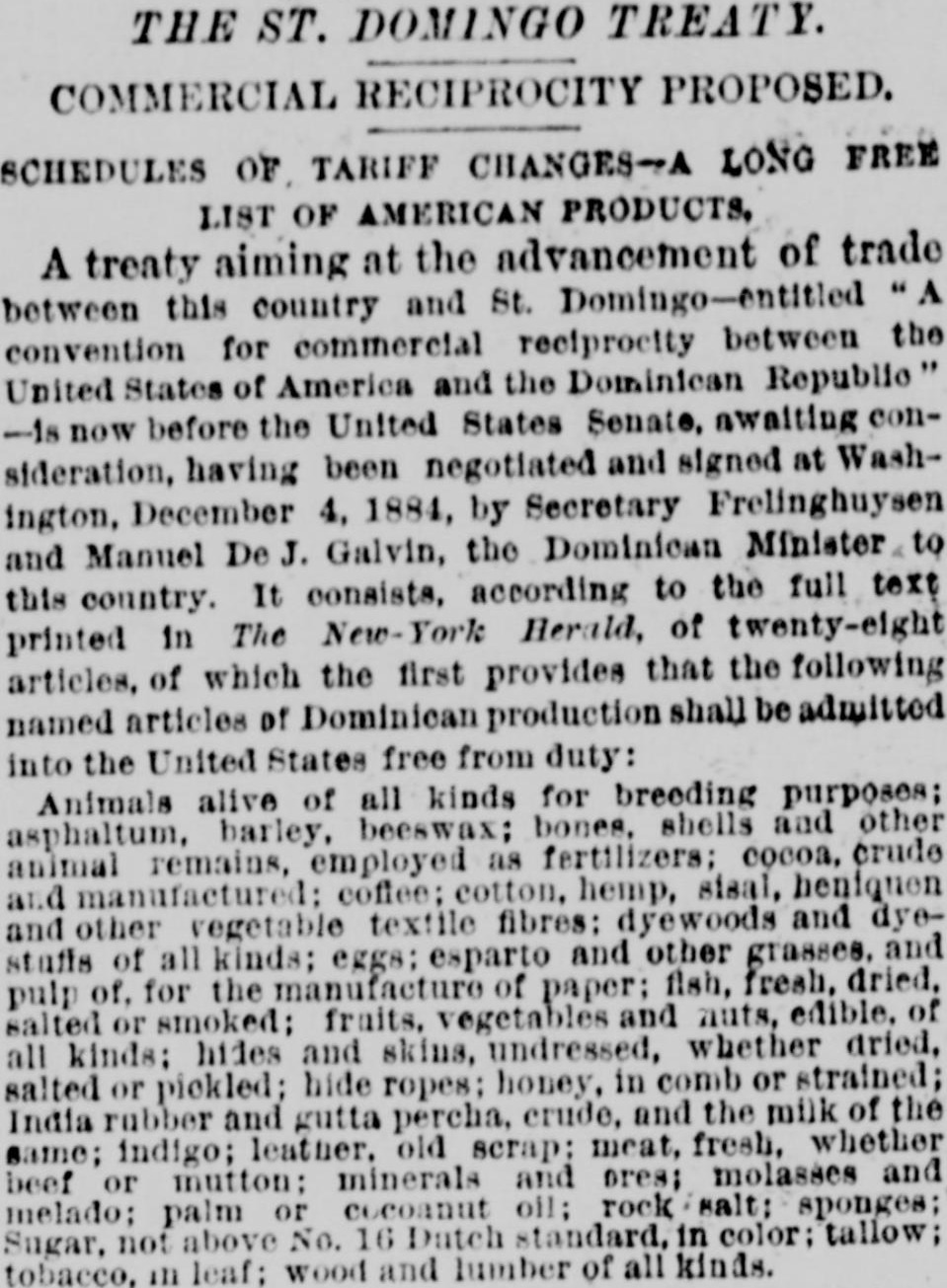
THE ST. DOMINGO TREATY.EL TRATADO DE SANTO DOMINGO.
COMMERCIAL RECIPROCITY PROPOSED.RECIPROCIDAD COMERCIAL PROPUESTA.
SCHEDULES OF TARIFF CHANGES—A LONG FREE LIST OF AMERICAN PRODUCTS.LISTAS DE CAMBIOS ARANCELARIOS—UNA LARGA LISTA LIBRE DE PRODUCTOS ESTADOUNIDENSES.
A treaty aiming at the advancement of trade between this country and St. Domingo—entitled "A convention for commercial reciprocity between the United States of America and the Dominican Republic"—is now before the United States Senate, awaiting consideration, having been negotiated and signed at Washington, December 4, 1884, by Secretary Frelinghuysen and Manuel De J. Galvin, the Dominican Minister to this country. It consists, according to the full text printed in The New-York Herald, of twenty-eight articles, of which the first provides that the following named articles of Dominican production shall be admitted into the United States free from duty:Un tratado dirigido al adelanto del comercio entre este país y Santo Domingo—intitulado «Una convención para la reciprocidad comercial entre los Estados Unidos de América y la República Dominicana»—está ahora ante el Senado de los Estados Unidos, aguardando consideración, habiendo sido negociado y firmado en Washington, el 4 de diciembre de 1884, por el Secretario Frelinghuysen y Manuel De J. Galvin, el Ministro dominicano ante este país. Consiste, según el texto completo impreso en The New-York Herald, de veintiocho artículos, de los cuales el primero provee que los siguientes artículos nombrados de producción dominicana serán admitidos en los Estados Unidos libres de derechos:
Animals alive of all kinds for breeding purposes; asphaltum, barley, beeswax; bones, shells and other animal remains, employed as fertilizers; cocoa, crude and manufactured; coffee; cotton, hemp, sisal, henequen and other vegetable textile fibres; dyewoods and dye-stuffs of all kinds; eggs; esparto and other grasses, and pulp of, for the manufacture of paper; fish, fresh, dried, salted or smoked; fruits, vegetables and nuts, edible, of all kinds; hides and skins, undressed, whether dried, salted or pickled; hide ropes; honey, in comb or strained; India rubber and gutta percha, crude, and the milk of the same; indigo; leather, old scrap; meat, fresh, whether beef or mutton; minerals and ores; molasses and melado; palm or cocoanut oil; rock salt; sponges; Sugar, not above No. 16 Dutch standard, in color; tallow; tobacco, in leaf; wood and lumber of all kinds.Animales vivos de toda clase para fines de cría; asfalto, cebada, cera de abejas; huesos, conchas y otros restos animales, empleados como fertilizantes; cacao, crudo y manufacturado; café; algodón, cáñamo, sisal, henequén y otras fibras textiles vegetales; palos de tinte y materias colorantes de toda clase; huevos; esparto y otras hierbas, y pulpa de, para la manufactura de papel; pescado, fresco, seco, salado o ahumado; frutas, vegetales y nueces, comestibles, de toda clase; cueros y pieles, sin curtir, ya secos, salados o en escabeche; sogas de cuero; miel, en panal o colada; caucho y gutapercha, crudos, y la leche de los mismos; índigo; cuero, retazos viejos; carne, fresca, ya de res o de carnero; minerales y menas; melaza y melado; aceite de palma o de coco; sal de roca; esponjas; Azúcar, no superior al No. 16 del estándar holandés, en color; sebo; tabaco, en hoja; madera y maderos de toda clase.