The Acquisition of St. Domingo by Spain.La adquisición de Santo Domingo por España.
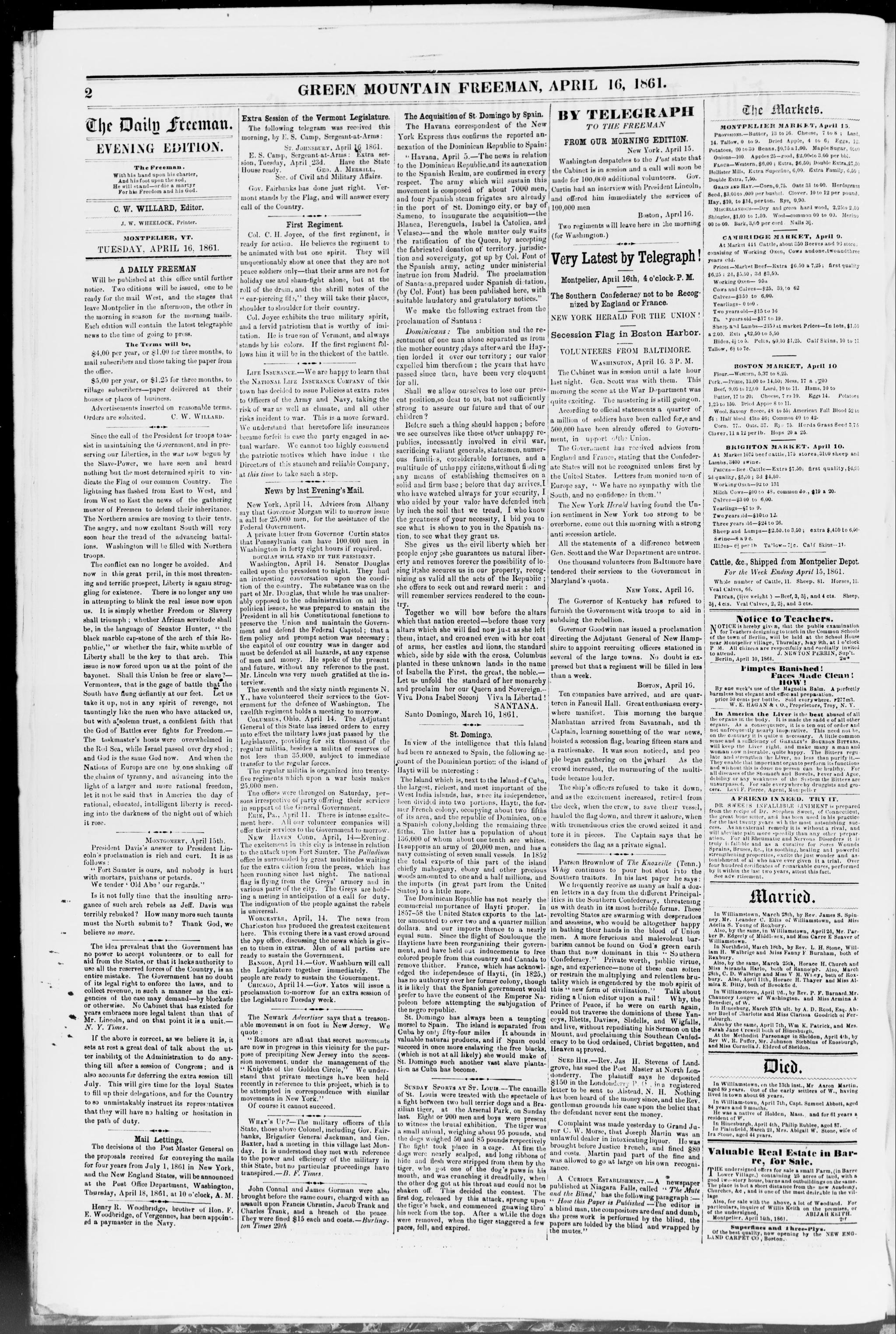
The Daily Green Mountain Freeman · Montpelier, Vt. · April 16, 1861 · Page 2The Daily Green Mountain Freeman · Montpelier, Vt. · 16 de abril de 1861 · Página 2 View the originalVer el original
 See the full pageVer la página completa
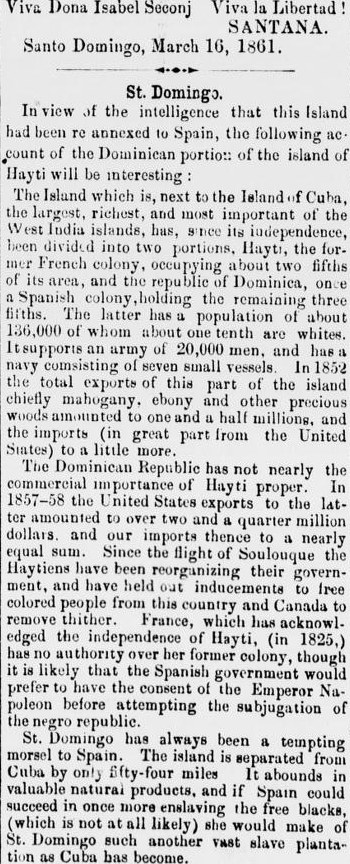
Following the closing lines of a proclamation dated Santo Domingo, March 10, 1861, and signed by Santana with cries of long live Doña Isabel II and liberty, The Daily Green Mountain Freeman presents an account of the Dominican portion of the island in view of intelligence that it has been re-annexed to Spain. The paper describes the island of Haiti as the largest, richest, and most important of the West India islands next to Cuba, noting that since its independence it has been divided into Haiti, a former French colony occupying about two-fifths of its area, and the "republic of Dominica" (the Dominican Republic), a former Spanish colony holding the remaining three-fifths. According to the report, the Dominican Republic has a population of about 105,000, roughly one-tenth of whom are white, and maintains an army of 20,000 men and a navy of seven small vessels. In 1852, its total exports—chiefly mahogany, ebony, and other precious woods—amounted to one and a half million dollars, while its imports, largely from the United States, totaled slightly more.Tras las líneas finales de una proclama fechada en Santo Domingo el 10 de marzo de 1861 y firmada por Santana con vivas a Doña Isabel II y a la libertad, The Daily Green Mountain Freeman presenta una reseña de la parte dominicana de la isla ante la noticia de que ha sido reanexada a España. El periódico describe la isla de Haití como la más grande, rica e importante de las Antillas después de Cuba, señalando que desde su independencia se ha dividido entre Haití, antigua colonia francesa que ocupa cerca de dos quintas partes de su superficie, y la llamada «república de Dominica» (la República Dominicana), antigua colonia española que posee las tres quintas partes restantes. Según el informe, la República Dominicana tiene una población de unos 105,000 habitantes, de los cuales aproximadamente una décima parte son blancos, y mantiene un ejército de 20,000 hombres y una armada de siete embarcaciones pequeñas. En 1852, sus exportaciones totales —principalmente caoba, ébano y otras maderas preciosas— ascendieron a un millón y medio de dólares, mientras que sus importaciones, procedentes en gran parte de los Estados Unidos, superaron ligeramente esa cifra.
FULL TEXT:TEXTO COMPLETO:
The Daily Green Mountain Freeman April 16, 186116 de abril de 1861
Original in English.Original en inglés.
The Acquisition of St. Domingo by Spain.La adquisición de Santo Domingo por parte de España.
The Havana correspondent of the New York Express thus confirms the reported annexation of the Dominican Republic to Spain:El corresponsal en La Habana del New York Express confirma de este modo la reportada anexión de la República Dominicana a España:
"Havana, April 5.—The news in relation to the Dominican Republic, and its annexation to the Spanish Realm, are confirmed in every respect. The army which will sustain this movement is composed of about 7000 men, and four Spanish steam frigates are already in the port of St. Domingo city, or bay of Sameno, to inaugurate the acquisition—the Blanca, Berenguela, Isabel la Catolica, and Velasco—and the whole matter only waits the ratification of the Queen, by accepting the fabricated donation of territory, jurisdiction and sovereignty, got up by Col. Font of the Spanish army, acting under ministerial instruction from Madrid. The proclamation of Santana, prepared under Spanish dictation, (by Col. Font) has been published here, with suitable laudatory and gratulatory notices."«La Habana, 5 de abril.—Las noticias relativas a la República Dominicana y su anexión al Reino de España se confirman en todos los aspectos. El ejército que sostendrá este movimiento está compuesto por unos 7000 hombres, y cuatro fragatas de vapor españolas ya se encuentran en el puerto de la ciudad de Santo Domingo, o bahía de Samaná, para inaugurar la adquisición —la Blanca, la Berenguela, la Isabel la Católica y el Velasco—, y todo el asunto solo aguarda la ratificación de la Reina mediante la aceptación de la fabricada donación de territorio, jurisdicción y soberanía, urdida por el coronel Font del ejército español, actuando bajo instrucciones ministeriales desde Madrid. La proclama de Santana, preparada bajo dictado español (por el coronel Font), ha sido publicada aquí, con oportunos avisos laudatorios y congratulatorios».
We make the following extract from the proclamation of Santana :Extraemos el siguiente pasaje de la proclama de Santana:
Dominicans: The ambition and the resentment of one man alone separated us from the mother country ;days afterward the Haytien lorded it over our territory ; our valor expelled him therefrom ; the years that have passed since then, have been very eloquent for all.Dominicanos: La ambición y el resentimiento de un solo hombre nos separaron de la madre patria; días después el haitiano se enseñoreó de nuestro territorio; nuestro valor lo expulsó de allí; los años transcurridos desde entonces han sido muy elocuentes para todos.
Shall we allow ourselves to lose our present position, so dear to us, but not sufficiently strong to assure our future and that of our children? Before such a thing should happen ; before we see ourselves like those other unhappy republics, incessantly involved in civil war, sacrificing valiant generals, statesmen, numerous families, considerable fortunes, and a multitude of unhappy citizens, without finding any means of establishing themselves on a solid and firm base ; before that day arrives, I who have watched always for your security, I who aided by your valor have defended inch by inch the soil that we tread, I who know the greatness of your necessity, I bid you to see what is shown to you in the Spanish nation, to see what they grant us.¿Nos permitiremos perder nuestra posición actual, tan cara para nosotros, pero no lo bastante fuerte como para asegurar nuestro porvenir y el de nuestros hijos? Antes de que tal cosa suceda; antes de vernos como aquellas otras desdichadas repúblicas, incesantemente envueltas en guerras civiles, sacrificando valientes generales, estadistas, numerosas familias, considerables fortunas y una multitud de infelices ciudadanos, sin hallar medio alguno de establecerse sobre una base sólida y firme; antes de que llegue ese día, yo, que he velado siempre por vuestra seguridad, yo que, ayudado por vuestro valor, he defendido palmo a palmo el suelo que pisamos, yo que conozco la grandeza de vuestra necesidad, os pido que veáis lo que se os muestra en la nación española, que veáis lo que ellos nos conceden.
She gives us the civil liberty which her people enjoy ;she guarantees us natural liberty and removes forever the possibility of losing it; she secures us in our property, recognizing as valid all the acts of the Republic ; she offers to seek out and reward merit : and will remember services rendered to the country.Ella nos da la libertad civil de la que goza su pueblo; nos garantiza la libertad natural y aleja para siempre la posibilidad de perderla; nos asegura en nuestra propiedad, reconociendo como válidos todos los actos de la República; ofrece buscar y recompensar el mérito; y recordará los servicios prestados a la patria.
Together we will bow before the altars which that nation erected—before those very altars which she will find now just as she left them, intact, and crowned even with her coat of arms, her castles and lions, the standard which, side by side with the cross, Columbus planted in these unknown lands in the name of Isabella the First, the great, the noble.—Let us unfold the standard of her monarchy and proclaim her our Queen and Sovereign.—Viva Dona Isabel Seconj Viva la Libertad!Juntos nos inclinaremos ante los altares que erigió esa nación —ante esos mismos altares que hallará ahora tal como los dejó, intactos y coronados aún con su escudo de armas, sus castillos y leones, el estandarte que, al lado de la cruz, Colón plantó en estas tierras desconocidas en nombre de Isabel Primera, la grande, la noble—. Despleguemos el estandarte de su monarquía y proclamémosla nuestra Reina y Soberana. —¡Viva Doña Isabel Segunda! ¡Viva la Libertad!
SANTANA.SANTANA.
Santo Domingo, March 16, 1861.Santo Domingo, 16 de marzo de 1861.
St. Domingo.Santo Domingo.
In view of the intelligence that this Island had been re annexed to Spain, the following account of the Dominican portion of the island of Hayti will be interesting :En vista de las noticias de que esta isla había sido reanexada a España, el siguiente relato de la porción dominicana de la isla de Haití resultará interesante:
The Island which is, next to the Island of Cuba, the largest, richest, and most important of the West India islands, has, since its independence, been divided into two portions, Hayti, the former French colony, occupying about two fifths of its area, and the republic of Dominica, once a Spanish colony, holding the remaining three fifths. The latter has a population of about 136,000 of whom about one tenth are whites. It supports an army of 20,000 men, and has a navy consisting of seven small vessels. In 1852 the total exports of this part of the island chiefly mahogany, ebony and other precious woods amounted to one and a half millions, and the imports (in great part from the United States) to a little more.La isla que es, después de la isla de Cuba, la más grande, rica e importante de las islas de las Indias Occidentales, ha estado, desde su independencia, dividida en dos porciones: Haití, la antigua colonia francesa, que ocupa aproximadamente dos quintas partes de su superficie, y la república de Dominica, antaño colonia española, que posee las tres quintas partes restantes. Esta última tiene una población de unos 136.000 habitantes, de los cuales alrededor de una décima parte son blancos. Mantiene un ejército de 20.000 hombres y cuenta con una marina compuesta por siete buques pequeños. En 1852 las exportaciones totales de esta parte de la isla, principalmente caoba, ébano y otras maderas preciosas, ascendieron a un millón y medio, y las importaciones (en gran parte procedentes de los Estados Unidos) a un poco más.
The Dominican Republic has not nearly the commercial importance of Hayti proper. In 1857-58 the United States exports to the latter amounted to over two and a quarter million dollars, and our imports thence to a nearly equal sum. Since the flight of Soulouque the Haytiens have been reorganizing their government, and have held out inducements to free colored people from this country and Canada to remove thither. France, which has acknowledged the independence of Hayti, (in 1825,) has no authority over her former colony, though it is likely that the Spanish government would prefer to have the consent of the Emperor Napoleon before attempting the subjugation of the negro republic.La República Dominicana no tiene ni de lejos la importancia comercial del Haití propiamente dicho. En 1857-58 las exportaciones de los Estados Unidos a este último ascendieron a más de dos millones y cuarto de dólares, y nuestras importaciones desde allí a una suma casi igual. Desde la huida de Soulouque, los haitianos han estado reorganizando su gobierno y han ofrecido incentivos a personas de color libres de este país y de Canadá para que se trasladen allí. Francia, que ha reconocido la independencia de Haití (en 1825), no tiene autoridad sobre su antigua colonia, aunque es probable que el gobierno español prefiriese contar con el consentimiento del emperador Napoleón antes de intentar el sojuzgamiento de la república negra.
St. Domingo has always been a tempting morsel to Spain. The island is separated from Cuba by only fifty-four miles. It abounds in valuable natural products, and if Spain could succeed in once more enslaving the free blacks, (which is not at all likely) she would make of St. Domingo such another vast slave plantation as Cuba has become.Santo Domingo ha sido siempre un bocado tentador para España. La isla está separada de Cuba por solo cincuenta y cuatro millas. Abunda en valiosos productos naturales, y si España lograra esclavizar una vez más a los negros libres (lo cual no es en absoluto probable), haría de Santo Domingo otra vasta plantación de esclavos semejante a lo que ha llegado a ser Cuba.
In this article, the newspaper calls the country 'Dominica.' It means the Dominican Republic, not the island of Dominica.En este artículo, el periódico llama al país «Dominica». Se refiere a la República Dominicana, no a la isla de Dominica.
[Editor's note: the paper writes of the east as part of Hayti. From 1822 to 1844 the Dominican Republic was held by Haitian military occupation, against its people's will; it restored its independence on February 27, 1844.][Nota del editor: el periódico habla del este como parte de Haití. De 1822 a 1844 la República Dominicana estuvo bajo ocupación militar haitiana, contra la voluntad de su pueblo; restauró su independencia el 27 de febrero de 1844.]