It was discovered that these two parts of the island of Santa DomingoSe descubrió que estas dos partes de la isla de Santo Domingo
Savannah Morning News · Savannah · December 23, 1881 · Page 1Savannah Morning News · Savannah · 23 de diciembre de 1881 · Página 1 View the originalVer el original
 See the full pageVer la página completa
The Savannah Morning News reported that the Samana Bay Company—chartered in New York by men including Marshall O. Roberts, William R. Grace, and Commodore Garrison—undertook trade and development in San Domingo, backed by a Dominican concession and railroad grant. The newspaper noted that utilizing the island through Spanish and French concessions was intended to eventually bring the West Indies into the United States, while government acquisition schemes sparked a major political fight resulting in the deposition of Charles Sumner from his chairmanship.El Savannah Morning News consignó que la Samana Bay Company —constituida en Nueva York por personalidades como Marshall O. Roberts, William R. Grace y el comodoro Garrison— emprendió el fomento y la explotación mercantil de Santo Domingo al amparo de una concesión dominicana y un privilegio ferroviario. Apuntó el diario que el aprovechamiento de la isla mediante concesiones españolas y francesas buscaba en último término la anexión de las Antillas a los Estados Unidos, en tanto los manejos gubernamentales de absorción territorial desataron una encarnizada batalla política que culminó con la deposición de Charles Sumner de la presidencia de su comité.
FULL TEXT:TEXTO COMPLETO:
Savannah Morning News December 23, 188123 de diciembre de 1881
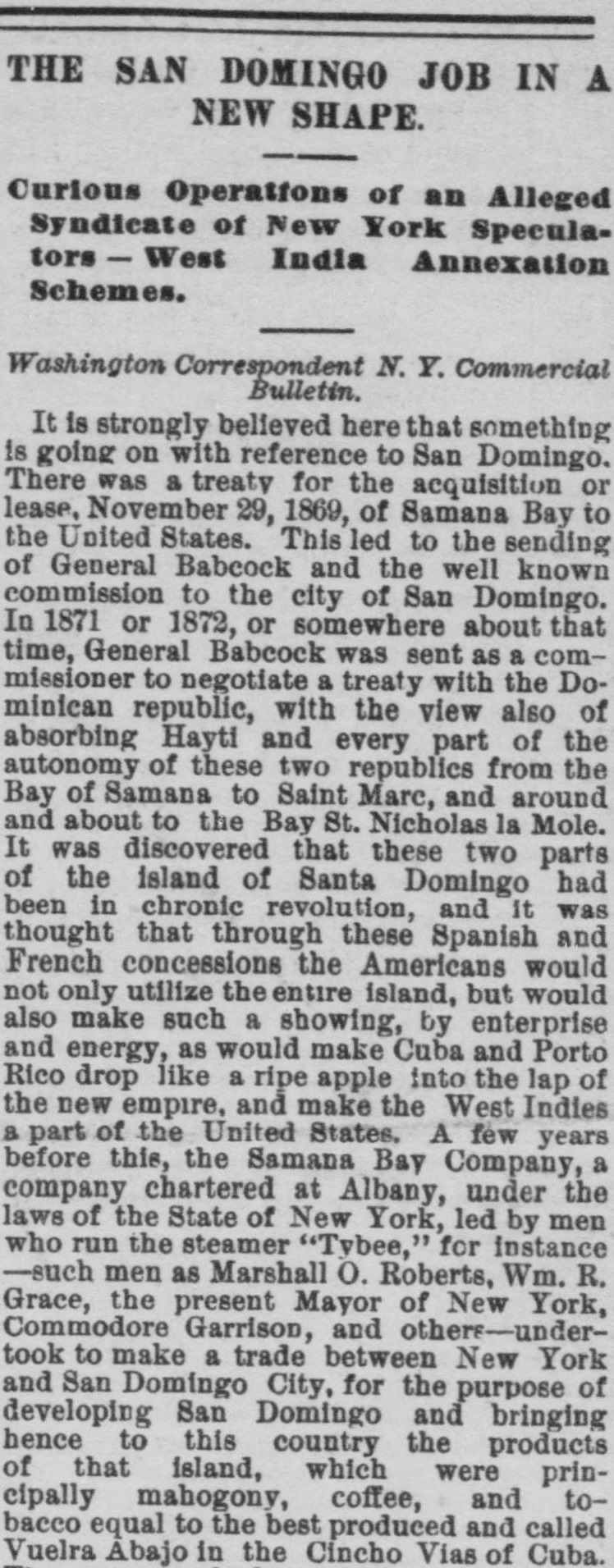
THE SAN DOMINGO JOB IN A NEW SHAPE.EL NEGOCIO DE SANTO DOMINGO EN UNA NUEVA FORMA.
Curious Operations of an Alleged Syndicate of New York Speculators--West India Annexation Schemes.Curiosas operaciones de un alegado sindicato de especuladores de Nueva York—Planes de anexión de las Indias Occidentales.
Washington Correspondent N. Y. Commercial Bulletin.Corresponsal en Washington del N. Y. Commercial Bulletin.
It is strongly believed here that something is going on with reference to San Domingo. There was a treaty for the acquisition or lease, November 29, 1869, of Samana Bay to the United States. This led to the sending of General Babcock and the well known commission to the city of San Domingo. In 1871 or 1872, or somewhere about that time, General Babcock was sent as a commissioner to negotiate a treaty with the Dominican republic, with the view also of absorbing Hayti and every part of the autonomy of these two republics from the Bay of Samana to Saint Marc, and around and about to the Bay St. Nicholas la Mole. It was discovered that these two parts of the island of Santa Domingo had been in chronic revolution, and it was thought that through these Spanish and French concessions the Americans would not only utilize the entire island, but would also make such a showing, by enterprise and energy, as would make Cuba and Porto Rico drop like a ripe apple into the lap of the new empire, and make the West Indies a part of the United States. A few years before this, the Samana Bay Company, a company chartered at Albany, under the laws of the State of New York, led by men who run the steamer "Tybee," for instance--such men as Marshall O. Roberts, Wm. R. Grace, the present Mayor of New York, Commodore Garrison, and others--undertook to make a trade between New York and San Domingo City, for the purpose of developing San Domingo and bringing hence to this country the products of that island, which were principally mahogony, coffee, and tobacco equal to the best produced and called Vuelra Abajo in the Cincho Vias of Cuba.Se cree firmemente aquí que algo está sucediendo con referencia a Santo Domingo. Hubo un tratado para la adquisición o arrendamiento, el 29 de noviembre de 1869, de la Bahía de Samaná a los Estados Unidos. Esto condujo al envío del general Babcock y de la bien conocida comisión a la ciudad de Santo Domingo. En 1871 o 1872, o por ahí en esa época, el general Babcock fue enviado como comisionado para negociar un tratado con la república dominicana, con miras también a absorber Haití y cada parte de la autonomía de estas dos repúblicas desde la Bahía de Samaná hasta Saint Marc, y alrededor y en torno a la Bahía de San Nicolás la Mole. Se descubrió que estas dos partes de la isla de Santo Domingo habían estado en revolución crónica, y se pensó que a través de estas concesiones españolas y francesas los estadounidenses no solo utilizarían la isla entera, sino que también harían tal demostración, por empresa y energía, que haría que Cuba y Puerto Rico cayeran como una manzana madura en el regazo del nuevo imperio, y haría de las Indias Occidentales una parte de los Estados Unidos. Unos pocos años antes de esto, la Compañía de la Bahía de Samaná, una compañía constituida en Albany, bajo las leyes del Estado de Nueva York, liderada por hombres que operan el vapor «Tybee», por ejemplo—tales hombres como Marshall O. Roberts, Wm. R. Grace, el presente Alcalde de Nueva York, el comodoro Garrison, y otros—emprendió hacer un comercio entre Nueva York y la ciudad de Santo Domingo, con el propósito de desarrollar Santo Domingo y traer de allí a este país los productos de esa isla, que eran principalmente caoba, café, y tabaco igual al mejor producido y llamado Vuelra Abajo en las Cincho Vias de Cuba.