Article in transcriptionArtículo en transcripción
The Cecil Whig · Elkton, Md. · October 5, 1872 · Page 2The Cecil Whig · Elkton, Md. · 5 de octubre de 1872 · Página 2 View the originalVer el original
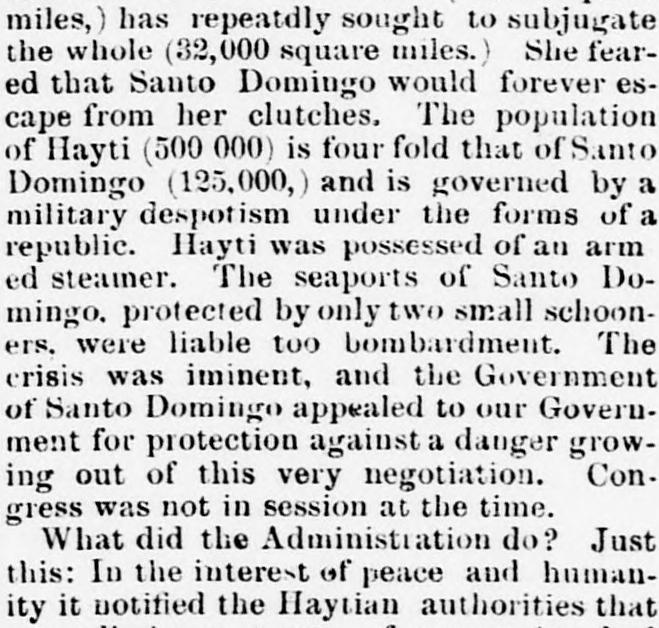
The newspaper reported that when Santo Domingo faced an imminent crisis and appealed to the United States for protection during an ongoing annexation negotiation, the U.S. Administration notified Haytian authorities that an invasion would be regarded as unfriendly to the U.S. until Congress decided on the treaty. Additionally, the President sent American warships into Dominican waters at the request of the Dominican Government, which successfully prevented conflict and kept the peace between Hayti and Santo Domingo without firing a shot or landing sailors on Haytian territory.El periódico refirió que, al afrontar Santo Domingo una crisis extrema y acudir en demanda de auxilio a los Estados Unidos durante las tratativas de anexión, el gobierno de Washington advirtió a las autoridades de Haití de que cualquier invasión sería juzgada como un acto inamistoso contra los Estados Unidos hasta tanto el Congreso se pronunciase sobre el tratado. Asimismo, el mandatario destacó buques navales estadounidenses en aguas dominicanas a instancias del gobierno de Santo Domingo, logrando disuadir las hostilidades y preservar la paz entre ambas naciones insulares sin haber efectuado un solo disparo ni desembarcado marinería en suelo haitiano.
FULL TEXT:TEXTO COMPLETO:
The Cecil Whig October 5, 18725 de octubre de 1872
Original in English.Original en inglés.
THE SAN DOMINGO QUESTION.LA CUESTIÓN DE SANTO DOMINGO.
WHAT PRESIDENT GRANT HAD TO DO WITH IT.LO QUE EL PRESIDENTE GRANT TUVO QUE VER CON ELLA.
To the Editors of the Boston Daily Advertiser:A los directores del Boston Daily Advertiser:
The annexation of San Domingo is not at present a party question. The Philadelphia platform did not endorse it. The Cincinnati and Baltimore did not oppose it. The New York Tribune has heretofore favored it. Other Liberal and Democratic papers have been neutral in regard to it.La anexión de Santo Domingo no es actualmente una cuestión de partido. La plataforma de Filadelfia no la respaldó. Las de Cincinnati y Baltimore no se opusieron a ella. El New York Tribune la ha favorecido hasta ahora. Otros periódicos liberales y demócratas se han mostrado neutrales al respecto.
* * * * * * * * ** * * * * * * * *
In his farewell speech on the Presidential election, Senator Sumner made the following specific charges against the President:En su discurso de despedida sobre la elección presidencial, el senador Sumner formuló las siguientes acusaciones específicas contra el Presidente:
1. That he had perpetrated an outrage upon Hayti and menaced her independence with war, in violation of international law.1. Que había perpetrado un atropello contra Haití y amenazado su independencia con la guerra, en violación del derecho internacional.
2. That he kept our navy hovering on the Haytian coast "like a hawk sailing in air," and has employed United States ships of war, at great expense, in maintaining "the usurper Baez" in power, thus acting in flagrant violation of the Federal Constitution.2. Que mantuvo a nuestra marina merodeando en la costa haitiana «como un halcón surcando el aire», y que ha empleado buques de guerra de los Estados Unidos, con gran gasto, para mantener en el poder al «usurpador Báez», actuando así en flagrante violación de la Constitución Federal.
3. That, through his agents, he has connived at and prolonged the imprisonment of Mr. Hatch, "an American citizen," and that Hatch was "immured" because it was feared that, if released, he would write against annexation.3. Que, a través de sus agentes, ha sido cómplice y ha prolongado el encarcelamiento del Sr. Hatch, «un ciudadano estadounidense», y que Hatch fue «encerrado» porque se temía que, de ser liberado, escribiría contra la anexión.
4. That he has insulted Frederick Douglass, first because Mr. Douglass was excluded from the Commissioners' table on board of a Potomac steamer, and again because Mr. Douglass was omitted from an invitation to a dinner given to the Commissioners at the Presidential mansion.4. Que ha insultado a Frederick Douglass, primero porque el Sr. Douglass fue excluido de la mesa de los Comisionados a bordo de un vapor del Potomac, y nuevamente porque el Sr. Douglass fue omitido de una invitación a una cena ofrecida a los Comisionados en la mansión presidencial.
The facts are briefly these:Los hechos son brevemente estos:
Spanish Santo Domingo comprises two thirds (22,000 square miles) of the island.—The Government de facto, through its Minister Plenipotentiary, formaily applied to President Grant three years ago; proposing annexation to the United States as a territory, upon the sole condition of our assuming its national indebtness, which was estimated as a million and a half dollars. The President, before entertaining the proposition, sent down his private secretary, Gen. Babcock, ann honorable and reliable man, to ascertain the competency and stability of the Dominician Government, the sentiment of the Dominican people in regard to annexation, the amount of the debt, and the value of the territory. Being fully satisfied upon all these points, two treaties were negotiated by the State Department—one for the lease of the peninsula and magnificent Bay of Samana at a rent of $150,000 a year, the other for the annexation of the whole country; the former to terminate upon the ratification of the latter, and both subject to the approval of Congress. The matter was brought before Congress in due time, and an annexation was recommended by the President, sustained by facts and arguments which have since been reiterated and sustained by the report of the Commissioners appointed to investigate the subject.El Santo Domingo español comprende dos tercios (22.000 millas cuadradas) de la isla.—El Gobierno de facto, por medio de su Ministro Plenipotenciario, solicitó formalmente al Presidente Grant hace tres años; proponiendo la anexión a los Estados Unidos como territorio, con la única condición de que asumiéramos su deuda nacional, que se estimaba en un millón y medio de dólares. El Presidente, antes de considerar la propuesta, envió a su secretario privado, el general Babcock, un hombre honorable y fidedigno, para constatar la competencia y estabilidad del Gobierno dominicano, el sentimiento del pueblo dominicano respecto a la anexión, el monto de la deuda y el valor del territorio. Habiendo quedado plenamente satisfecho en todos estos puntos, el Departamento de Estado negoció dos tratados: uno para el arrendamiento de la península y la magnífica bahía de Samaná por una renta de 150.000 dólares al año, y el otro para la anexión de todo el país; debiendo el primero terminar tras la ratificación del segundo, y ambos sujetos a la aprobación del Congreso. El asunto fue presentado ante el Congreso a su debido tiempo, y el Presidente recomendó la anexión, respaldada por hechos y argumentos que desde entonces han sido reiterados y sustentados por el informe de los Comisionados designados para investigar el tema.
These negotiations were frank and explicit. So far from shunning publicity, the President called in person upon Senator Sumner at his own house, and in presence of Colonel Forney, asked for his co-operation. Mr. Sumner returned an evasive answer, which both the President and Col. Forney understood to be affirmative and favorable. Soon afterwards, without previous remonstrance, without any effort to induce the Administration to forego or modify its plans, Senator Sumner publicly assailed the Administration and the President as guilty of a violation of all laws, human and divine.Estas negociaciones fueron francas y explícitas. Lejos de rehuir la publicidad, el Presidente visitó en persona al senador Sumner en su propia casa y, en presencia del coronel Forney, solicitó su cooperación. El Sr. Sumner dio una respuesta evasiva, que tanto el Presidente como el coronel Forney entendieron como afirmativa y favorable. Poco después, sin previo reclamo, sin esfuerzo alguno por inducir a la Administración a desistir de sus planes o modificarlos, el senador Sumner atacó públicamente a la Administración y al Presidente acusándolos de ser culpables de una violación de todas las leyes, humanas y divinas.
1. The alleged outrage upon Hayti occurred as follows: No sooner was it known that a negotiation for annexation was pending than preparations were made by the Haytian authorities to invade their feeble neighbor, instigated to this course by the deplomatic representatives of certain European Powers, who were jealous of American suprmacy. Hayti, which comprises less than one-third of the island (10,000 square miles,) has repeatdly sought to subjugate the whole (32,000 square miles.) She feared that Santo Domingo would forever escape from her clutches. The population of Hayti (500 000) is four fold that of Santo Domingo (125,000,) and is governed by a military despotism under the forms of a republic. Hayti was possessed of an armed steamer. The seaports of Santo Domingo, protected by only two small schooners, were liable too bombardment. The crisis was iminent, and the Government of Santo Domingo appealed to our Government for protection against a danger growing out of this very negotiation. Congress was not in session at the time.1. El presunto atropello contra Haití ocurrió de la siguiente manera: Tan pronto como se supo que una negociación para la anexión estaba pendiente, las autoridades haitianas hicieron preparativos para invadir a su débil vecino, instigadas a este proceder por los representantes diplomáticos de ciertas potencias europeas, celosas de la supremacía estadounidense. Haití, que comprende menos de un tercio de la isla (10.000 millas cuadradas), ha intentado repetidamente sojuzgar la totalidad (32.000 millas cuadradas). Temía que Santo Domingo escapara para siempre de sus garras. La población de Haití (500.000) cuadruplica la de Santo Domingo (125.000), y está gobernada por un despotismo militar bajo las formas de una república. Haití poseía un vapor armado. Los puertos marítimos de Santo Domingo, protegidos únicamente por dos pequeñas goletas, estaban expuestos al bombardeo. La crisis era inminente, y el Gobierno de Santo Domingo apeló a nuestro Gobierno en busca de protección contra un peligro derivado de esta misma negociación. El Congreso no estaba en sesiones en ese momento.
What did the Administration do? Just this: In the interest of peace and humanity it notified the Haytian authorities that a preliminary treaty of annexation had been negotiated, and that, until Congress should have expressed its decision, an invasion of the Dominician territory by any foreign Power would be regarded as an act unfriendly to the United States.¿Qué hizo la Administración? Justo esto: En interés de la paz y de la humanidad, notificó a las autoridades haitianas que se había negociado un tratado preliminar de anexión y que, hasta que el Congreso hubiera expresado su decisión, una invasión del territorio dominicano por parte de cualquier potencia extranjera sería considerada como un acto hostil hacia los Estados Unidos.
Was this an outrage? Was it a violation of international law? So far from it, any fair-minded man, no matter what his views concerning annexation may be, would say that it was a duty. To have done less or to have done otherwise, under the circumstances, would have been a base desertion of the gallant little nation whose only crime was its aspiration to merge itself in the great American Republic.¿Fue esto un atropello? ¿Fue una violación del derecho internacional? Lejos de ello, cualquier hombre imparcial, independientemente de cuáles sean sus opiniones sobre la anexión, diría que fue un deber. Haber hecho menos o haber procedido de otro modo, bajo tales circunstancias, habría sido un vil abandono de la valiente y pequeña nación cuyo único delito fue su aspiración a fundirse en la gran República estadounidense.
2. With a sagacious knowledge of human nature, the President prevented any necessity of forcible intervention, and kept the peace between Hayti and Santo Domingo, by sending several American vessels of war (which would otherwise have been cruising at equal expense in the Mediterranean or upon the South American coast) not into Haytian, but into Dominician waters, at the request of the Dominician Government. Not a gun was fired, not a sailor was landed upon Haytian territory. Nor was the Dominician Government, which Senator Sumner so insultingly terms "the usurper Baez," upheld by our fleet. No American interference in the internal affairs of Santo Domingo was offered, nor would it have been welcomed.—The presence of American vessels was valued only as an evidence of sympathy and as a guaranty against foreign invasion; their subsequent withdrawal in deference to the clamor of the opposition was followed by no popular uprising. The Government of President Baez, after the lapse of years, is to-day stronger and more popular than ever. Was it a violation of international law for the Russian fleet to visit the harbor of New York? Just as much so, and no more, was the weicome presence of American ships of war in the Bay of Mansanillo and the port of Santo Domingo!2. Con un sagaz conocimiento de la naturaleza humana, el Presidente previno cualquier necesidad de intervención forzosa y mantuvo la paz entre Haití y Santo Domingo enviando varios buques de guerra estadounidenses (que de otro modo habrían estado navegando con igual gasto en el Mediterráneo o en la costa sudamericana) no a aguas haitianas, sino a aguas dominicanas, a petición del Gobierno dominicano. No se disparó un solo cañón, ni desembarcó un solo marinero en territorio haitiano. Tampoco el Gobierno dominicano, al que el senador Sumner califica tan insultantemente de «el usurpador Báez», fue sostenido por nuestra flota. No se ofreció injerencia estadounidense alguna en los asuntos internos de Santo Domingo, ni habría sido bien recibida.—La presencia de buques estadounidenses se valoró únicamente como prueba de simpatía y como garantía contra una invasión extranjera; su posterior retirada en atención al clamor de la oposición no fue seguida de ningún levantamiento popular. El Gobierno del Presidente Báez, al cabo de los años, es hoy más fuerte y más popular que nunca. ¿Fue una violación del derecho internacional que la flota rusa visitara el puerto de Nueva York? ¡Exactamente en la misma medida, y no más, lo fue la grata presencia de buques de guerra estadounidenses en la bahía de Manzanillo y el puerto de Santo Domingo!
3. The Congressional committee of investigation have demonstrated that Mr. Hatch, though a native of Connecticut, afterwards claimed that he was a naturalized subject of Spain. Being a resident of Santo Domingo he was subject, as such, to Dominician laws, and was legally tried and sentenced to death for actual participation in civil war and revolution. Nevertheless, at the intercession of the American Consul, his sentence was commuted to imprisonment, and he was finally released at the request of our Government. The Dominician authorities frankly avow that his imprisonment was prolonged by them because they did not choose to be subject to his calumnies. This they had a perfect right to do, nor had we any right to insist upon his release.3. El comité de investigación del Congreso ha demostrado que el Sr. Hatch, aunque nativo de Connecticut, afirmó posteriormente ser súbdito naturalizado de España. Al ser residente de Santo Domingo estaba sujeto, como tal, a las leyes dominicanas, y fue juzgado y condenado legalmente a muerte por su participación efectiva en la guerra civil y la revolución. Sin embargo, por intercesión del cónsul estadounidense, su sentencia fue conmutada por la de prisión, y finalmente fue puesto en libertad a petición de nuestro Gobierno. Las autoridades dominicanas reconocen francamente que prolongaron su encarcelamiento porque no deseaban quedar expuestas a sus calumnias. Esto tenían perfecto derecho de hacerlo, ni teníamos nosotros derecho alguno a insistir en su liberación.
The appointment of Mr. Douglass as a Secretary of the Commission was an honor, not an insult. Every one who accompanied the Commissioners will testify that he was treated by the Commissioners with the consideration and respect to which he is so justly due. He was one of the five or six gentlemen who dined with the Commissioners at the Captain's table on board the Tennessee, to which most of the correspondents and members of the scientific corps could not be admitted for want of room. While on the island Mr. Douglass resided with the Commissioners, and accompanied them upon the most intimate and confidential footing. Just before reaching Washington the Captain of a Potomac steamer, over whom the Commissioners had no control, refused to allow Mr. Douglass a seat at his table, whereupon the Commissioners and every member of their party, with one exception, resented the insult by leaving the table.—That exception, by a singular coincidence, was a reporter of the New York Tribune, who retained his seat. But no one charges the Tribune with having insulted the colored race in the person of Mr. Douglass.—The only reason why Mr. Douglass was not invited by the President to dine with the Commissioners was that Mr. Douglass was not one of the Commissioners. But let Mr. Douglass speak for himself. He says:El nombramiento del Sr. Douglass como secretario de la Comisión fue un honor, no un insulto. Todos los que acompañaron a los Comisionados darán testimonio de que fue tratado por estos con la consideración y el respeto que tan justamente se le deben. Fue uno de los cinco o seis caballeros que cenaron con los Comisionados en la mesa del capitán a bordo del Tennessee, a la cual la mayoría de los corresponsales y miembros del cuerpo científico no pudieron ser admitidos por falta de espacio. Durante su estancia en la isla, el Sr. Douglass residió con los Comisionados y los acompañó en el trato más íntimo y de confianza. Justo antes de llegar a Washington, el capitán de un vapor del Potomac, sobre quien los Comisionados no tenían control, se negó a permitir que el Sr. Douglass ocupara un asiento en su mesa, ante lo cual los Comisionados y todos los miembros de su comitiva, con una sola excepción, repudiaron el insulto abandonando la mesa.—Esa excepción, por singular coincidencia, fue un reportero del New York Tribune, que conservó su asiento. Pero nadie acusa al Tribune de haber insultado a la raza de color en la persona del Sr. Douglass.—La única razón por la que el Sr. Douglass no fue invitado por el Presidente a cenar con los Comisionados fue que el Sr. Douglass no era uno de los Comisionados. Pero dejemos que el Sr. Douglass hable por sí mismo. Dice:
"I never was received by any gentleman in the United States with more kindness, more cordiality, I may say with more confidence—never felt more at home in the presence of any gentleman—than I have in the presence of this true and steady man. You know what he is to-day what he was yesterday and what he will be to-morrow, for he does not turn with every wind of doctrine, and for that reason we want him."«Nunca fui recibido por ningún caballero en los Estados Unidos con mayor amabilidad, mayor cordialidad, y podría decir que con mayor confianza —nunca me sentí más a gusto en presencia de ningún caballero— que en presencia de este hombre veraz y firme. Sabéis lo que es hoy, lo que fue ayer y lo que será mañana, pues no gira con cualquier viento de doctrina, y por esa razón lo queremos».
Since Mr. Sumner has made so great a mistake in the case of Mr. Douglass, the public may well pause before crediting the other charges which are contradicted by the three Commissioners—viz: Dr. Samuel G. Howe, Hon. B. F. Wade and Hon. A. D. White—also by Hon. Allen C. Burton, Frederick Douglass, General Sigel, Major Hazzard, Dr. Necomb and many other gentlemen who acocmpanied the Commission. Such charges, if made by men of less eminence, would be severely characterized. As it is, they constitute a case of misconception and consequent misstatement unparalleled in our political history.Puesto que el Sr. Sumner ha cometido un error tan grande en el caso del Sr. Douglass, el público bien puede vacilar antes de dar crédito a las demás acusaciones que son contradichas por los tres Comisionados —a saber: el Dr. Samuel G. Howe, el Honorable B. F. Wade y el Honorable A. D. White—, así como también por el Honorable Allen C. Burton, Frederick Douglass, el general Sigel, el mayor Hazzard, el Dr. Necomb y muchos otros caballeros que acompañaron a la Comisión. Tales acusaciones, si fueran formuladas por hombres de menor eminencia, serían calificadas con severidad. Tal como se presentan, constituyen un caso de malentendido y consecuente tergiversación sin paralelo en nuestra historia política.
The great grossness of the charges will create a reaction of the public mind. I confess that my own regard for the character and services of President Grant is stirred into enthusiasm by my keen sense of the scandalous injustice of aspersions which he has too much self-respect and reticence to deny. But above all, I feel indignant at the opprobrium which has been cast upon the Government and people of San Domingo, who deserve better treatment from the friends of the colored race.La enorme grosería de los cargos provocará una reacción en la opinión pública. Confieso que mi propio aprecio por el carácter y los servicios del Presidente Grant se enciende de entusiasmo ante mi vivo sentimiento de la escandalosa injusticia de unas difamaciones que él tiene demasiado amor propio y reserva para desmentir. Pero por encima de todo, siento indignación ante el oprobio que se ha arrojado sobre el Gobierno y el pueblo de Santo Domingo, que merecen un mejor trato por parte de los amigos de la raza de color.
Respectfully,Respetuosamente,
HENRY B. BLACKWELL.HENRY B. BLACKWELL.
Boston, September 10, 1872.Boston, 10 de septiembre de 1872.