Article in transcriptionArtículo en transcripción
The Cleveland Gazette · Cleveland, Ohio · January 8, 1887 · Page 1The Cleveland Gazette · Cleveland, Ohio · 8 de enero de 1887 · Página 1 View the originalVer el original
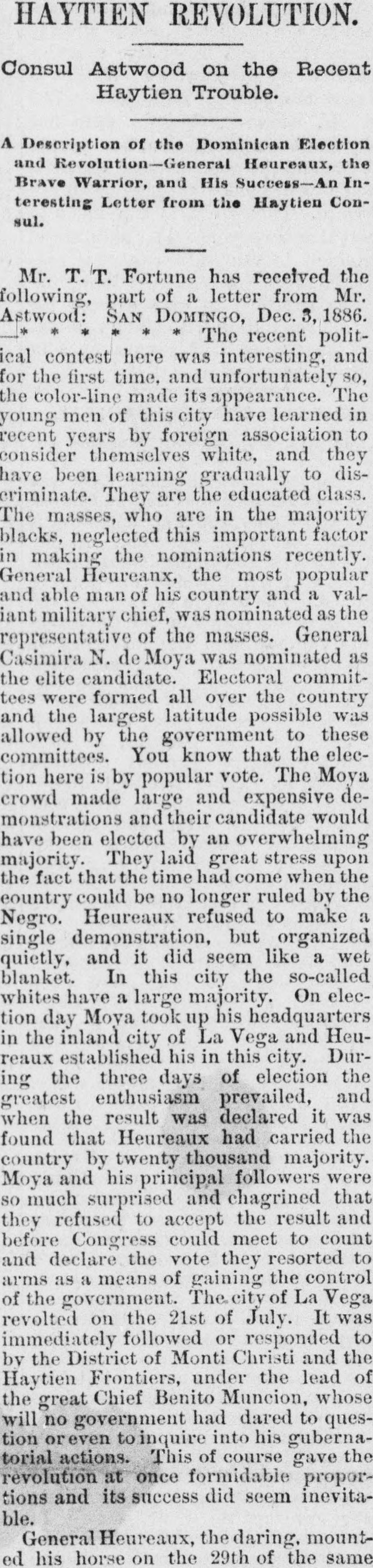
In a letter dated December 3, 1886, Haytien Consul Mr. Astwood reported to Mr. T. T. Fortune on the Dominican political contest, noting that the color-line made its appearance for the first time as educated young men influenced by foreign association discriminated against the black majority. The election featured General Heureaux representing the masses and General Casimira N. de Moya representing the elite candidate, with the Moya faction making large demonstrations and expected to win by an overwhelming majority through popular vote.En una misiva fechada el 3 de diciembre de 1886, el cónsul estadounidense en Santo Domingo, Sr. Astwood, comunicó a T. T. Fortune pormenores de la disputa política dominicana, destacando que el prejuicio de color se manifestaba por primera vez ante la actitud de jóvenes letrados influidos por costumbres foráneas que discriminaban a la masa negra. La contienda enfrentaba al general Heureaux, personero de las clases populares, con el general Casimiro N. de Moya, adalid de las élites, exhibiendo la facción moyerista imponentes alardes y confiando en imponerse por abrumador sufragio popular.
FULL TEXT:TEXTO COMPLETO:
The Cleveland Gazette January 8, 18878 de enero de 1887
Original in English.Original en inglés.
HAYTIEN REVOLUTION.REVOLUCIÓN HAITIANA.
Consul Astwood on the Recent Haytien Trouble.El cónsul Astwood sobre el reciente conflicto haitiano.
A Description of the Dominican Election and Revolution—General Heureaux, the Brave Warrior, and His Success—An Interesting Letter from the Haytien Consul.Una descripción de las elecciones y la revolución dominicanas—El general Heureaux, el valiente guerrero, y su éxito—Una interesante carta del cónsul haitiano.
Mr. T. T. Fortune has received the following, part of a letter from Mr. Astwood: SAN DOMINGO, Dec. 3, 1886. —* * * * * * The recent political contest here was interesting, and for the first time, and unfortunately so, the color-line made its appearance. The young men of this city have learned in recent years by foreign association to consider themselves white, and they have been learning gradually to discriminate. They are the educated class. The masses, who are in the majority blacks, neglected this important factor in making the nominations recently. General Heureanx, the most popular and able man of his country and a valiant military chief, was nominated as the representative of the masses. General Casimira N. de Moya was nominated as the elite candidate. Electoral committees were formed all over the country and the largest latitude possible was allowed by the government to these committees. You know that the election here is by popular vote. The Moya crowd made large and expensive demonstrations and their candidate would have been elected by an overwhelming majority. They laid great stress upon the fact that the time had come when the country could be no longer ruled by the Negro. Heureaux refused to make a single demonstration, but organized quietly, and it did seem like a wet blanket. In this city the so-called whites have a large majority. On election day Moya took up his headquarters in the inland city of La Vega and Heureaux established his in this city. During the three days of election the greatest enthusiasm prevailed, and when the result was declared it was found that Heureaux had carried the country by twenty thousand majority. Moya and his principal followers were so much surprised and chagrined that they refused to accept the result and before Congress could meet to count and declare the vote they resorted to arms as a means of gaining the control of the government. The city of La Vega revolted on the 21st of July. It was immediately followed or responded to by the District of Monti Christi and the Haytien Frontiers, under the lead of the great Chief Benito Muncion, whose will no government had dared to question or even to inquire into his gubernatorial actions. This of course gave the revolution at once formidable proportions and its success did seem inevitable.El Sr. T. T. Fortune ha recibido lo siguiente, parte de una carta del Sr. Astwood: SANTO DOMINGO, 3 de diciembre de 1886. —* * * * * * La reciente contienda política aquí fue interesante y, por primera vez y desafortunadamente, la barrera del color hizo su aparición. Los jóvenes de esta ciudad han aprendido en años recientes, mediante el trato con extranjeros, a considerarse blancos, y han ido aprendiendo gradualmente a discriminar. Ellos constituyen la clase educada. Las masas, que en su mayoría son negras, pasaron por alto este factor importante al hacer las nominaciones recientemente. El general Heureanx, el hombre más popular y capaz de su país y un valiente jefe militar, fue nominado como el representante de las masas. El general Casimira N. de Moya fue nominado como el candidato de la élite. Se formaron comités electorales en todo el país y el gobierno otorgó la mayor libertad posible a estos comités. Usted sabe que las elecciones aquí son por voto popular. La multitud de Moya hizo grandes y costosas manifestaciones y su candidato habría sido elegido por una abrumadora mayoría. Hicieron gran hincapié en el hecho de que había llegado el momento en que el país ya no podía ser gobernado por el negro. Heureaux se negó a hacer una sola manifestación, pero se organizó discretamente, y aquello pareció ser un jarro de agua fría. En esta ciudad, los llamados blancos tienen una gran mayoría. El día de las elecciones, Moya estableció su cuartel general en la ciudad interior de La Vega y Heureaux estableció el suyo en esta ciudad. Durante los tres días de las elecciones reinó el mayor entusiasmo, y cuando se proclamó el resultado, se constató que Heureaux se había impuesto en el país por una mayoría de veinte mil votos. Moya y sus principales seguidores quedaron tan sorprendidos y contrariados que se negaron a aceptar el resultado y, antes de que el Congreso pudiera reunirse para contar y declarar el voto, recurrieron a las armas como medio para obtener el control del gobierno. La ciudad de La Vega se sublevó el 21 de julio. A esto siguió o respondió de inmediato el distrito de Monti Christi y las fronteras haitianas, bajo el mando del gran jefe Benito Muncion, cuya voluntad ningún gobierno se había atrevido a cuestionar ni siquiera a indagar en sus actos de gobierno. Esto, por supuesto, otorgó de inmediato a la revolución proporciones formidables y su éxito ciertamente parecía inevitable.
General Heureaux, the daring, mounted his horse on the 29th of the same month, followed by one thousand men. His ranks were swelled all along the route and in the early days of August he surrounded the city of La Vega. The night preceding his well planned attack upon that city, Moya and his followers became alarmed and evacuated the city, taking refuge in the Mountains of Jarabacoa. Heureaux entered the city the next morning without firing a shot. The contest then became fearful, almost a hand to hand struggle, but this daring man pushed on, the enemy fleeing before him in every direction. He passed through the city of Moca, reached Santiago and then encountered Muncion with all of his forces in front of this important city, the largest and wealthiest of the country. Muncion fought desperately. He was fighting for his home and his fortune and the district that he had so despotically ruled ever since the dawn of this Republic; but he was forced to fly and took refuge across the Haytien frontiers, from which country he has gone into exile. He has by his foolish ambition lost all of the prestige he had gained in a lifetime. Heureaux's victory is complete and he stands before the country as one of the most remarkable men in connection with its history. I am glad of this. It is another evidence of the Negro's superior ability and tact whenever an equal chance is afforded him. I have written you at such great length that I must now bring my communication to a close. With my best regards to you and yours, I am with great respect, your friend, H. C. C. ASTWOOD.El general Heureaux, el osado, montó a caballo el 29 del mismo mes, seguido por mil hombres. Sus filas aumentaron a lo largo de toda la ruta y en los primeros días de agosto rodeó la ciudad de La Vega. La noche anterior a su bien planeado ataque contra esa ciudad, Moya y sus seguidores se alarmaron y evacuaron la ciudad, refugiándose en las montañas de Jarabacoa. Heureaux entró en la ciudad a la mañana siguiente sin disparar un solo tiro. La contienda se volvió entonces temible, casi una lucha cuerpo a cuerpo, pero este hombre audaz avanzó, huyendo el enemigo ante él en todas direcciones. Pasó por la ciudad de Moca, llegó a Santiago y luego se enfrentó a Muncion con todas sus fuerzas frente a esta importante ciudad, la más grande y rica del país. Muncion luchó desesperadamente. Estaba luchando por su hogar y su fortuna y por el distrito que tan despóticamente había gobernado desde los albores de esta República; pero se vio obligado a huir y se refugió al otro lado de las fronteras haitianas, país desde el cual ha partido al exilio. Por su insensata ambición ha perdido todo el prestigio que había ganado a lo largo de toda una vida. La victoria de Heureaux es completa y se presenta ante el país como uno de los hombres más notables relacionados con su historia. Me alegro de esto. Es una prueba más de la capacidad y el tacto superiores del negro siempre que se le brinda una oportunidad equitativa. Le he escrito con tanta extensión que ahora debo poner fin a mi comunicación. Con mis mejores saludos para usted y los suyos, quedo con gran respeto, su amigo, H. C. C. ASTWOOD.