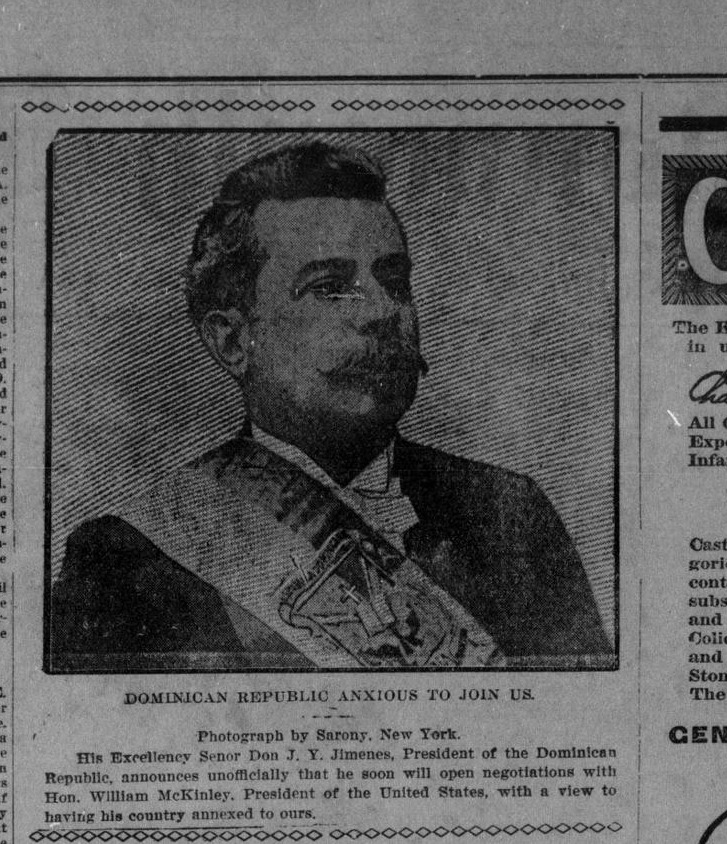
Profiles · Dominican RepublicPerfiles · República Dominicana
Juan Isidro Jimenes
President of the Dominican Republic (1899-1902, 1914-1916); the merchant-president whose second resignation opened the way to the United States occupation.Presidente de la República Dominicana (1899-1902, 1914-1916); el presidente comerciante cuya segunda renuncia abrió el camino a la ocupación de los Estados Unidos.
Also printed as: Jimenez · Jiminez · Juan Isidoro JimenezTambién impreso como: Jimenez · Jiminez · Juan Isidoro Jimenez
Jimenes, a wealthy Cibao merchant, was the civilian face of the generation that fought Heureaux. President from 1899 to 1902, he was driven out by his own vice president, Vásquez; the revolution of 1903 that fought in his name opens this archive's collapse years. Elected again in 1914, he governed a republic whose customs were already in American hands, and in May 1916, with his war minister in revolt and United States warships offshore, he resigned. His resignation is the hinge of the archive: weeks later the United States proclaimed a military government that lasted eight years.Jimenes, acaudalado comerciante del Cibao, fue el rostro civil de la generación que combatió a Heureaux. Presidente de 1899 a 1902, fue expulsado por su propio vicepresidente, Vásquez; la revolución de 1903 que luchó en su nombre abre los años de colapso de este archivo. Electo de nuevo en 1914, gobernó una república cuyas aduanas ya estaban en manos estadounidenses, y en mayo de 1916, con su ministro de Guerra en rebeldía y buques de guerra de los Estados Unidos frente a la costa, renunció. Su renuncia es la bisagra del archivo: semanas después, los Estados Unidos proclamaron un gobierno militar que duró ocho años.
The exile's expeditionsLas expediciones del exiliado
He enters this archive as a revolutionary general. In June 1898 the papers reported an armed revolt against President Heureaux led by General Juan Isidro Jimenes, with rebel columns advancing on Puerto Plata and Santiago de los Caballeros — The Herald, June 4, 1898. The expedition had come by sea, aboard the steamer Fanita, and it failed: President Heureaux traveled to Great Inagua and personally made a charge of piracy against Señor Jimenes, who had previously been released on bail under a charge of violating the navigation laws, and Heureaux believed he had proof the vessel had left the United States with the countenance of the American government — New-York Tribune, June 10, 1898.Entra en este archivo como general revolucionario. En junio de 1898, los periódicos informaron de una revuelta armada contra el presidente Heureaux encabezada por el general Juan Isidro Jimenes, con columnas rebeldes que avanzaban sobre Puerto Plata y Santiago de los Caballeros — The Herald, 4 de junio de 1898. La expedición había llegado por mar, a bordo del vapor Fanita, y fracasó: el presidente Heureaux viajó a Gran Inagua y presentó personalmente una acusación de piratería contra el señor Jimenes, que antes había sido liberado bajo fianza acusado de violar las leyes de navegación, y Heureaux creía tener pruebas de que el buque había salido de los Estados Unidos con la anuencia del gobierno estadounidense — New-York Tribune, 10 de junio de 1898.
The government kept watching the frontier for him. In April 1899 Port-au-Prince reported that the Dominican government was massing troops on the frontier for fear of an invasion by Juan Jiménez from St. Marc, and that Jiménez himself was in St. Thomas — Alexandria Gazette, April 6, 1899. In May, Jimenes published his own explanation of why his last revolution had failed, under the form of an appeal to the Dominican people — New-York Tribune, May 21, 1899. When Heureaux was assassinated that July, one paper summed up the exile's standing career: Juan Jiminez, a former merchant of Monte Cristi and a permanent candidate for the presidency, named as one of the chief troublemakers of a republic long disturbed by dissensions and revolutionary movements — Foster's Daily Democrat, July 28, 1899.El gobierno siguió vigilando la frontera por él. En abril de 1899, Puerto Príncipe informó que el gobierno dominicano concentraba tropas en la frontera por temor a una invasión de Juan Jiménez desde San Marcos, y que el propio Jiménez estaba en Santo Tomás — Alexandria Gazette, 6 de abril de 1899. En mayo, Jimenes publicó su propia explicación de por qué había fracasado su última revolución, en forma de un llamamiento al pueblo dominicano — New-York Tribune, 21 de mayo de 1899. Cuando Heureaux fue asesinado ese julio, un periódico resumió la carrera permanente del exiliado: Juan Jiminez, antiguo comerciante de Monte Cristi y candidato permanente a la presidencia, nombrado como uno de los principales perturbadores de una república largo tiempo agitada por disensiones y movimientos revolucionarios — Foster's Daily Democrat, 28 de julio de 1899.
Heureaux fallsCae Heureaux
Heureaux was shot at Moca in late July 1899, and the exiles moved at once. A dispatch from Cape Haitien reported that Dominican exiles there rejoiced once the news of the president's death was confirmed, and were preparing to arm themselves and enter Santo Domingo, where they expected their chief, Juan Isidro Jimenez, to join them — The Florida Times Union, July 29, 1899. Jimenes was still in Havana on August 8, saying that several Dominican generals had already declared in his favor and asserting that the present executive would not be able to make effective resistance — New-York Tribune, August 9, 1899.Heureaux fue baleado en Moca a fines de julio de 1899, y los exiliados se movieron enseguida. Un despacho de Cabo Haitiano informó que los exiliados dominicanos allí se regocijaron al confirmarse la noticia de la muerte del presidente, y se preparaban para armarse y entrar en Santo Domingo, donde esperaban que su jefe, Juan Isidro Jimenez, se les uniera — The Florida Times Union, 29 de julio de 1899. Jimenes seguía en La Habana el 8 de agosto, diciendo que varios generales dominicanos ya se habían declarado a su favor y afirmando que el ejecutivo actual no podría oponer una resistencia efectiva — New-York Tribune, 9 de agosto de 1899.
The revolution spread faster than the government could answer it. Government troops sent against General Pacheco at Dajabón deserted to him, the revolutionists became masters of the Yaque crossings, Monte Cristi was cut off from the interior, and news from all parts of the republic favored Jiménez — The Semi-Weekly Messenger, August 11, 1899. On August 31, advices from Cape Haytien confirmed that President Figuereo had abdicated, reportedly in favor of Jimenez — Santa Fe New Mexican, August 31, 1899. Horacio Vásquez, made provisional president by the chiefs of the revolution, declared himself ready to deliver up control to General Juan Isidro Jimenez — New York Journal and Advertiser, September 3, 1899, and on Tuesday, September 13, Jimenes arrived in the capital aboard the Dominican warship Presidente, to great festivities and expressions of satisfaction — The Manitowoc Pilot, September 14, 1899. The permanent candidate was now the prospective president: a wealthy native whom Heureaux had expatriated several years earlier, returned at the head of a powerful band of revolutionists — The Bourbon News, October 6, 1899.La revolución se extendió más rápido de lo que el gobierno pudo responder. Las tropas gubernamentales enviadas contra el general Pacheco en Dajabón desertaron hacia él, los revolucionarios se hicieron dueños de los pasos del Yaque, Monte Cristi quedó incomunicada del interior, y las noticias de todas partes de la república favorecían a Jiménez — The Semi-Weekly Messenger, 11 de agosto de 1899. El 31 de agosto, noticias de Cabo Haitiano confirmaron que el presidente Figuereo había abdicado, según se informó, a favor de Jimenez — Santa Fe New Mexican, 31 de agosto de 1899. Horacio Vásquez, hecho presidente provisional por los jefes de la revolución, se declaró listo para entregar el control al general Juan Isidro Jimenez — New York Journal and Advertiser, 3 de septiembre de 1899, y el martes 13 de septiembre Jimenes llegó a la capital a bordo del buque de guerra dominicano Presidente, entre grandes festejos y expresiones de satisfacción — The Manitowoc Pilot, 14 de septiembre de 1899. El candidato permanente era ahora el presidente prospectivo: un acaudalado nativo a quien Heureaux había expatriado varios años antes, de regreso al frente de una poderosa banda de revolucionarios — The Bourbon News, 6 de octubre de 1899.
First presidency, first fallPrimera presidencia, primera caída
A traveler who reached the republic in November 1900 described the peaceful transition of power that had followed the assassination of President Heureaux and the enthusiastic election of President Juan Isidro Jimenes — The Indianapolis Journal, November 25, 1900. A magazine survey of the same season filled in the world he governed: eighteen years of despotism and bond-broker rule, the customs held by a foreign corporation, and Jiménez's years of exile, when his secret correspondence had traveled hidden in coffee-sample tins — The Independent, November 30, 1900.Un viajero que llegó a la república en noviembre de 1900 describió la pacífica transición de poder que había seguido al asesinato del presidente Heureaux y la entusiasta elección del presidente Juan Isidro Jimenes — The Indianapolis Journal, 25 de noviembre de 1900. Un examen de revista de la misma temporada completó el mundo que gobernaba: dieciocho años de despotismo y gobierno de corredores de bonos, las aduanas en manos de una corporación extranjera, y los años de exilio de Jiménez, cuando su correspondencia secreta había viajado escondida en latas de muestras de café — The Independent, 30 de noviembre de 1900.
The foreign corporation was the business of his second year. In January 1901 Dr. Francisco Henríquez y Carvajal, the Dominican minister of foreign affairs, arrived in New York as a special commissioner appointed by President Jimenes, to present to the State Department at Washington Santo Domingo's case in its controversy with the San Domingo Improvement Company — New-York Tribune, January 31, 1901.La corporación extranjera fue el asunto de su segundo año. En enero de 1901, el Dr. Francisco Henríquez y Carvajal, ministro de Relaciones Exteriores dominicano, llegó a Nueva York como comisionado especial nombrado por el presidente Jimenes, para presentar al Departamento de Estado en Washington el caso de Santo Domingo en su controversia con la San Domingo Improvement Company — New-York Tribune, 31 de enero de 1901.
The end came from inside his own government. In May 1902 the Minneapolis Journal reported that Vice President Horacio Vásquez had broken with President Juan Isidro Jimenes over detrimental financial contracts and had successfully captured the capital, and that President Jimenes had sought asylum in the French consulate — The Minneapolis Journal, May 5, 1902. Vásquez had overthrown the government after field operations of less than two weeks, turning against Jimenes, his friends said, because of contracts the president had made to the financial injury of the republic — Bismarck Daily Tribune, May 6, 1902.El fin vino de dentro de su propio gobierno. En mayo de 1902, el Minneapolis Journal informó que el vicepresidente Horacio Vásquez había roto con el presidente Juan Isidro Jimenes por contratos financieros perjudiciales y había capturado la capital, y que el presidente Jimenes había buscado asilo en el consulado francés — The Minneapolis Journal, 5 de mayo de 1902. Vásquez había derrocado al gobierno tras operaciones de campaña de menos de dos semanas, volviéndose contra Jimenes, decían sus amigos, por contratos que el presidente había hecho en perjuicio financiero de la república — Bismarck Daily Tribune, 6 de mayo de 1902.
The revolution in his nameLa revolución en su nombre
Within eighteen months the exiles were moving again. In November 1903 the Star printed an account of the exiles' expedition from Cuba: they had decided to cooperate with a general uprising along the frontier of Haiti, taking in the towns of Monte Cristi, Dajabón and Guayubín, and extending to Santiago — Evening Star, November 16, 1903. A Puerto Plata dispatch of November 25 reported that the capital had capitulated to the revolutionary forces, that salutes of twenty-one guns were fired throughout the country, and that there was great rejoicing — The Monmouth Inquirer, November 26, 1903. The Wichita Daily Eagle announced General Juan Isidro Jiminez, on the word of Cape Haytien dispatches, as the new president of San Domingo, a man who was not a novice in the business of revolutions and who had been president before — The Wichita Daily Eagle, November 24, 1903.En dieciocho meses, los exiliados se movían otra vez. En noviembre de 1903, el Star publicó una relación de la expedición de los exiliados desde Cuba: habían decidido cooperar con un levantamiento general a lo largo de la frontera de Haití, abarcando los pueblos de Monte Cristi, Dajabón y Guayubín, y extendiéndose hasta Santiago — Evening Star, 16 de noviembre de 1903. Un despacho de Puerto Plata del 25 de noviembre informó que la capital había capitulado ante las fuerzas revolucionarias, que se dispararon salvas de veintiún cañonazos en todo el país, y que hubo gran regocijo — The Monmouth Inquirer, 26 de noviembre de 1903. El Wichita Daily Eagle anunció al general Juan Isidro Jiminez, según despachos de Cabo Haitiano, como el nuevo presidente de San Domingo, un hombre que no era novato en el negocio de las revoluciones y que ya había sido presidente — The Wichita Daily Eagle, 24 de noviembre de 1903.
The presidency, however, went to his ally. A later account of General Carlos F. Morales's career laid out the bargain: there had been an understanding between General Morales and General Jiménez that if the movement was successful, Jiménez was again to take the presidency; the rebellion triumphed, but Morales reached the capital before Jiménez and declared himself president, notwithstanding the agreement — New-York Tribune, June 1, 1907. By January 1904 the inhabitants of the city of Santo Domingo had declared that they would stand by President Morales and would under no consideration permit Jimenez to assume the presidency — Evening Star, January 27, 1904.La presidencia, sin embargo, fue para su aliado. Una relación posterior de la carrera del general Carlos F. Morales expuso el pacto: había existido un entendimiento entre el general Morales y el general Jiménez de que, si el movimiento triunfaba, Jiménez tomaría de nuevo la presidencia; la rebelión triunfó, pero Morales llegó a la capital antes que Jiménez y se declaró presidente, a pesar del acuerdo — New-York Tribune, 1 de junio de 1907. Para enero de 1904, los habitantes de la ciudad de Santo Domingo habían declarado que respaldarían al presidente Morales y que bajo ninguna consideración permitirían que Jimenez asumiera la presidencia — Evening Star, 27 de enero de 1904.
In April 1904 the deposed president arrived in New York and disputed the new government's account of the country. President Morales had not subdued the province of Monte Cristi, Jimenes declared, and parts of the interior were resisting the president's control; he alleged that he was in the United States to rest, and not to buy arms and ammunition, and the paper noted that his statements did not agree with the reports made to the State Department, which held that Morales had the situation well under control — The Washington Times, April 12, 1904.En abril de 1904, el presidente depuesto llegó a Nueva York y disputó la versión del nuevo gobierno sobre el país. El presidente Morales no había sometido la provincia de Monte Cristi, declaró Jimenes, y partes del interior resistían el control del presidente; alegó que estaba en los Estados Unidos para descansar, y no para comprar armas y municiones, y el periódico notó que sus declaraciones no coincidían con los informes hechos al Departamento de Estado, según los cuales Morales tenía la situación bien bajo control — The Washington Times, 12 de abril de 1904.
Exile, againEl exilio, otra vez
The reports of his return kept coming, and kept dissolving. In January 1906 the Springfield Weekly Republican reported that former President Juan Isidro Jimenes had traveled to Monte Cristi to seek the presidency, with the backing of the fugitive President Morales and broad support in the north — Springfield Weekly Republican, January 12, 1906. That summer a correction ran in the other direction: General Berroa, arrived from Turks Island, stated that General Jimenez was still in Ponce, Puerto Rico, and that it was General Mauricio Jimenez, a different man who shared his surname, who had taken command of the insurgents, and not the ex-president, as had been announced from Washington — The Evening Times, June 30, 1906. By September, an insurrection was underway in the Dominican Republic to restore former President Juan Isidro Jiménez to power, with numerous supporters active in New York — The Evening Times, September 12, 1906.Los informes de su regreso siguieron llegando, y siguieron disolviéndose. En enero de 1906, el Springfield Weekly Republican informó que el expresidente Juan Isidro Jimenes había viajado a Monte Cristi a buscar la presidencia, con el respaldo del fugitivo presidente Morales y un amplio apoyo en el norte — Springfield Weekly Republican, 12 de enero de 1906. Ese verano corrió una corrección en sentido contrario: el general Berroa, llegado de la isla de Turcas, declaró que el general Jimenez seguía en Ponce, Puerto Rico, y que era el general Mauricio Jimenez, un hombre distinto que compartía su apellido, quien había tomado el mando de los insurgentes, y no el expresidente, como se había anunciado desde Washington — The Evening Times, 30 de junio de 1906. Para septiembre, una insurrección estaba en marcha en la República Dominicana para restaurar en el poder al expresidente Juan Isidro Jiménez, con numerosos partidarios activos en Nueva York — The Evening Times, 12 de septiembre de 1906.
Four years later he was still in the exile circle in Puerto Rico. In December 1910 the Tribune reported that two former presidents of the Dominican Republic, General Carlos Morales and General Juan Isidro Jimenez, were both in exile there, as bitter in their enmity to President Cáceres as General Deschamps, whose arrival from Puerto Rico was viewed as the harbinger of an insurrection to depose Cáceres — New-York Tribune, December 15, 1910.Cuatro años después seguía en el círculo del exilio en Puerto Rico. En diciembre de 1910, el Tribune informó que dos expresidentes de la República Dominicana, el general Carlos Morales y el general Juan Isidro Jimenez, estaban ambos exiliados allí, tan amargos en su enemistad hacia el presidente Cáceres como el general Deschamps, cuya llegada desde Puerto Rico era vista como el anuncio de una insurrección para deponer a Cáceres — New-York Tribune, 15 de diciembre de 1910.
President again, and the resignationPresidente otra vez, y la renuncia
The return, when it came, came by election. Juan Isidro Jiminez, proclaimed president of the Dominican Republic by the National Congress on December 4, 1914, took the oath of office the next day, and quiet prevailed throughout the country; the dispatch noted that a recent election had been held under the supervision of an American commission selected by the State Department, and that opponents of Jiminez in control of Congress had for a time declined to hold a session, so that the new president, who was to have assumed office on November 30, could not appear to take the oath — The Montgomery Advertiser, December 6, 1914. His appointments carried his surname twice over: Enrique Jimenes, his nephew, was appointed Dominican minister at Washington — Evening Star, December 10, 1914, and in September 1915 he appointed José Manuel Jimenes, who had served as minister of public works and of the interior in previous cabinets, as minister of the interior — Evening Star, September 12, 1915.El regreso, cuando llegó, llegó por elección. Juan Isidro Jiminez, proclamado presidente de la República Dominicana por el Congreso Nacional el 4 de diciembre de 1914, prestó juramento al día siguiente, y la quietud reinaba en todo el país; el despacho notó que una elección reciente se había celebrado bajo la supervisión de una comisión estadounidense seleccionada por el Departamento de Estado, y que los opositores de Jiminez, en control del Congreso, se habían negado por un tiempo a sesionar, de modo que el nuevo presidente, que debía haber asumido el cargo el 30 de noviembre, no pudo presentarse a juramentar — The Montgomery Advertiser, 6 de diciembre de 1914. Sus nombramientos llevaron su apellido por partida doble: Enrique Jimenes, su sobrino, fue nombrado ministro dominicano en Washington — Evening Star, 10 de diciembre de 1914, y en septiembre de 1915 nombró a José Manuel Jimenes, que había servido como ministro de Obras Públicas y del Interior en gabinetes anteriores, como ministro del Interior — Evening Star, 12 de septiembre de 1915.
His second presidency ended in a week of dispatches. The Chamber of Deputies impeached General Juan I. Jimenez for an alleged violation of the constitution regarding the budget — El Paso Herald, May 2, 1916. Declaring the capital in a state of siege, he transferred the seat of government to San Geronimo, while Washington considered the impeachment a disguised revolution and held Rear Admiral Caperton under broad instructions to maintain the constitutional government — The Laramie Republican, May 4, 1916; Caperton was authorized to use military force, including landing marines and bluejackets, to maintain the constitutional government of President Jimenes — Evening Public Ledger, May 5, 1916. On May 8 the El Paso Herald announced that General Juan Jimenez, president of the Dominican Republic, had resigned from office, his resignation tendered in order to avoid armed intervention by the United States — El Paso Herald, May 8, 1916.Su segunda presidencia terminó en una semana de despachos. La Cámara de Diputados acusó al general Juan I. Jimenez por una presunta violación de la constitución en relación con el presupuesto — El Paso Herald, 2 de mayo de 1916. Declarando la capital en estado de sitio, trasladó la sede del gobierno a San Gerónimo, mientras Washington consideraba la acusación una revolución disfrazada y mantenía al contralmirante Caperton bajo amplias instrucciones de sostener el gobierno constitucional — The Laramie Republican, 4 de mayo de 1916; Caperton fue autorizado a usar la fuerza militar, incluido el desembarco de marines e infantes de marina, para sostener el gobierno constitucional del presidente Jimenes — Evening Public Ledger, 5 de mayo de 1916. El 8 de mayo, el El Paso Herald anunció que el general Juan Jimenez, presidente de la República Dominicana, había renunciado al cargo, renuncia presentada para evitar la intervención armada de los Estados Unidos — El Paso Herald, 8 de mayo de 1916.
The intervention he had resigned to avoid arrived without him. On May 16, American marines entered the capital and occupied the center of the city without opposition; the rebel forces had evacuated the city on Saturday night, following Minister W. W. Russell's warning — Norwich Bulletin, May 16, 1916. In July, Congress proclaimed Federico Henríquez Carvajal provisional president of Santo Domingo in succession to Juan Isidoro Jimenez — Evening Star, July 26, 1916.La intervención que había renunciado para evitar llegó sin él. El 16 de mayo, los marines estadounidenses entraron en la capital y ocuparon el centro de la ciudad sin oposición; las fuerzas rebeldes habían evacuado la ciudad el sábado por la noche, tras la advertencia del ministro W. W. Russell — Norwich Bulletin, 16 de mayo de 1916. En julio, el Congreso proclamó a Federico Henríquez Carvajal presidente provisional de Santo Domingo en sucesión de Juan Isidoro Jimenez — Evening Star, 26 de julio de 1916.
The last portrait the papers draw of him is a quiet one. In November 1916, General Juan Isidro Jiménez, former president of the Dominican Republic, arrived in the mountains near Wernersville, Pennsylvania, seeking rest for his nerves, accompanied by his wife and his daughter Carmela; he was almost seventy, he had been president of Santo Domingo off and on for five years, and he would not talk Latin-American politics — Askov American, November 9, 1916. His name surfaces once more in this archive a generation later, printed in reverse, when the Evening Star recalled that Dr. Francisco J. Peynado had been minister of justice and public instruction in the governments of Dr. Ramón Báez and of Juan Jiminez Isidro — Evening Star, April 28, 1938.El último retrato que los periódicos dibujan de él es uno tranquilo. En noviembre de 1916, el general Juan Isidro Jiménez, expresidente de la República Dominicana, llegó a las montañas cercanas a Wernersville, Pensilvania, en busca de descanso para sus nervios, acompañado de su esposa y su hija Carmela; tenía casi setenta años, había sido presidente de Santo Domingo de forma intermitente durante cinco años, y no quería hablar de política latinoamericana — Askov American, 9 de noviembre de 1916. Su nombre aflora una vez más en este archivo una generación después, impreso al revés, cuando el Evening Star recordó que el Dr. Francisco J. Peynado había sido ministro de Justicia e Instrucción Pública en los gobiernos del Dr. Ramón Báez y de Juan Jiminez Isidro — Evening Star, 28 de abril de 1938.
In this archiveEn este archivo
Eight reports that carry his story in this collection, from the first expedition of 1898 to the last echoes of 1938:Ocho reportajes que cargan su historia en esta colección, de la primera expedición de 1898 a los últimos ecos de 1938:
Garcia, another Dominician leader, is said to be taking part In the revolutionEl *Indianapolis Journal* informó que fuerzas insurgentes encabezadas por los generales Morales
The *Indianapolis Journal* reported that insurgent forces led by Generals Morales and Villanueva were advancing on Puerto Plata and Santiago de lEl *Indianapolis Journal* informó que fuerzas insurgentes encabezadas por los generales Morales y Villanueva avanzaban sobre Puerto Plata y Santi
Assassination of Heureaux. The Work of an AvengerEl Union publica un despacho de Cabo Haitiano del 28 de julio con los detalles del asesinato: e
The Union prints a Cape Haytien dispatch of July 28 with the details of the murder: General Ulysses Heureaux, president of the Dominican republicEl Union publica un despacho de Cabo Haitiano del 28 de julio con los detalles del asesinato: el general Ulises Heureaux, presidente de la repúbl
The Dominican Revolt.El Dispatch publica el despacho de Cabo Haitiano del 10 de agosto: el general Francisco Liriano
The Dispatch prints the Cape Haytien dispatch of August 10: General Francisco Liriano, sent from Monte Cristi by the Dominican government to attaEl Dispatch publica el despacho de Cabo Haitiano del 10 de agosto: el general Francisco Liriano, enviado desde Monte Cristi por el gobierno domin
Continuing an account of Dominican politics, The Greenville Times discussesContinuando un relato sobre la política dominicana, The Greenville Times aborda la presidencia
Continuing an account of Dominican politics, The Greenville Times discusses the presidency of Don Juan Isidro Jimenes, a wealthy native of the isContinuando un relato sobre la política dominicana, The Greenville Times aborda la presidencia de Don Juan Isidro Jimenes, un acaudalado nativo d
The Eagle prints an editorial on General Juan Isidro JiminezEl Eagle publica un editorial sobre el general Juan Isidro Jiménez, a quien los despachos de Ca
The Eagle prints an editorial on General Juan Isidro Jiminez, whom Cape Haytien dispatches announce as the new president of San Domingo: he is noEl Eagle publica un editorial sobre el general Juan Isidro Jiménez, a quien los despachos de Cabo Haitiano anuncian como el nuevo presidente de S
The Advertiser prints a New York item: Gen. Isidro JimenezEl Advertiser publica una nota de Nueva York: el general Isidro Jiménez, expresidente de la Rep
The Advertiser prints a New York item: Gen. Isidro Jimenez, ex-president of the Dominican Republic, who for six months has been leading a revolutEl Advertiser publica una nota de Nueva York: el general Isidro Jiménez, expresidente de la República Dominicana, que durante seis meses ha estad
A news brief from Santo Domingo in the Grand Forks Daily Herald reportsUna breve noticia desde Santo Domingo en el Grand Forks Daily Herald informa que el general Jua
A news brief from Santo Domingo in the Grand Forks Daily Herald reports that General Juan I. Jimenez, President of the Dominican Republic, was imUna breve noticia desde Santo Domingo en el Grand Forks Daily Herald informa que el general Juan I. Jiménez, presidente de la República Dominican
Trujillo Awaits Retirement VoteIniciando con una referencia al liderazgo dominicano saliente que conservará una posición domin
Opening with a reference to outgoing Dominican leadership retaining party influence, promoting agricultural betterment, and pointing to a balanceIniciando con una referencia al liderazgo dominicano saliente que conservará una posición dominante en su partido, promoverá el mejoramiento agrí
Articles about Juan Isidro JimenesArtículos sobre Juan Isidro Jimenes · The Sun, November 10, 1888The Sun, 10 de noviembre de 1888
This profile is sewn entirely from the articles in this archive. Every episode is cited to the newspaper and the date that reported it; where the papers disagree, the disagreement is left standing as part of the record. The papers in this archive disagree on the date of his impeachment by the Chamber of Deputies: May 1, 1916, May 2, 1916. No portrait of Juan Isidro Jimenes that this archive can verify as public domain has been found, so this page carries none.Este perfil está cosido por completo de los artículos de este archivo. Cada episodio se cita con el periódico y la fecha que lo reportó; donde los periódicos discrepan, la discrepancia se deja en pie como parte del registro. Los periódicos de este archivo difieren en la fecha de su acusación por la Cámara de Diputados: 1 de mayo de 1916, 2 de mayo de 1916. No se ha encontrado ningún retrato de Juan Isidro Jimenes que este archivo pueda verificar como de dominio público, así que esta página no lleva ninguno.
ProfilesPerfiles: Juan Francisco SánchezJuan Francisco Sánchez