Profiles · Dominican RepublicPerfiles · República Dominicana
Ramfis Trujillo
Son of Rafael Trujillo and commander of the armed forces after the assassination (1961); his hold on the army anchored the family's last months in power.Hijo de Rafael Trujillo y comandante de las fuerzas armadas tras el asesinato (1961); su control del ejército sostuvo los últimos meses de la familia en el poder.
Also printed as: Rafael Trujillo Jr. · Rafael (Ramfis) TrujilloTambién impreso como: Rafael Trujillo Jr. · Rafael (Ramfis) Trujillo
Ramfis, the dictator's eldest son, held the armed forces in the months after the assassination and used them as a throne in escrow. The record shows him threatening a coup by his generals if the OAS withheld support, accused by the opposition of blackmailing the United States, and resigning his command the day after his uncles Héctor and Arismendi flew back to attempt a restoration. He left the country in November 1961; the Era's heir ended as an exile, and died in a car crash in Spain in 1969.Ramfis, el hijo mayor del dictador, retuvo las fuerzas armadas en los meses posteriores al asesinato y las usó como un trono en depósito. El registro lo muestra amenazando con un golpe de sus generales si la OEA retiraba su apoyo, acusado por la oposición de chantajear a los Estados Unidos, y renunciando a su mando al día siguiente del regreso de sus tíos Héctor y Arismendi para intentar una restauración. Salió del país en noviembre de 1961; el heredero de la Era terminó como exiliado, y murió en un accidente de automóvil en España en 1969.
A name on the country before it was a man in itUn nombre sobre el país antes de ser un hombre en él
Ramfis enters this archive first as a name the regime had already stamped on the republic. A Washington travel page of January 1938, promoting the Dominican Republic as a year-round destination, ran its photographs with captions for the Old Jesuit College, the University of Santo Domingo, the ruins of St. Nicholas church, and Ramfis Park — The Washington Times, January 8, 1938. A philatelic column of 1941, surveying bridges pictured on the world's stamps, noted that the republic's postage showed three spans: the San Rafael, the Trujillo, and the Ramfis bridges — The Waterbury Democrat, March 11, 1941. The boy himself appears in the same years only at his parents' side: in October 1939 his mother arrived in Miami by train with her ten-year-old son and an infant daughter and boarded the general's yacht to await his arrival by airplane — Evening Star, October 6, 1939, and in December 1940 a society item recorded Señora de Trujillo reaching New York with her son Rafael and her daughter María de los Ángeles — Evening Star, December 1, 1940.Ramfis entra en este archivo primero como un nombre que el régimen ya había estampado sobre la república. Una página de viajes de Washington de enero de 1938, que promovía la República Dominicana como destino para todo el año, acompañó sus fotografías con pies sobre el antiguo Colegio de los Jesuitas, la Universidad de Santo Domingo, las ruinas de la iglesia de San Nicolás y el Parque Ramfis — The Washington Times, 8 de enero de 1938. Una columna filatélica de 1941, que repasaba los puentes ilustrados en los sellos del mundo, anotó que el correo de la república mostraba tres puentes: el San Rafael, el Trujillo y el Ramfis — The Waterbury Democrat, 11 de marzo de 1941. El niño mismo aparece en esos años solo al lado de sus padres: en octubre de 1939, su madre llegó a Miami en tren con su hijo de diez años y una hija pequeña y abordó el yate del general para esperar su llegada en avión — Evening Star, 6 de octubre de 1939, y en diciembre de 1940 una nota social registró la llegada a Nueva York de la señora de Trujillo con su hijo Rafael y su hija María de los Ángeles — Evening Star, 1 de diciembre de 1940.
The name sailed, too. General Trujillo's yacht was the Ramfis, formerly the American millionaire Julius Fleischmann's vessel, and aboard it he hosted a lavish reception at the New York World's Fair in July 1939 — Evening Star, July 6, 1939. A Washington column later recalled that the yacht, originally named the Camargo, had been one of the largest afloat when Trujillo bought it — The Washington Daily News, September 4, 1941. In March 1942 the United States Navy announced its purchase of the 968-ton yacht Ramfis from Generalissimo Rafael Trujillo for $180,000, a vessel built at a cost of $850,000 — Evening Star, March 3, 1942. The name the dictator had given his son thus went to war under an American flag, renamed by the Navy that bought it.El nombre también navegó. El yate del general Trujillo era el Ramfis, antes buque del millonario estadounidense Julius Fleischmann, y a bordo ofreció una suntuosa recepción en la Feria Mundial de Nueva York en julio de 1939 — Evening Star, 6 de julio de 1939. Una columna de Washington recordó después que el yate, llamado originalmente Camargo, había sido uno de los más grandes a flote cuando Trujillo lo compró — The Washington Daily News, 4 de septiembre de 1941. En marzo de 1942, la Armada de los Estados Unidos anunció la compra del yate Ramfis, de 968 toneladas, al generalísimo Rafael Trujillo por 180.000 dólares, un buque construido a un costo de 850.000 dólares — Evening Star, 3 de marzo de 1942. El nombre que el dictador había dado a su hijo fue así a la guerra bajo bandera estadounidense, renombrado por la Armada que lo compró.
An army major at threeMayor del ejército a los tres años
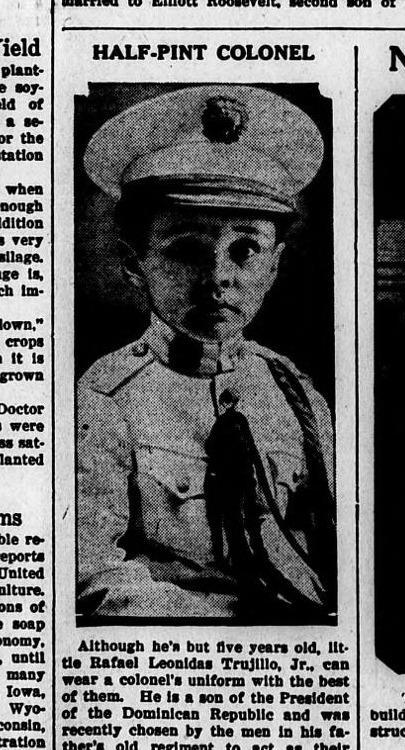
The career itself was laid out in a single profile published the day after his father's assassination. Rafael ("Ramfis") Trujillo Jr. had been earning his own living since he was three years old, when the generalissimo appointed him a major in the army; the rank was honorary, but it brought a $200-a-month salary, and the boy was an honorary colonel by the time he was seven. At sixteen he gave up his rank and enrolled in cadet school, graduating a year later as a second lieutenant; by 1950 he was a major again, colonel in 1952, major general in 1953, and in 1955, at twenty-five, lieutenant general in both the Army and the Air Force, an achievement the paper noted was all the more remarkable in that he was not a pilot — Evening Star, June 1, 1961.La carrera misma quedó expuesta en un solo perfil publicado el día después del asesinato de su padre. Rafael («Ramfis») Trujillo hijo ganaba su propio sustento desde los tres años, cuando el generalísimo lo nombró mayor del ejército; el rango era honorario, pero traía un salario de 200 dólares al mes, y el niño era coronel honorario a los siete años. A los dieciséis renunció a su rango y entró en la escuela de cadetes, de la que se graduó un año después como segundo teniente; para 1950 era mayor de nuevo, coronel en 1952, mayor general en 1953 y, en 1955, a los veinticinco años, teniente general del Ejército y de la Fuerza Aérea a la vez, un logro que el periódico anotó como tanto más notable cuanto que no era piloto — Evening Star, 1 de junio de 1961.
The profile closed on the two facts that framed his command. Because of his absences, the United States Army had refused to graduate him from the command college at Fort Leavenworth; his father promptly appointed him chief of staff of all the Dominican armed forces. And the paper recorded, of the man who now held the army of the republic his father had ruled for thirty-one years, that it was not known whether Rafael Trujillo had ever been in an actual battle or fired a shot in anger — Evening Star, June 1, 1961.El perfil cerró con los dos datos que enmarcaron su mando. Por sus ausencias, el Ejército de los Estados Unidos se había negado a graduarlo de la escuela de comando de Fort Leavenworth; su padre lo nombró en seguida jefe de estado mayor de todas las fuerzas armadas dominicanas. Y el periódico registró, del hombre que ahora retenía el ejército de la república que su padre había gobernado durante treinta y un años, que no se sabía si Rafael Trujillo había estado alguna vez en una batalla real o disparado un tiro en combate — Evening Star, 1 de junio de 1961.
Leavenworth and HollywoodLeavenworth y Hollywood
The American schooling that produced that refusal had been news in itself. In February 1958 Diario Las Américas reported Time magazine's account of Lieutenant General Rafael (Ramfis) Trujillo at the Army Command and Staff School at Fort Leavenworth: visitors forbidden on the whole ninth floor of Kansas City's Hotel Ambassador, lights and bells rigged against intrusion, a room full of pistols and tear gas bombs, a house in Leavenworth at $450 a month behind six private detectives, and a bank account of one million dollars opened on his arrival in Kansas — Diario Las Américas, February 13, 1958. His fellow students, most of them combat veterans, made fun of the security measures and of Ramfis's high rank, Time added.La escuela estadounidense que produjo esa negativa había sido noticia en sí misma. En febrero de 1958, Diario Las Américas reportó el relato de la revista Time sobre el teniente general Rafael (Ramfis) Trujillo en la Escuela de Comando y Estado Mayor del Ejército en Fort Leavenworth: visitantes prohibidos en todo el noveno piso del Hotel Ambassador de Kansas City, luces y timbres instalados contra intrusiones, una habitación llena de pistolas y bombas de gas lacrimógeno, una casa en Leavenworth a 450 dólares al mes tras seis detectives privados, y una cuenta bancaria de un millón de dólares abierta a su llegada a Kansas — Diario Las Américas, 13 de febrero de 1958. Sus compañeros de estudios, en su mayoría veteranos de combate, se burlaban de las medidas de seguridad y del alto rango de Ramfis, añadió Time.
That spring he was in Hollywood. The Key West Citizen reported the farewell of actress Kim Novak, twenty-four, and Lieutenant General Rafael Trujillo Jr., who spent half an hour saying goodbye aboard his private railroad car; the twenty-nine-year-old son of the Dominican strongman said he planned to return for Novak in July, when he finished his studies at the Army Command School in Kansas, and that a Mexican divorce from his wife would be final by then — The Key West Citizen, May 21, 1958. The spending followed him in the record: the 1961 profile put his outlays in the United States at about $1 million a year, nearly the same amount as United States annual aid to the Dominican Republic, and listed among them an $8,400 Mercedes-Benz convertible bought for Kim Novak in 1958 — Evening Star, June 1, 1961.Esa primavera estaba en Hollywood. El Key West Citizen reportó la despedida de la actriz Kim Novak, de veinticuatro años, y el teniente general Rafael Trujillo hijo, que pasaron media hora diciéndose adiós a bordo de su vagón privado; el hijo del hombre fuerte dominicano, de veintinueve años, dijo que planeaba volver por Novak en julio, cuando terminara sus estudios en la Escuela de Comando del Ejército en Kansas, y que para entonces un divorcio mexicano de su esposa sería final — The Key West Citizen, 21 de mayo de 1958. El gasto lo siguió en el registro: el perfil de 1961 situó sus desembolsos en los Estados Unidos en cerca de 1 millón de dólares al año, casi la misma cantidad que la ayuda anual estadounidense a la República Dominicana, y enumeró entre ellos un Mercedes-Benz convertible de 8.400 dólares comprado para Kim Novak en 1958 — Evening Star, 1 de junio de 1961.
The last autumnEl último otoño
After the assassination, the army he held was the family's remaining power, and the capital under his command saw the worst street fighting since May. On October 21, 1961, the unofficial toll in the clash between police and rock-hurling rioters rose to four dead and scores injured, capping five straight days of anti-government disorders throughout the country; officers had attacked stone-hurling students and workers with semi-automatic rifles, firehoses and tear gas after demonstrators paraded down a main street shouting for liberty — Evening Star, October 22, 1961. Three weeks later the opposition, led by Manuel Vaquero of the National Civic Union, was fighting any relaxation of the OAS sanctions against the regime the family still anchored — Evening Star, November 10, 1961.Tras el asesinato, el ejército que retenía era el poder restante de la familia, y la capital bajo su mando vio los peores combates callejeros desde mayo. El 21 de octubre de 1961, el saldo no oficial del choque entre policías y manifestantes que lanzaban piedras subió a cuatro muertos y decenas de heridos, al cabo de cinco días seguidos de desórdenes antigubernamentales en todo el país; los agentes habían atacado con rifles semiautomáticos, mangueras y gas lacrimógeno a estudiantes y obreros que lanzaban piedras, tras una marcha por una calle principal al grito de libertad — Evening Star, 22 de octubre de 1961. Tres semanas después, la oposición, encabezada por Manuel Vaquero, de la Unión Cívica Nacional, combatía cualquier relajación de las sanciones de la OEA contra el régimen que la familia aún sostenía — Evening Star, 10 de noviembre de 1961.
The end of his command came with his uncles' return. The Dominican Republic announced that Rafael "Ramfis" Trujillo had resigned as chief of the Dominican army on the Tuesday after Generals Héctor and Arismendi Trujillo, brothers of the assassinated dictator, returned from exile to Ciudad Trujillo, and that he had departed the country; the State Department said there was evidence the uncles hoped to take over from "Ramfis," while Secretary of State Rusk warned that leading figures of the old dictatorship appeared to be planning an attempt to reassert dictatorial domination — Evening Star, November 19, 1961. The heir who had been a major at three left the army, and the country, in the same week his father's brothers came back to claim what was left of the regime.El fin de su mando llegó con el regreso de sus tíos. La República Dominicana anunció que Rafael «Ramfis» Trujillo había renunciado como jefe del ejército dominicano el martes posterior al regreso del exilio a Ciudad Trujillo de los generales Héctor y Arismendi Trujillo, hermanos del dictador asesinado, y que había salido del país; el Departamento de Estado dijo que había evidencia de que los tíos esperaban tomar el relevo de «Ramfis», mientras el secretario de Estado Rusk advertía que figuras destacadas de la vieja dictadura parecían planear un intento de reafirmar la dominación dictatorial — Evening Star, 19 de noviembre de 1961. El heredero que había sido mayor a los tres años dejó el ejército, y el país, en la misma semana en que los hermanos de su padre volvieron a reclamar lo que quedaba del régimen.
In this archiveEn este archivo
Eight reports that carry his story in this collection, from a travel page naming Ramfis Park in 1938 to his resignation as army chief in November 1961:Ocho reportajes que cargan su historia en esta colección, de una página de viajes que nombra el Parque Ramfis en 1938 a su renuncia como jefe del ejército en noviembre de 1961:
Accompanied by captions for the Old Jesuit College, the University of SantoAcompañado de pies de foto sobre el antiguo Colegio de los Jesuitas, la Universidad de Santo Do
Accompanied by captions for the Old Jesuit College, the University of Santo Domingo, the ruins of St. Nicholas church, and Ramfis Park, an articlAcompañado de pies de foto sobre el antiguo Colegio de los Jesuitas, la Universidad de Santo Domingo, las ruinas de la iglesia de San Nicolás y e
The family of Gen. Rafael Trujillo, army chief of staff of the DominicanLa familia del general Rafael Trujillo, jefe de estado mayor del ejército de la República Domin
The family of Gen. Rafael Trujillo, army chief of staff of the Dominican Republic, arrived in Miami by train from New York and Washington and boaLa familia del general Rafael Trujillo, jefe de estado mayor del ejército de la República Dominicana, llegó a Miami por tren desde Nueva York y W
A syndicated philatelic column surveying bridge illustrationsUna columna filatélica sindicada que examina ilustraciones de puentes en sellos internacionales
A syndicated philatelic column surveying bridge illustrations on international stamps mentions that the Dominican Republic portrays three such stUna columna filatélica sindicada que examina ilustraciones de puentes en sellos internacionales menciona que la República Dominicana representa t
Sweden Still Bound to Finland, Envoy Says, Explaining AidUna columna de Washington recuerda que un par de años antes Junky vendió su yate, uno de los má
A Washington column recalls that a couple of years earlier Junky sold his yacht, one of the largest afloat, to Generalissimo Rafael Trujillo of tUna columna de Washington recuerda que un par de años antes Junky vendió su yate, uno de los más grandes a flote, al generalísimo Rafael Trujillo
Dominican Chief Sells U. S. YachtEl generalísimo Rafael Trujillo, comandante en jefe del ejército dominicano y expresidente, ven
Generalissimo Rafael Trujillo, commander-in-chief of the Dominican army and former president, has sold his 968-ton yacht Ramfis to the Navy at a El generalísimo Rafael Trujillo, comandante en jefe del ejército dominicano y expresidente, vendió su yate Ramfis de 968 toneladas a la Armada co
They'll Meet Again In July Kim, Trujillo Part With Fond FarewellLa actriz Kim Novak, de veinticuatro años, y el teniente general Rafael Trujillo hijo pasaron m
Actress Kim Novak, twenty-four, and Lieutenant General Rafael Trujillo Jr. spent half an hour saying goodbye aboard his private railroad car. TheLa actriz Kim Novak, de veinticuatro años, y el teniente general Rafael Trujillo hijo pasaron media hora despidiéndose a bordo del vagón de tren
Dominican Death Toll Rises to 4El saldo de los violentos choques entre la policía y manifestantes en Ciudad Trujillo ascendió
Casualties from violent clashes between police and stone-hurling demonstrators in Ciudad Trujillo rose to four dead and scores injured, capping fEl saldo de los violentos choques entre la policía y manifestantes en Ciudad Trujillo ascendió a cuatro muertos y decenas de heridos, culminando
Young Trujillo Quits In Dominican Crisis Rusk Warns Against New Dictatorship Effort Seen To Thwart 2 UnclesLa República Dominicana anunció oficialmente que Rafael 'Ramfis' Trujillo dimitió como jefe del
The Dominican Republic officially announced that Rafael 'Ramfis' Trujillo resigned as commander of the armed forces on Tuesday, one day after hisLa República Dominicana anunció oficialmente que Rafael 'Ramfis' Trujillo dimitió como jefe del ejército el martes, un día después del regreso de
Articles about Ramfis TrujilloArtículos sobre Ramfis Trujillo · The Washington Times, January 8, 1938The Washington Times, 8 de enero de 1938
This profile is sewn entirely from the articles in this archive. Every episode is cited to the newspaper and the date that reported it; where the papers disagree, the disagreement is left standing as part of the record. No portrait of Ramfis Trujillo that this archive can verify as public domain has been found, so this page carries none.Este perfil está cosido por completo de los artículos de este archivo. Cada episodio se cita con el periódico y la fecha que lo reportó; donde los periódicos discrepan, la discrepancia se deja en pie como parte del registro. No se ha encontrado ningún retrato de Ramfis Trujillo que este archivo pueda verificar como de dominio público, así que esta página no lleva ninguno.