The American Annexation FightLa lucha por la anexión estadounidense
After Spain withdrew, the annexation argument moved to Washington. President Ulysses S. Grant pushed a treaty in 1869 to annex the Dominican Republic and lease Samaná Bay, sent a commission in 1870, and fought for the plan in public. American newspapers argued it as an American question — destiny, race, naval strategy, and the smell of corruption — with Charles Sumner leading the opposition until the Senate killed the treaty in 1870.Después de la retirada de España, el argumento de la anexión se mudó a Washington. El presidente Ulysses S. Grant impulsó en 1869 un tratado para anexar la República Dominicana y arrendar la bahía de Samaná, envió una comisión en 1870 y peleó el plan en público. Los periódicos estadounidenses lo discutieron como una cuestión estadounidense — destino, raza, estrategia naval y olor a corrupción — con Charles Sumner al frente de la oposición hasta que el Senado enterró el tratado en 1870.
In Santo Domingo the same plan read differently. President Buenaventura Báez had bargained with the country as if it were his own property, mortgaging its revenues and offering its bay; the Dominicans who opposed him, Luperón and the exiles among them, fought annexation as the sale of the nation itself. The Senate's refusal settled the question in Washington, though lease schemes around Samaná dragged on until 1874.En Santo Domingo el mismo plan se leía de otro modo. El presidente Buenaventura Báez había negociado con el país como si fuera su propiedad, hipotecando sus ingresos y ofreciendo su bahía; los dominicanos que se le oponían, Luperón y los exiliados entre ellos, combatieron la anexión como la venta de la nación misma. La negativa del Senado cerró la cuestión en Washington, aunque los planes de arrendamiento sobre Samaná se arrastraron hasta 1874.
Two readingsDos lecturas
Notice how rarely the American debate below asks Dominicans what they want. The annexation fight was conducted in Washington newspapers and Senate speeches; the Dominican answer — the Restoration generation's flat refusal to be sold — has to be read between the lines, and against them.Note cuán rara vez el debate estadounidense que sigue pregunta a los dominicanos qué quieren. La lucha por la anexión se libró en periódicos de Washington y discursos del Senado; la respuesta dominicana — la negativa rotunda de la generación de la Restauración a ser vendida — hay que leerla entre líneas, y contra ellas.
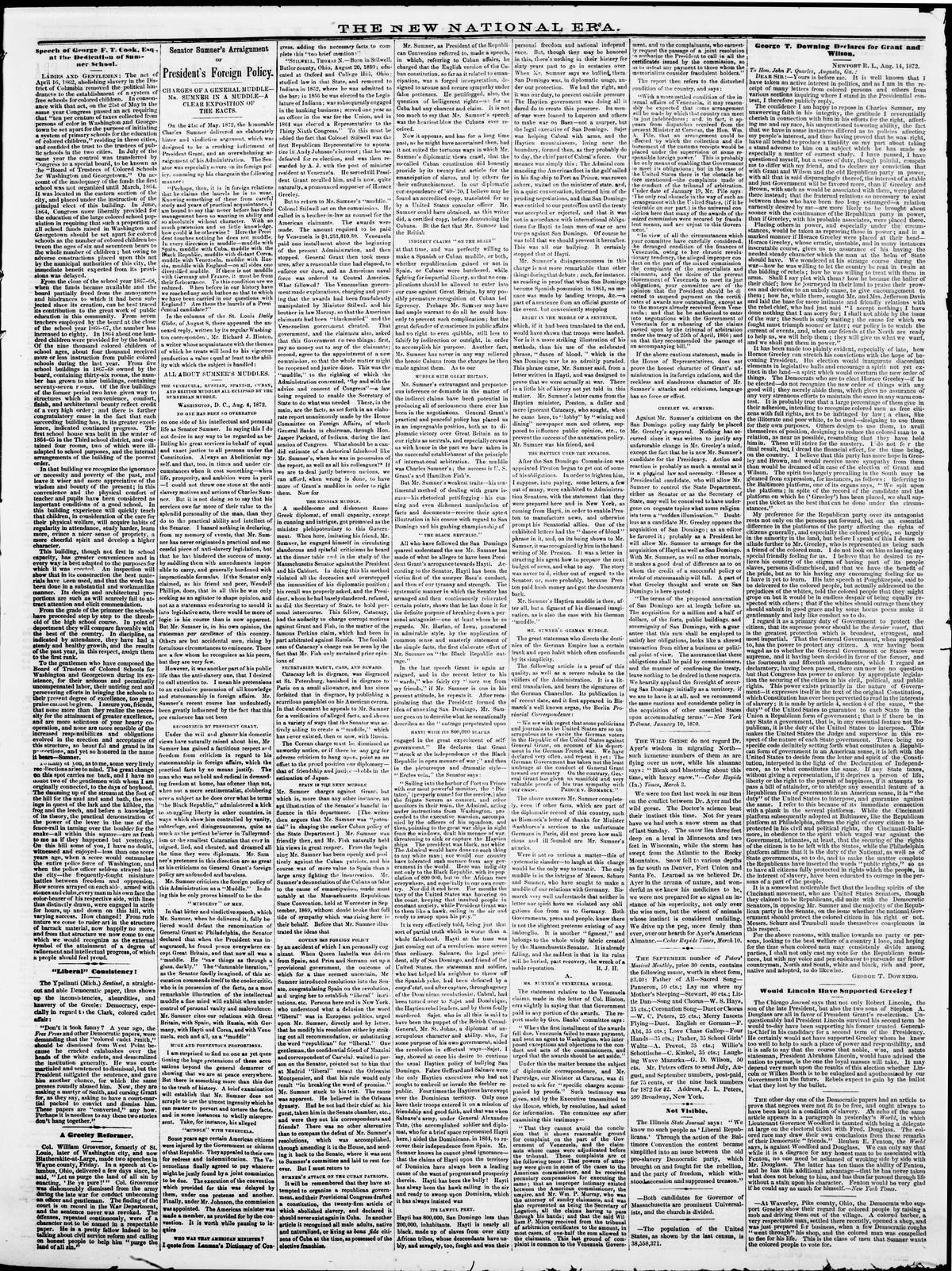
Iiayti has been the bully Hayt tas alway been the hawk
ENGLAND’S RECOGNITION OF THE DOMINICANS.
[From the Madrid Epoca, Dec. 18.] In consequence of the effect produced upon the public mind by this announcement, Sir John Crampton, the English Ambassador at this Court, felt bound to request explanations from his government upon a matter…
Vera Cruz advices represent the emperor s troops as makiugcousidcrablc pro
Part of the Belgian legion have reached Mexico, and more are expected. Vera Cruz advices represent the emperor's troops as making considerable progress against the liberals in various directions, but the news is not much to be relied on.--N…
MISCELLANEOUS NEWS.
From St. Domingo we learn that the National Convention, sitting at Santiago de los Caballeros, adjourned sine die on the 25th of March, after electing a legal government, to hold office until ninety days after the country has been evacuated…
Thus the great war against the rebellion, which all lie nations
According to The New York Herald on April 30, 1865, European monarchies were described as quaking with fear over the growing strength of the United States and its potential impact on Spanish possessions like Cuba and Porto Rico. The article specifically cited a fearful argument presented by the "Conqueror of Africa," which claimed the United States planned to send thousands of freed colored people to St. Domingo to form a negro nationality and army to ultimately attack and destroy Cuba. The newspaper dismissed this theory as a "raving of an imagination entirely possessed by fear," asserting that no dilatory measures would be needed if the United States truly intended to conquer European possessions.
Según The New York Herald del 30 de abril de 1865, las monarquías europeas temblaban de recelo ante el creciente poderío de los Estados Unidos y sus posibles repercusiones en las posesiones españolas de Cuba y Puerto Rico. El artículo citó en particular un medroso alegato esgrimido por el «Conquistador de África», quien aseguraba que los Estados Unidos proyectaban enviar a miles de libertos de color a Santo Domingo a fin de constituir una nacionalidad y un ejército negros con el propósito final de asaltar y arrasar a Cuba. El diario desestimó dicha teoría como el «desvarío de una imaginación presa del pánico», asegurando que los Estados Unidos no necesitarían recurrir a maniobras indirectas si de veras abrigaran el propósito de conquistar posesiones europeas.
Domingo correspondent makes a statement of numerous outrages committed on the
Our St. Domingo correspondent makes a statement of numerous outrages committed on the property and rights of citizens of the United States domiciled in the Dominican republic by the Spanish military forces during their invasion of that coun…
ST. DOMINGO.
Permit one who has been no inactive spectator of the events described to offer to the American people in what way your Monroe doctrine has been attacked and defended at St. Domingo. It is a matter of history that Spain, taking advantage of …
The lives of the Awerican und English Consuls had been frequently
According to the New-York Daily Tribune of August 22, 1865, the Boletin Oficial of Santiago reported on July 7 that departing Spanish troops were taking Dominican cannon and property, while a few Spanish troops still lingered in St. Domingo because Gen. Gándara and the Dominicans had not agreed on a final evacuation treaty. The Dominican government rejected a drafted treaty because Gándara's preferred language made the agreement appear to be a Spanish concession rather than a surrender, and Gándara subsequently refused to receive new commissioners unless they confirmed the objectionable treaty. Consequently, the Dominican government officially expressed its determination not to yield, signifying that the war had not ceased.
Según el New-York Daily Tribune del 22 de agosto de 1865, el Boletín Oficial de Santiago denunció el 7 de julio que las tropas españolas en retirada se llevaban cañones y propiedades dominicanas, quedando aún remanentes peninsulares en Santo Domingo debido a desacuerdos entre el general Gándara y los dominicanos sobre el tratado definitivo de evacuación. El gobierno dominicano rechazó el borrador del convenio porque los términos exigidos por Gándara hacían figurar el acuerdo como una concesión graciosa de España y no como una capitulación en regla, negándose luego Gándara a recibir nuevos comisionados si no convalidaban dicho documento objetado. Por consiguiente, el gobierno dominicano ratificó oficialmente su firme decisión de no transigir, lo que evidenciaba que las hostilidades no habían concluido.
ST. DOMINGO AFFAIRS.
NEW YORK, August 22.—The August 2d St. Thomas advice gives further particulars of the matter heretofore mentioned, regarding the new issue raised by General Gandara, the commander of the Spanish troops, with the Dominican Government, appare…
This latter Mtement Is hardly borne oot l>y the reports which
The New York Herald reported that Spanish commander General Gandam blockaded the principal ports of the Dominican Republic after the Dominican government refused his peace treaty demands, preventing the exportation of American and European tobacco. In response, the Dominicans resolved to commission privateers against Spanish commerce, sending an authorized agent to the United States and Europe to issue letters of marque. Additionally, the newspaper reported that a severe summer drought, heavy taxes, and poverty left thousands of negro laborers in Jamaica on the verge of starvation, creating fears of a local outbreak against the Governor and his officers.
The New York Herald reportó que el jefe militar español, general Gándara [Gandam en el texto], bloqueó los puertos principales de la República Dominicana tras rehusar el gobierno dominicano sus exigencias para un tratado de paz, obstaculizando la exportación de tabaco consignado a Europa y los Estados Unidos. Como réplica, los dominicanos resolvieron armar corsarios contra el tráfico mercante español, enviando un agente facultado a los Estados Unidos y a Europa para conceder patentes de corso. Por otra parte, el periódico comunicó que una persistente sequía estival, tributos gravosos y la miseria general tenían a miles de trabajadores negros en Jamaica al borde de la inanición, desatando temores de un levantamiento popular contra el gobernador colonial y sus subordinados.
Gandara, the Spanish commander, having withdrawn his troops from the Interior
The Daily Ohio Statesman reported on September 2, 1865, that Spanish commander General Gandara withdrew troops from the interior and blockaded the principal ports of the Dominican Republic after the Dominican government refused unreasonable peace treaty demands, prompting Dominicans to commission privateers against Spanish commerce. Additionally, a Kingston, Jamaica correspondent reported that revolutionists were making alarming headway, causing President Geffrard to charter a mail steamer to prepare for his escape, while severe drought and heavy taxes left Jamaican negro laborers in abject poverty and near starvation.
El Daily Ohio Statesman informó el 2 de septiembre de 1865 que el comandante español general Gándara replegó sus fuerzas del interior y bloqueó los puertos principales de la República Dominicana luego de que el gobierno dominicano rechazara desmedidas exigencias para un tratado de paz, lo que indujo a los dominicanos a armar buques corsarios contra el comercio marítimo español. Asimismo, un corresponsal en Kingston, Jamaica, informó que los revolucionarios avanzaban de forma alarmante, lo que llevó al presidente Geffrard a fletar un vapor correo para preparar su fuga, mientras que una rigurosa sequía y excesivos impuestos sumían a los peones negros de Jamaica en la indigencia y la hambruna.
The Revolution in Hayti—President Geffrard preparing to escape—Suffering among the Negroes on the Island of Jamaica—An Outbreak Feared—San Domingo Affairs.
The Herald's Kingston, Jamaica, correspondent says the progress the Haytian revolutionists are making in Hayti, has been deemed by President Geffrard as sufficiently alarming to induce him to make preparations for flight from the island. A …
News from St.
News from St. Domingo to September 9 describes Dominicans celebrating the second anniversary of their liberation from Spain, after eighteen months of fighting forced Spain to evacuate the island. General Pimentel, elected provisional president in March, became unpopular for harsh and unlawful acts, and after citizens in the capital repudiated him he resigned, while General J. M. Cabral was commissioned as Protector of the republic to summon a National Convention.
Noticias de Santo Domingo hasta el 9 de septiembre describen a los dominicanos celebrando el segundo aniversario de su liberación de España, después de que dieciocho meses de lucha obligaron a España a evacuar la isla. El general Pimentel, elegido presidente provisional en marzo, se volvió impopular por actos duros e ilegales, y después de que los ciudadanos de la capital lo repudiaron, renunció, mientras el general J. M. Cabral fue nombrado Protector de la república para convocar una Convención Nacional.
THE REPUBLIC OF SAN DOMINGO.
The Dominican Republic has arisen! No more will she be the prey to the great mother of republics. Should the Republic of Washington now turn her back, or refuse to unite the lot of this loyal American Republic, the white race will soon be e…
Well, then," said the stranger, "I am on emissary of the
An armed man abruptly entered a session of the Dominican Congress to announce the impending arrival of revolutionary forces and proclaim General Baez as president, causing the ministers to flee in terror. Following this confusion, General Pedro Guillermo was appointed dictator until Baez could arrive, and an election on December 14th unanimously named Buenaventura Baez President of the Dominican Republic. Meanwhile, Cabral accepted a military position under the new government, which Guillermo practically headed.
Un individuo armado irrumpió súbitamente en una sesión del Congreso dominicano para anunciar la inminente llegada de huestes revolucionarias y proclamar presidente al general Báez, haciendo que los ministros huyeran despavoridos. En medio del desconcierto subsiguiente, el general Pedro Guillermo fue investido como mandatario provisorio hasta la llegada de Báez, y en los comicios del 14 de diciembre se proclamó unánimemente a Buenaventura Báez presidente de la República Dominicana. Entretanto, Cabral aceptó un cargo militar bajo el nuevo régimen, que de facto encabezaba Guillermo.
Latest from Havana.
We have before us the Havana Diario de la Marina, to 7th instant. Among its official announcements we find notifications of the departure of troops meant to reinforce the garrison for the Siempre fiel Ysla. The total is between twelve and f…
The Revolution in St. Domingo.
Revolutions are sometimes brought about by singular agencies. Seldom is such means as effectual as force of arms. A recent arrival from St. Domingo furnishes the following account of the mode in which a recent revolution was accomplished, a…
A coup d'tat effected his elevation to the Presidency through the
According to The Evening Telegraph of January 30, 1866, Mr. Baez attained the presidency through a coup d'état aided by General Cabral's relinquishment of power and Pedro Guillermo's armed force. The article reports that the majority of the nation opposes Baez's administration due to his service as a Spanish Field Marshal during the independence struggle, and notes that his regime is currently jailing and persecuting suspected opponents of a thwarted uprising at Puerto Plata.
Según The Evening Telegraph del 30 de enero de 1866, el Sr. Báez ascendió a la presidencia mediante un golpe de Estado facilitado por la declinación del poder del general Cabral y el respaldo armado de Pedro Guillermo. La crónica refiere que la mayoría de los ciudadanos rechaza el gobierno de Báez en razón de su pasado como mariscal de campo al servicio de España durante la guerra de independencia, señalando asimismo que el régimen persigue y encarcela a presuntos desafectos involucrados en un frustrado alzamiento en Puerto Plata.
A reap d'etat effected hi elevation to tho 1 "residency through
Based on the provided excerpt, the newspaper reported that Mr. Baez attained the presidency through a coup d'état aided by General Cabral's relinquishment of pretensions and the armed force of Pedro Guillermo, though the majority of the nation opposed his administration. The report notes that Baez remained a Field Marshal in the pay of Spain during the struggle for independence, only resigning after the Spanish evacuation, and that his current government is persecuting and imprisoning political opponents following a recent attempt to overthrow his power at Puerto Plata.
A tenor del extracto periodístico, el rotativo expuso que el Sr. Báez accedió a la presidencia mediante un cuartelazo apuntalado por la renuncia a sus pretensiones del general Cabral y la fuerza armada de Pedro Guillermo, pese al rechazo mayoritario de la ciudadanía hacia su gestión. La noticia subrayaba que Báez conservó el rango y sueldo de mariscal de campo de España durante toda la gesta independentista, renunciando únicamente tras la evacuación peninsular, y que su actual gobierno encarcelaba y perseguía a contradictores políticos tras una reciente tentativa golpista en Puerto Plata.
President Rabz said he was very happy to have tho honor
President Baez stated to the U.S. Secretary of State that a revolution had occurred in the republic and requested the recognition of the United States to give stability to the new government. The U.S. Secretary replied that the United States had previously instructed its consul to recognize the republic under General Cabral, noting that a subsequent change placed Baez at the head of the republic in antagonism to the previously expressed will of the people in favor of Cabral.
El presidente Báez comunicó al secretario de Estado de los Estados Unidos que se había producido una revolución en la república y recabó el reconocimiento del gobierno estadounidense para consolidar la estabilidad del nuevo régimen. El secretario estadounidense contestó que su país ya había dado instrucciones al cónsul para reconocer a las autoridades bajo el mando del general Cabral, añadiendo que una alteración posterior encumbró a Báez a la presidencia en abierta contradicción con la voluntad popular antes expresada en favor de Cabral.
I con only say that whenever a minister snail be sent
The New York Herald reported on February 5, 1866, that Secretary Seward stated the United States would receive a minister from the Dominican Republic and conduct negotiations in accordance with the law of nations and friendly relations. The newspaper noted that the U.S. government had recognized the independence of Dominica and that the President nominated General Cazenau, who was engaged as a merchant there, as Minister to that republic. Additionally, the excerpt briefly reported on a fire that broke out in a closet of a building on Chatham Street between 12 and 1 o'clock on Sunday morning.
The New York Herald publicó el 5 de febrero de 1866 que el secretario Seward declaró que los Estados Unidos recibirían a un ministro de la República Dominicana y entablarían negociaciones con arreglo al derecho de gentes y a las relaciones amistosas entre naciones. El diario consignó que el gobierno de Washington reconoció la independencia de Santo Domingo y que el presidente propuso al general Cazneau, quien residía allí como comerciante, como ministro plenipotenciario ante esa república. Asimismo, el texto hizo una breve mención sobre un siniestro ocurrido en el armario de una edificación de Chatham Street entre las doce y la una de la madrugada del domingo.
MR. SEWARD IN HAYTI.
The following is an extract from a letter received from a person holding place in Hayti, and who was present during the late visit of Mr. Seward, Secretary of State, accompanied by Mr. and Mrs. Frederick Seward:— The De Soto arrived in our …
Mr. beward called en Bacz, the new President and expressed his
Secretary Seward recently visited and congratulated the new Dominican President, Baez, promising that the United States would recognize San Domingo upon sending a minister to Washington. President Johnson has already submitted to the Senate the appointment of General Cazneau as Minister to San Domingo. Additionally, the Dominican port of Monte Christi has been closed against foreign commerce.
El secretario Seward visitó y felicitó recientemente al nuevo mandatario dominicano, el presidente Báez, asegurando que los Estados Unidos reconocerían a Santo Domingo tan pronto como se acreditara un ministro en Washington. El presidente Johnson ya remitió al Senado la designación del general Cazneau como ministro plenipotenciario en Santo Domingo. Por otra parte, el puerto dominicano de Montecristi ha quedado clausurado al comercio extranjero.
To ihc Senate and House of Representa tive Believing the commercial
On February 9, 1866, the Burlington Weekly Free Press reported that on February 3, President Andrew Johnson sent a message to the House and Senate recommending the formal recognition of the Dominican Republic's independence to promote U.S. commercial interests. To achieve this, the President nominated an officer of the same grade as the one accredited to Hayti and requested that Congress appropriate funds for his compensation.
El 9 de febrero de 1866, el Burlington Weekly Free Press informó que el 3 de febrero el presidente Andrew Johnson remitió un mensaje a la Cámara y al Senado recomendando el reconocimiento formal de la independencia de la República Dominicana a fin de promover los intereses mercantiles de los Estados Unidos. Para tal fin, el presidente designó a un representante del mismo rango que el acreditado ante Haití y solicitó al Congreso la consignación de fondos para sus haberes.
A A resolution was adopted to inquire into the expediency of
On February 15, 1866, the Litchfield Enquirer reported that in the Senate on Tuesday, Mr. Sumner, speaking from the Committee on Foreign Relations, reported a bill to appoint a diplomatic representative to the Dominican Republic. Additionally, petitions for universal suffrage were presented and referred, a resolution regarding loyal citizens' quartermaster's stores was adopted, and the joint resolution for the Amendment of the Constitution was taken up.
El 15 de febrero de 1866, el Litchfield Enquirer informó que el martes en el Senado el Sr. Sumner, en representación del Comité de Relaciones Exteriores, presentó un proyecto de ley para designar un representante diplomático ante la República Dominicana. Asimismo, se presentaron y remitieron peticiones a favor del sufragio universal, se adoptó una resolución relativa a los pertrechos de intendencia de ciudadanos leales y se debatió la resolución conjunta para la enmienda constitucional.
The steamer Californian, trora Liverpool, had touched at Po.ii-au Piince on
The newspaper reported that Salnave and other Haitian refugees were in St. Domingo city, where they were either restricted to city limits or confined in a tower and facing execution. Additionally, President Baez was encountering significant difficulty restoring order, having arrested several Dominican leaders implicated in Luperon's recent revolution against his government. Finally, the new government under Baez had not yet been recognized by Haiti because official notification of the change had not been made.
El rotativo reportó que Salnave y otros asilados haitianos se hallaban en la ciudad de Santo Domingo, donde se encontraban confinados dentro del perímetro urbano o recluidos en una torre bajo riesgo de ser pasados por las armas. Además, el presidente Báez tropezaba con notorias dificultades para restablecer el orden, tras haber encarcelado a varios caudillos dominicanos comprometidos en la reciente revolución de Luperón contra su régimen. Por último, la nueva administración de Báez aún no había obtenido el reconocimiento de Haití debido a la falta de notificación oficial sobre la mutación política.
The Yuma, the largest river in San Do- mingo, empties itself
The New-York Tribune reported that the bay and a portion of the peninsula of Samaná, located on the northeast coast of the island of Hayti, possess great natural facilities for repairing vessels and occupy an important strategic position relative to inter-oceanic routes. The article stated that possession of Samaná would be of incalculable value to the United States for commercial purposes and as a naval station, comparing its potential importance to that of Gibraltar. Additionally, the excerpt described the area as having a fertile soil, a salubrious tropical climate, and being reachable from New York in four days by steamer.
El New-York Tribune informó que la bahía y una parte de la península de Samaná, situadas en la costa nororiental de la isla de Santo Domingo, ofrecen excelentes condiciones naturales para el carenado y reparación de buques y ocupan una posición estratégica primordial respecto a las rutas interoceánicas. El artículo aseveró que la posesión de Samaná revestiría un valor inestimable para los Estados Unidos con fines mercantiles y como base naval, comparando su trascendencia potencial con la de Gibraltar. Además, el extracto describió la zona dotada de un suelo feraz y un saludable clima tropical, accesible desde Nueva York en cuatro singladuras por vapor.
Ence of the past, and the late Spanish intervention, have shown
According to the New-York Tribune on October 4, 1867, the peoples of Hayti and the Dominican Republic recognized that union was necessary to maintain their independence and prosperity, following past experience and Spanish intervention. A treaty—awaiting only the ratification of the Dominican Congress—had its preliminaries signed six days after the arrival of six delegates sent by President Balnave, amidst great enthusiasm from the government and people. The treaty's articles provided for the suppression of frontier brigandage and the extradition of political refugees, a commitment by both parties to preserve the inviolability of their respective territories (ruling out any United States purchase of the Bay of Samaná), and the settlement of claims arising from injuries sustained during the 1844 separation.
Según el New-York Tribune del 4 de octubre de 1867, los pueblos de Haití y de la República Dominicana reconocieron la imperiosa necesidad de la unión para preservar su independencia y prosperidad tras las lecciones del pasado y la intervención española. Se firmaron las bases de un tratado —pendiente solo de la ratificación del Congreso dominicano— a los seis días del arribo de seis delegados comisionados por el presidente Salnave, en medio del fervor popular y oficial. Los artículos del convenio pactaban la represión del bandolerismo fronterizo y la extradición de asilados políticos, el solemne compromiso de ambas partes de salvaguardar la inviolabilidad de sus territorios respectivos (descartando cualquier adquisición estadounidense de la bahía de Samaná) y la indemnización de reclamaciones por perjuicios sufridos durante la separación de 1844.
Among its articles is one providing for the suppression of brigandage
A newly signed treaty between Haiti and St. Domingo includes articles providing for the suppression of frontier brigandage, the extradition of political refugees, the preservation of territorial integrity, and the settlement of claims dating from the 1844 separation. Because the treaty pledges that no portion of either territory will be alienated, the newspaper notes there is no longer any hope of the United States acquiring the bay of Samana by purchase. The agreement, initiated by Salnave's government and welcomed by the Dominican people, aims to heal 23 years of strife and is already benefiting the region through peace and resource development.
Un reciente tratado suscrito entre Haití y Santo Domingo comprende estipulaciones tendientes a la represión de correrías y bandoleros fronterizos, la extradición de reos políticos, la preservación de la integridad territorial y el arreglo de reclamaciones pendientes desde la separación de 1844. Dado que el convenio consagra que ninguna fracción de ambos territorios podrá ser enajenada, el periódico hace notar que se desvanecen las aspiraciones de los Estados Unidos de adquirir por compra la bahía de Samaná. El acuerdo, promovido por la administración de Salnave y recibido con beneplácito por el pueblo dominicano, procura restañar veintitrés años de querellas y rinde ya provechosos frutos de paz y desarrollo en la región.
An armed expedition of tbe partisans of General Uaez has landed
The New York Herald reported that an expedition of partisans supporting General Báez landed in Haitian vessels at Monte Cristi and occupied Guayabín. Dominican government forces commanded by General Polanco defeated the insurgents and suppressed the uprising. Suspicions that Haitian President Salnave aided the plot sparked outrage in Santo Domingo, prompting Dominican President Cabral to recall his diplomatic envoy from Haiti.
The New York Herald informó que una expedición de partidarios del general Báez desembarcó en navíos haitianos por Montecristi y se apoderó de Guayabín. Las tropas del gobierno dominicano, bajo el mando del general Polanco, vencieron a los facciosos y sofocaron la rebelión. La sospecha de que el presidente haitiano Salnave patrocinó la conspiración encendió la indignación en Santo Domingo, obligando al presidente dominicano Cabral a llamar a consultas a su representante diplomático en Haití.
Tho majority of the Dominicans, however, do not lend their aid
The New York Herald reported that Dominican forces under General Polanco decisively crushed Báezist insurgents at Esperanza. The article accused Haitian President Salnave of betraying diplomatic treaties to support Báez, prompting General Cabral to recall his minister and sever relations with Haiti. Dominican leaders warned that they were prepared to retaliate militarily against Salnave's government.
The New York Herald publicó que las columnas dominicanas al mando del general Polanco aplastaron de modo concluyente a los rebeldes baecistas en La Esperanza. El rotativo inculpó al presidente haitiano Salnave de quebrantar los tratados diplomáticos para auxiliar a Báez, lo que indujo al general Cabral a retirar a su ministro plenipotenciario y suspender relaciones con Haití. Los dignatarios dominicanos previnieron que se hallaban dispuestos a tomar represalias militares contra el régimen de Salnave.
It is said Prince Salnave became so audacious as to secretly
HAVANA, Nov. 17—We have the announcement that St. Domingo City has been destroyed, probably by an earthquake. I have telegraphed for details, which I shall forward at once. The news of the insurrection in Hayti is confirmed. On the 12th of …
A great panic exists all ver the island in consequence of
The newspaper reported that a continued outbreak and threatened force created a great panic across Santo Domingo, menacing the white population, while severe earthquakes occurred on the 11th and 12th, with a special report indicating that St. Domingo City was probably destroyed. In Haiti, an insurrection was confirmed, and a violent scene in the Legislative Chambers involved President Salnave inciting a rabble to attack the House of Assembly, during which the American Consul was fired at and the Diplomatic Corps presented a unanimous protest. Additionally, it was noted that Port au Prince was quieting a treaty with the United States, which remained in suspense.
El diario consignó que la persistencia de disturbios y la exhibición de fuerzas armadas desataron el pánico en Santo Domingo con amenazas sobre la población blanca, sumándose fuertes terremotos los días 11 y 12, con un parte extraordinario sugiriendo la probable destrucción de la ciudad de Santo Domingo. En Haití se confirmó la insurrección y una violenta trifulca en el hemiciclo legislativo donde el presidente Salnave incitó al populacho a asaltar la asamblea, disparándose contra el cónsul estadounidense y elevando el cuerpo diplomático una protesta unánime. Se refirió asimismo que en Puerto Príncipe se aplacaban los ánimos mientras el tratado con los Estados Unidos quedaba en suspenso.
This they did, amid loud voices lor ??Salnave," and cries of
According to the newspaper, a unanimous protest was presented by the Diplomatic Corps following violent disturbances in Port-Au-Prince during which the American Consul was fired at unhurt, while the treaty with the United States remained in suspense. Additionally, Dominican President Cabral issued a proclamation formally denying reports that Samana or any other part of Dominican territory had been sold or parted with to the United States, individuals, or any other foreign power.
Según el periódico, el cuerpo diplomático elevó una formal y unánime protesta tras los violentos tumultos de Puerto Príncipe en que se hicieron disparos sin herir al cónsul estadounidense, manteniéndose en suspenso el tratado con los Estados Unidos. Asimismo, el mandatario dominicano Cabral promulgó una alocución desmintiendo categóricamente los rumores de que Samaná o cualquier otra porción del suelo patrio hubiesen sido vendidas o enajenadas a los Estados Unidos, a particulares o a potencia extranjera alguna.
The hurricane lasted four hours and destroyed nearly all the shipping
A Havana press dispatch reported that a tremendous hurricane struck St. Domingo on October 30, lasting four hours, destroying nearly all harbor shipping and Commerce street in St. Domingo city, and causing two hundred deaths, though no American vessels were reported lost. Additionally, a dispatch from Havana stated that the treaty with St. Domingo had been annulled, the Haytian Minister had returned, revolutionary movements were rife with Dominican forces on the Haytian frontier, and an intended issue of $600,000 in bonds was unpopular.
Un despacho de prensa desde La Habana comunicó que un tremendo huracán azotó a Santo Domingo el 30 de octubre durante cuatro horas consecutivas, destruyendo la casi totalidad de las embarcaciones del puerto y la calle del Comercio en la capital, con un saldo de doscientos muertos, sin registrarse pérdidas de navíos estadounidenses. Además, un parte habanero indicó la anulación del tratado con Santo Domingo, el regreso del ministro haitiano, la proliferación de movimientos revolucionarios con destacamentos dominicanos en la frontera con Haití y el unánime repudio hacia una proyectada emisión de bonos de 600.000 pesos.
And Charge d’Affairs of France, was presented to Presi- dent Salnave
The New-York Tribune reported on an extraordinary audience where the French Charge d'Affairs presented President Salnave with a friendly letter from Emperor Napoleon regarding a previous assassination attempt, which was met with Salnave's expressions of sympathy for France. The newspaper also noted that President Salnave received an autograph letter from Peruvian President Col. Prado assuring amicable relations, and reported that the Cacos Insurrection had been entirely suppressed, leaving the country quiet.
El New-York Tribune dio cuenta de una audiencia extraordinaria en la que el encargado de negocios francés presentó al presidente Salnave una misiva afectuosa del emperador Napoleón relativa a un anterior atentado contra su vida, respondida por Salnave con expresiones de viva simpatía hacia Francia. El diario añadió que Salnave recibió una carta autógrafa del presidente de Perú, el coronel Prado, asegurando fraternales relaciones, y consignó la extinción total de la insurrección de los cacos, recobrando el país entera calma.
The resignation of part of Cabral's Cabinet had fceen accepted, and
The newspaper reported that President Cabral received extraordinary powers after the proclamation of martial law, and that part of his Cabinet was replaced by Valverde, Curiel, and Perdomo. While the provinces of St. Domingo, Cibao, Azua, and Samana remained tranquil, General Hungria's Baecist revolution continued to make progress in the northern part of the republic. Additionally, the French loan was disapproved, a new civil code and reorganization of the judiciary were sanctioned, and Dominican Commissioner Pujol was scheduled to leave for New York.
El rotativo refirió que el presidente Cabral fue investido de facultades extraordinarias al declararse la ley marcial, siendo renovada parte de su cartera ministerial con Valverde, Curiel y Perdomo. En tanto las provincias de Santo Domingo, Cibao, Azua y Samaná permanecían en sosiego, la rebelión baecista encabezada por el general Hungría cobraba terreno en el norte del territorio. Por lo demás, se desestimó el empréstito francés, se promulgaron un nuevo código civil y la reforma de los tribunales de justicia y se anunció el próximo viaje a Nueva York del comisionado dominicano Pujol.
The resignation of part of Cabral’s Cabinet had been accepted, and
The newspaper reported that Senor Pujol was leaving for New York to close negotiations regarding Samana, and noted several political developments in San Domingo, including cabinet changes under President Cabral, the sanctioning of a new civil code, and the ongoing Baezist revolution in the north. Additionally, the dispatch noted that Mr. Larrienties took possession of the American consulate in Havana, and Captain General Lessundi issued orders against thieves, brigands, and slaves.
El diario informó que el señor Pujol partía hacia Nueva York con el propósito de finiquitar las negociaciones concernientes a Samaná, consignando diversas novedades políticas en Santo Domingo, como los reajustes de gabinete del presidente Cabral, la aprobación de un nuevo código civil y la persistencia de la sublevación baecista en el norte. El despacho agregó además que el Sr. Larrienties tomó posesión del consulado de los Estados Unidos en La Habana y que el capitán general Lersundi dictó severas providencias contra salteadores, bandidos y esclavos cimarrones.
Domingo and Hayti was immicent, in fact, had already broken out
The New-York Tribune reported that war between St. Domingo and Hayti was imminent and had effectively broken out following the Haytian capture of the Dominican schooner Copotille, which was accused of supplying the Cacos rebels. The Haytian government declared a state of war after seizing papers signed by General Cabral that encouraged the rebels, while Cabral's agent failed to secure a loan for firearms from ex-President Geffrard in Kingston. Additionally, it was believed that Salnave was retaliating by assisting the Baez party in St. Domingo with money and arms.
El New-York Tribune advirtió que la contienda entre Santo Domingo y Haití era inminente y prácticamente se había iniciado tras apresar los haitianos la goleta dominicana Capotillo [Copotille en el texto], inculpada de avituallar a los facciosos cacos. El gobierno de Puerto Príncipe decretó el estado de guerra tras incautar pliegos suscritos por el general Cabral alentando a los alzados, al tiempo que el enviado de Cabral fracasaba en Kingston al gestionar ante el expresidente Geffrard un crédito para comprar fusiles. Se estimaba asimismo que Salnave tomaba represalias aprovisionando con fondos y pertrechos a la facción de Báez en Santo Domingo.
Seward do under the olrcumstances? llo thought he had this business
The New York Herald reported that Mr. Seward's plans regarding the Bay of Samaná have been thwarted by St. Domingo negroes, whom the author characterizes as disrespectful toward white "Yankees" following federal policies in the Southern States. Additionally, the newspaper noted the receipt of a telegram from Venezuela stating that a growing rebellion there, like numerous preceding ones, arose from incorporating negroes into politics.
The New York Herald afirmó que los designios del secretario Seward relativos a la bahía de Samaná se vieron frustrados por los negros de Santo Domingo, a quienes el corresponsal tacha de refractarios hacia los «yanquis» blancos a causa de las políticas federales en los estados del Sur. Además, el periódico acusó el recibo de un telegrama de Venezuela que aseguraba que una rebelión en ascenso en ese país, al igual que muchas otras anteriores, emanaba de haber integrado a los negros en la vida política.
With which that party was acting against bim, and for the
The New-York Tribune reported on February 13, 1868, that President Cabral faced declining popularity and a growing Baez party due to Cabral's recent actions regarding the leasing of the Bay of Samaná to the United States. The newspaper noted that Dominicans and Haytiens were fiercely opposed to foreign influence and territorial cessions, and that Cabral had taken a solemn oath upon assuming office never to cede any part of Santo Domingo's territory to a foreign power.
El New-York Tribune reportó el 13 de febrero de 1868 que el presidente Cabral afrontaba un declive en su ascendiente público frente al avance del bando baecista debido a sus tratativas sobre el arrendamiento de la bahía de Samaná a los Estados Unidos. El diario hizo notar que dominicanos y haitianos aborrecían por igual la injerencia extranjera y las desmembraciones territoriales, recordando que Cabral había jurado solemnemente al asumir la primera magistratura no ceder palmo alguno del suelo dominicano a potencia foránea.
There was a great scarcitv of provisions in Bor to Rico
The Portland daily press reported on March 24, 1868, that the U.S. steamer Pallos arrived at St. Domingo to a favorable reception, while Hungod, Luciano, and Gomez served as government administrators pending the arrival of President Baez, who was being fetched from Curaçao by a Dominican deputation. The report also noted that cholera had entirely disappeared from St. Domingo and that business was very dull.
El Portland daily press informó el 24 de marzo de 1868 que el vapor estadounidense Pallas [Pallos en el texto] arribó a Santo Domingo con favorable acogida, al tiempo que Hungría [Hungod], Luciano y Gómez fungían como encargados del gobierno a la espera del arribo del presidente Báez, traído desde Curazao por una comisión comisionada. El parte refirió además que el cólera se había extinguido por completo en Santo Domingo y que la actividad mercantil se hallaba sumamente paralizada.
The general banker, Jesurun, and Colonel Fabena ave Ixien charged with
On April 27, 1868, the New York Herald reported that Dominican commissioner Mr. Fabens and Curaçao banker Señor Jesurun arrived in Havana en route to Washington to negotiate the sale of the Bay of Samaná and a loan secured by Dominican customs revenues. Meanwhile, the people of Santo Domingo were reportedly exasperated with the Baez administration—which was imprisoning adversaries and suspected of planning to abscond with state funds—and a revolution expected to elevate General Luperon or ex-President Cabral was imminent. Additionally, reports of specie arriving for the Samaná purchase were contradicted, and it was believed the Baez party was acting in concert with President Salnave of Haiti.
El 27 de abril de 1868, The New York Herald comunicó que el comisionado dominicano señor Fabens y el banquero de Curazao señor Jesurun arribaron a La Habana rumbo a Washington con miras a negociar la venta de la bahía de Samaná y un empréstito garantizado por los ingresos de las aduanas dominicanas. Entretanto, la ciudadanía de Santo Domingo se hallaba indignada con la administración de Báez —la cual encarcelaba adversarios y era sospechosa de preparar el desfalco del tesoro público—, vislumbrándose una inminente revuelta que encumbraría al general Luperón o al expresidente Cabral. Se desmintió por otra parte el rumor sobre la llegada de numerario para la adquisición de Samaná, presumiéndose que los partidarios de Báez obraban de acuerdo con el presidente Salnave de Haití.
It proposes to establish a liberal and uniform tariff, place all
Based on the provided excerpt, Carlos and Valentin Baez recently undertook a confidential mission to Hayti to propose a treaty establishing a liberal, uniform tariff, common frontier port regulations, and the abolition of interior custom houses to free border trade. Additionally, Dominican troops are moving to the "Hunda Frontera" to cooperate with Hayti's forces in suppressing border guerilla outbreaks that are frequently misreported by the foreign press as major revolutions. The Dominican republic is currently reported to be perfectly quiet, with its people tired of civil war and increasingly interested in foreign enterprises.
A tenor del extracto de prensa, Carlos y Valentín Báez cumplieron recientemente una misión reservada en Haití para proponer un tratado que consagrase un arancel liberal y uniforme, reglamentaciones aduaneras fronterizas comunes y la supresión de las aduanas interiores para franquear el tráfico fronterizo. Asimismo, destacamentos dominicanos marchaban hacia la frontera profunda para cooperar con las fuerzas haitianas en la represión de correrías guerrilleras en la demarcación, a menudo presentadas falsamente por la prensa extranjera como grandes revoluciones. Se informaba que la República Dominicana gozaba de absoluta quietud, hallándose la población fatigada de contiendas intestinas y deseosa de promover iniciativas foráneas.
Domingo provinces, in which neighborhood they are to meet the Orsve
The New York Herald reported that General Báez faces ongoing opposition from General Manzueta in the Seybo and St. Domingo provinces and struggles to maintain a functioning government because employees and appointees quickly resign, viewing his administration as illegal. Additionally, letters from St. Thomas stated that the Caeos captured Carlos Baez while he was allegedly en route to sell Dominican territory south of the Rio Vaqui to Salnave's government in exchange for aid against Cabral.
The New York Herald informó que el general Báez afronta la tenaz resistencia del general Manzueta en las provincias de El Seibo y Santo Domingo, debiendo bregar para sostener el aparato administrativo en razón de la pronta renuncia de funcionarios y empleados, quienes consideran ilegítimo su régimen. Por lo demás, epístolas de Santo Tomás aseveraban que los insurrectos cacos apresaron a Carlos Báez cuando presuntamente viajaba a convenir la cesión territorial dominicana al sur del río Yaque al régimen de Salnave a cambio de auxilios bélicos contra Cabral.
Tlic leaders of the movement In the nout.li are anxiously wa
Based on the provided excerpt, The New York Herald reported on June 17, 1868, that revolutionary leaders were planning a simultaneous movement across all sections of the Dominican Republic to overthrow President Baez, whom they claimed lacked the men and money to put down the rebellion. The newspaper noted that supporters of Baez, including Jesurun's father (who had previously aided him and loaned him money), were regretting their actions or feeling deceived. Additionally, the revolutionary committee of Jacmel offered Cabral full support to drive Baez from the island, while a prevailing reign of terror and scarcity of money had left business paralyzed.
A juzgar por el extracto periodístico, The New York Herald informó el 17 de junio de 1868 que los cabecillas de la revolución concertaban una acometida simultánea en todas las regiones de la República Dominicana para derrocar al presidente Báez, a quien suponían desprovisto de tropas y numerario para sofocar la rebelión. El rotativo señaló que allegados a Báez, entre ellos el padre de Jesurun (quien previamente le había facilitado auxilio y empréstitos), se lamentaban de su proceder o se confesaban defraudados. Además, el comité revolucionario de Jacmel ofreció al general Cabral total concurso para desalojar a Báez del territorio insular, al paso que el clima de terror reinante y la falta de liquidez mantenían por entero estancado el giro comercial.
The siege of Port au Princc, Hayti, is still going on
According to telegraphic dispatches received by The New York Herald, Salnave was personally directing the defense during the ongoing siege of Port-au-Prince, Hayti, and had received the American Minister kindly. Meanwhile, in St. Domingo, Baez was offering the bay and peninsula of Samana as security for a $1,000,000 loan from the United States.
Según despachos telegráficos recibidos por The New York Herald, Salnave dirigía personalmente la defensa durante el prolongado asedio a Puerto Príncipe, Haití, y había dispensado una grata acogida al ministro estadounidense. Entretanto, en Santo Domingo, Báez ofrecía la bahía y la península de Samaná en garantía de un empréstito de 1.000.000 de dólares proveniente de los Estados Unidos.
A letter from Santo Domingo City dated July 4, 1868 reports a spreading insurrection against President Baez, with…
A letter from Santo Domingo City dated July 4, 1868 reports a spreading insurrection against President Baez, with General Polanco in the field in the south under ex-President Cabral and General Luperon, the revolutionists' commander-in-chief, sailing from St. Thomas to take command in the north. Government troops at Azua stay on the defensive while towns desert, prisoners are taken at Higuey, and the capital lives in alarm as money runs out and Baez cannot find men willing to fight.
Una carta desde la ciudad de Santo Domingo fechada el 4 de julio de 1868 informa de una insurrección creciente contra el presidente Baez, con el general Polanco en campaña en el sur bajo el mando del expresidente Cabral y el general Luperon, comandante en jefe de los revolucionarios, zarpando de Santo Tomás para tomar el mando en el norte. Las tropas del gobierno en Azua se mantienen a la defensiva mientras los pueblos quedan desiertos, se toman prisioneros en Higuey y la capital vive en alarma porque se acaba el dinero y Baez no encuentra hombres dispuestos a luchar.
President was on the best of terms with the American Minister
According to the New-York Tribune of July 24, 1868, the president was on excellent terms with American Minister Mr. Hollister, who was working to restore peace, while rumors circulated that the general in command at Cape Hayti had deserted to the Cacos. The newspaper also reported on various domestic conflicts and military movements, including the arrest of a senator named Iomean at Aux Cayes for alleged complicity with rebels, and historical background regarding Geffrard, British Consul General Mr. Spencer St. John, and the bombardment of fortifications by the steamer Bulldog.
Según el New-York Tribune del 24 de julio de 1868, el mandatario mantenía óptimas relaciones con el ministro estadounidense, el Sr. Hollister, quien gestionaba el restablecimiento de la paz, al tiempo que corrían rumores de que el general al mando en Cabo Haitiano se había pasado a las filas de los cacos. El rotativo también dio cuenta de diversos choques intestinos y movimientos castrenses, incluida la detención en Aux Cayes de un senador llamado Iomean por supuesta complicidad con los facciosos, así como antecedentes históricos relativos a Geffrard, al cónsul general británico Spencer St. John y al cañoneo de fortificaciones por el vapor Bulldog.
A dispatch from St.
A dispatch from St. Domingo City, dated July 11, 1868, reports that rebel General Timoteo Ogando routed the government forces at Ceiba, killing General Brigman, and that an alarmed President Baez placed two cannons before his house and ordered forty prominent citizens, including men he had held in prison, to leave the country. It also reports aid and money reaching Baez from Curacao, Dominican exiles sailing from there under General Aybar, government troops living off the cattle of private owners, and whole companies deserting on the march.
Un despacho desde la ciudad de Santo Domingo, fechado el 11 de julio de 1868, informa que el general rebelde Timoteo Ogando derrotó a las fuerzas del gobierno en Ceiba, dando muerte al general Brigman, y que un alarmado presidente Báez colocó dos cañones ante su casa y ordenó a cuarenta ciudadanos prominentes, incluidos hombres que había tenido presos, que abandonaran el país. También informa de ayuda y dinero que llegaban a Báez desde Curazao, de exiliados dominicanos que zarparon de allí bajo el mando del general Aybar, de tropas gubernamentales que vivían del ganado de propietarios privados y de compañías enteras que desertaban en la marcha.
Domingo city, Aug 8, safe: In appearance the conn ry is
Writing from St. Domingo City on August 8, a New York Times correspondent reported that President Baez's enemies assembled in Hayti are awaiting the downfall of Salnave to cross the frontier and incite a rebellion, prompting Baez to bolster his border forces and release prisoners to join the army. Baez is also awaiting a delayed European loan and pinning hopes on the sale of a tract of land to the United States for $2,000,000 through his agent, Colonel Fabeus, with the bargain reportedly already closed with Mr. Seward. Meanwhile, General Luperon has been proclaimed Commander-in-Chief of the impending rebellion to overthrow Baez.
Escribiendo desde la ciudad de Santo Domingo el 8 de agosto, un corresponsal de The New York Times comunicó que los adversarios del presidente Báez congregados en Haití aguardaban la caída de Salnave para cruzar la frontera y desatar una rebelión, lo que llevó a Báez a reforzar sus destacamentos fronterizos y excarcelar presidiarios para engrosar el ejército. Báez esperaba asimismo un demorado empréstito europeo y cifraba sus esperanzas en la enajenación de una franja de tierra a los Estados Unidos por 2.000.000 de dólares por mediación de su agente, el coronel Fabens, negocio presuntamente ya concertado con el secretario Seward. Entretanto, el general Luperón había sido proclamado general en jefe del inminente alzamiento armado para deponer a Báez.
A private letter from Santo Domingo denounces the Baez administration, saying its efforts to obtain gold through the…
A private letter from Santo Domingo denounces the Baez administration, saying its efforts to obtain gold through the Samana negotiation, a Spanish protectorate and foreign loans have failed, while ruinous contributions are exacted from the people. It describes cattle seized in the province of La Vega and sold in Santiago, with the money then presented in La Vega as part of a foreign loan, and it lists arrests, forced contributions, the exile of 22 political prisoners on the schooner Dos Hermanos, and executions in Azua.
Una carta privada desde Santo Domingo denuncia a la administración de Báez y dice que sus esfuerzos por obtener oro mediante la negociación de Samaná, un protectorado español y préstamos extranjeros han fracasado, mientras se exigen contribuciones ruinosas al pueblo. Describe ganado incautado en la provincia de La Vega y vendido en Santiago, cuyo dinero fue presentado después en La Vega como parte de un préstamo extranjero, y enumera arrestos, contribuciones forzadas, el exilio de 22 presos políticos en la goleta Dos Hermanos y ejecuciones en Azua.
The government troops con tinued to pursue with great activity, dispersing
According to the newspaper report, government troops in the Dominican Republic actively pursued and dispersed the Orgando faction while elections progressed quietly throughout the country, and a revival of trade at Puerto Plata helped restore public confidence. Meanwhile, foreign residents in Havana joined active-service volunteers for the seat of war, prominent individuals denied Mexican involvement in the rebellion, and military battalions prepared to sail for Gibara and take the field in Cuba.
De acuerdo con el parte de prensa, las tropas gubernamentales en la República Dominicana persiguieron activamente y dispersaron a la facción de los Ogando [Orgando], mientras los comicios se desarrollaban pacíficamente en todo el país y el restablecimiento del comercio en Puerto Plata contribuía a devolver la confianza pública. En La Habana, por su parte, los residentes extranjeros se alistaron en los batallones de voluntarios de campaña para el teatro de operaciones, figuras prominentes desmintieron toda injerencia mexicana en la rebelión y varios contingentes militares se aprestaron a zarpar rumbo a Gibara para entrar en combate en Cuba.
The Advertiser’s correspondent assures us that the idea of the United
The Worcester Daily Spy reported that the island of St. Domingo is divided between the Dominican Republic, where Spaniards and their descendants rule, and Hayti, where negroes hold all governmental power. According to the newspaper's correspondent, the natives of both parts are entirely opposed to the United States obtaining a foothold on the island, and the Dominicans are described as demoralized, heavily armed, and consumed by rapid political revolutions, judicial murders, and private assassinations. Although overtures have been made regarding the sale of Samana to the United States despite local hostility toward foreigners, it is stated that any such treaty would likely be abrogated by the Dominicans if purchased.
El Worcester Daily Spy refirió que la isla de Santo Domingo se halla dividida entre la República Dominicana, donde gobiernan los españoles y sus descendientes, y Haití, donde los negros retienen todo el poder político. Según el corresponsal del rotativo, los naturales de ambas partes se oponen tenazmente a que los Estados Unidos sienten pie en la isla, describiéndose a los dominicanos como desmoralizados, fuertemente pertrechados y consumidos por vertiginosas revoluciones políticas, ajusticiamientos judiciales y homicidios privados. Si bien se habían entablado propuestas para la venta de Samaná a los Estados Unidos a pesar de la hostilidad local hacia los extranjeros, se advertía que cualquier tratado de compra probablemente sería revocado por los dominicanos con posterioridad.
A letter to the editor attacks Secretary of State Seward's shifting plans for St.
A letter to the editor attacks Secretary of State Seward's shifting plans for St. Domingo, arguing that whether the form is intervention, a protectorate or annexation, the result would be enormous wealth for certain private individuals. The writer says President Baez, entrenched in his capital with civil wars to look after and exiles including Cabral returning, proposes through Seward to transfer to the United States the parts of his country over which he has no control.
Una carta al editor ataca los cambiantes planes del secretario de Estado Seward para Santo Domingo, argumentando que, ya sea bajo la forma de intervención, de protectorado o de anexión, el resultado sería una riqueza enorme para ciertos particulares. El autor dice que el presidente Báez, atrincherado en su capital con guerras civiles que atender y exiliados como Cabral de regreso, propone por medio de Seward transferir a los Estados Unidos las partes de su país sobre las que no tiene ningún control.
A Washington letter attacks Secretary Seward's scheme for St.
A Washington letter attacks Secretary Seward's scheme for St. Domingo, which shifted within weeks from a protectorate to annexation with no explanation offered for either. The writer argues that President Baez, entrenched in his capital with several civil wars to look after, has no more right to give his country to the United States than Seward would have to give the United States to Great Britain, and warns that the Samana Bay Company and the Alta Vela Guano Company would gain land, mines and guano while the United States took on the Dominican public debt.
Una carta desde Washington ataca el plan del secretario Seward para Santo Domingo, que en pocas semanas pasó de un protectorado a la anexión sin que se ofreciera explicación alguna de ninguno de los dos. El autor sostiene que el presidente Báez, atrincherado en su capital con varias guerras civiles que atender, no tiene más derecho a entregar su país a los Estados Unidos que el que tendría Seward de entregar los Estados Unidos a Gran Bretaña, y advierte que la Samana Bay Company y la Alta Vela Guano Company ganarían tierras, minas y guano mientras los Estados Unidos asumían la deuda pública dominicana.
With the Washington Cabinet for a naval depot at suniuiu "or
The New York Herald reported that Dominican envoy Pujol sought to offer Samaná or Manzanillo to the United States as a naval station, even as a free gift without requiring prior formal recognition. However, Secretary of State Seward, reportedly influenced by the Spanish minister, refused to grant Pujol an interview or acknowledge the Dominican Republic. The paper criticized the State Department for repeatedly disregarding strategic American opportunities in Samaná to accommodate Spanish interests.
The New York Herald informó que el comisionado dominicano Pujol intentó ceder Samaná o Manzanillo a los Estados Unidos como estación naval, ofreciéndola incluso a título gratuito sin condicionarla al previo reconocimiento diplomático. No obstante, el secretario de Estado Seward, supuestamente influenciado por el ministro de España, se rehusó a conceder una audiencia a Pujol y a reconocer a la República Dominicana. El diario censuró al Departamento de Estado por desaprovechar reiteradamente ventajas estratégicas estadounidenses en Samaná en deferencia a los intereses españoles.
The ious chiefs printed It od bv wholesale and sold It
Based on the provided excerpt, the newspaper reported that the Dominican Republic's paper currency was overprinted by various chiefs and ultimately repudiated, leaving the masses with a deep aversion to government money. An attempted revolution in January to redeem a currency issue with silver failed to attract even 200 people. Additionally, General Cabral entered the Dominican territory and remained in the border belt without advancing further or being driven out, with conflicting reports claiming minor skirmishes resulting in fewer than a dozen casualties on either side up to May 5.
A partir del extracto, el periódico expuso que las sucesivas emisiones clandestinas de papel moneda por diversos caudillos terminaron por desacreditarlo y llevarlo al repudio general, dejando en las clases populares una profunda aversión hacia el dinero fiscal. Una tentativa insurreccional en enero para rescatar una emisión fiduciaria en plata no logró concitar la adhesión ni de 200 hombres. Asimismo, el general Cabral incursionó en territorio dominicano manteniéndose en la franja fronteriza sin conseguir avanzar más ni ser desalojado, con partes contradictorios que reportaban escaramuzas aisladas que no alcanzaban la docena de bajas en ningún bando hasta el 5 de mayo.
Ex-President Cabral was some- where on the Haytian frontier, but all
The New-York Tribune reported on conditions in Santo Domingo, noting strong popular sentiment in favor of annexation to the United States, favorable reports on mineral wealth by State Geologist Professor Gabb, and a record tobacco crop. The paper also reported that many Dominicans were departing to assist Cuban insurgents against Spain. While initial reports claimed former President Cabral's rebellion had failed, subsequent dispatches indicated Cabral had defeated government forces in several southern towns, prompting President Báez to concentrate his troops at Azua.
El New-York Tribune informó sobre la situación en Santo Domingo, destacando una marcada corriente popular favorable a la anexión a los Estados Unidos, informes elogiosos sobre los yacimientos minerales rendidos por el geólogo del Estado, el profesor Gabb, y una cosecha tabacalera sin precedentes. El diario también dio cuenta de que numerosos dominicanos partían para socorrer a los insurrectos cubanos frente a España. Aunque las primeras noticias aseguraban el fracaso de la revuelta del expresidente Cabral, partes posteriores indicaron que Cabral había batido a las tropas del gobierno en varias poblaciones del sur, lo que constriñó al presidente Báez a reconcentrar sus contingentes en Azua.
Gen. [Luperon, who is acting in concert with ex-President Cabral for
Gen. Luperón, acting with ex-President Cabral to overthrow the Báez government, used his steamer Telegrafo to bombard Puerto Plata intermittently for six days starting June 2. Because the vessel maintained a distant position, no damage, property destruction, or loss of life occurred, and the town's forts were unable to return fire before the steamer departed westward on the 8th. Meanwhile, intelligence indicated that Cabral had begun active military operations in the south-western territory as part of a coordinated plan to force Báez to divide his forces.
El general Luperón, obrando en concierto con el expresidente Cabral para deponer al gobierno de Báez, empleó su vapor Telégrafo para cañonear intermitentemente a Puerto Plata durante seis días a partir del 2 de junio. Debido a que el buque conservó una prudente distancia de tiro, no se registraron daños materiales ni pérdidas de vidas, y los fuertes de la plaza no pudieron ripostar el fuego antes de que la nave partiese hacia el oeste el día 8. En tanto, informes confidenciales señalaban que Cabral había iniciado activas operaciones bélicas en el sudoeste como parte de un plan sincronizado para forzar a Báez a fraccionar sus tropas.
A correspondent of the steamer Tybee, writing from Santo Domingo City on June 22, 1869, describes five lively days…
A correspondent of the steamer Tybee, writing from Santo Domingo City on June 22, 1869, describes five lively days loading an assorted cargo of exports and visiting the capital, which he calls the oldest city in the western hemisphere, its site selected by Christopher Columbus. He describes the old walls and fortifications, the chapel built by Columbus and his sundial, the first cathedral with its gilded high altar and silver furnishings, and the many ancient Spanish buildings still in use, in a city whose population is now about half the 20,000 it once held.
Un corresponsal del vapor Tybee, que escribe desde la ciudad de Santo Domingo el 22 de junio de 1869, describe cinco días animados cargando un surtido cargamento de exportaciones y visitando la capital, a la que llama la ciudad más antigua del hemisferio occidental, cuyo sitio fue escogido por Cristóbal Colón. Describe las viejas murallas y fortificaciones, la capilla construida por Colón y su reloj de sol, la primera catedral con su altar mayor dorado y sus enseres de plata, y los muchos edificios españoles antiguos todavía en uso, en una ciudad cuya población es ahora cerca de la mitad de los 20,000 habitantes que tuvo una vez.
Official information has since been received here that the said steamer
The New York Herald reported that a steamer carrying the exiled rebel General Gregorio Luperón and his followers cleared from a port for Jamaica, subsequently taking on board Dominican refugees at Turk's Island and appearing off Puerto Plata before arriving at St. Marc by June 26th. Officials entertained apprehensions that Luperón contemplated a descent on the Dominican coast to operate against Mr. Domingo's government. In response, the Baez government of the Dominican Republic issued a decree detailing the rebel operations and documenting the activities of Luperón aboard the armed steamer Telegrafo.
The New York Herald informó que un vapor que conducía al desterrado caudillo rebelde general Gregorio Luperón y a sus secuaces zarpó hacia Jamaica, embarcando luego a asilados dominicanos en las islas Turcas y avistándose frente a Puerto Plata antes de atracar en Saint-Marc el 26 de junio. Las autoridades abrigaban el fundado recelo de que Luperón preparase un desembarco en las costas dominicanas para actuar contra el gobierno de Santo Domingo. En contestación, la administración de Báez en la República Dominicana promulgó un decreto pormenorizando las maniobras facciosas y denunciando las operaciones de Luperón a bordo del vapor armado Telégrafo.
A letter from St.
A letter from St. Johns reports that the American steamer El Heroe, bound from New York for the Orinoco, put in there in distress after touching at Puerto Plata and Samana, where it was rumored to be a filibuster expedition and was said to have landed men and arms. Her captain maintained that the vessel had been built under another name for a Venezuelan company to navigate the Orinoco, and the letter adds that the steamer Telegrafo had fought two armed schooners of the Baez government off Samana and disabled them.
Una carta desde St. Johns informa que el vapor estadounidense El Héroe, en ruta de Nueva York hacia el Orinoco, llegó allí en dificultades tras tocar en Puerto Plata y Samaná, donde se rumoreaba que era una expedición filibustera y se decía que había desembarcado hombres y armas. Su capitán sostuvo que la embarcación había sido construida con otro nombre para una compañía venezolana destinada a navegar el Orinoco, y la carta añade que el vapor Telégrafo había combatido contra dos goletas armadas del gobierno de Báez frente a Samaná y las había dejado inutilizadas.
Minican War Minister, on board, and the further fact that the
The New-York Tribune reported that revolutionists led by Luperón retreated from Samana after believing Americans were assisting Báez, subsequently capturing several Dominican vessels and delivering them along with arms and ammunition to Cabral. While at Samana, Luperón organized a provisional government and issued a circular declaring that the revolutionists controlled Samana Bay and would treat any treaties or contracts regarding its sale or cession as null and void.
El New-York Tribune refirió que los revolucionarios acaudillados por Luperón se retiraron de Samaná creyendo que los estadounidenses auxiliaban a Báez, tras lo cual apresaron varios bajeles dominicanos y los pusieron junto con armas y municiones a disposición de Cabral. Durante su permanencia en Samaná, Luperón instauró un gobierno provisorio y circuló una proclama sosteniendo que las fuerzas de la revolución señoreaban la bahía de Samaná y declararían írrito y nulo cualquier pacto, cesión o enajenación de su territorio.
A special report from St.
A special report from St. Domingo describes Samana Bay in detail, calling it a powerful and convenient naval station if the United States becomes its possessor. It traces the bay's entrance, headlands, landmarks such as Sugar Loaf Mountain, its channels and reefs, and its inner anchorage where a fleet, fortifications, docks and warehouses could be placed.
Un informe especial desde Santo Domingo describe en detalle la Bahía de Samaná, llamándola una estación naval poderosa y conveniente si los Estados Unidos llegan a poseerla. Traza la entrada de la bahía, sus cabos, puntos de referencia como la montaña Pan de Azúcar, sus canales y arrecifes, y su fondeadero interior, donde podrían colocarse una flota, fortificaciones, muelles y almacenes.
This special report, datelined St.
This special report, datelined St. Domingo, July 12, 1869, presents Samana Bay as an American Gibraltar of the Antilles and describes its history, geography and importance to the United States. It recounts a fight in the bay between the Dominican war schooners Capotilla and Alta Gracia and the craft Telegrafo, and then surveys the bay's entrance, headlands, channels and islands, and the Yuna river, which enters the bay at its western end and is one of the largest rivers on the island.
Este reportaje especial, fechado en Santo Domingo el 12 de julio de 1869, presenta la bahía de Samaná como un Gibraltar americano de las Antillas y describe su historia, su geografía y su importancia para los Estados Unidos. Relata un combate en la bahía entre las goletas de guerra dominicanas Capotilla y Alta Gracia y la embarcación Telégrafo, y luego describe la entrada de la bahía, sus cabos, canales e islas, y el río Yuna, que desemboca en la bahía en su extremo occidental y es uno de los ríos más grandes de la isla.
A special report dated July 12, 1869 calls Samana Bay the American Gibraltar of the Antilles and describes it in…
A special report dated July 12, 1869 calls Samana Bay the American Gibraltar of the Antilles and describes it in detail: a mouth twenty-one miles wide between Cape Samana and Cape Raphael, a reach of thirty miles to the mouth of the Yuna River, and sheltering cays and reefs. It also recounts the defeat of Luperon's vessel Telegrafo by the Dominican war schooners Capotillo and Alta Gracia, and presents the bay as the anchorage and fortified naval station the United States would gain by possessing it.
Un reportaje especial fechado el 12 de julio de 1869 llama a la bahía de Samana el Gibraltar americano de las Antillas y la describe en detalle: una boca de veintiún millas de ancho entre el cabo Samana y el cabo Raphael, una extensión de treinta millas hasta la desembocadura del río Yuna, y cayos y arrecifes que la protegen. También relata la derrota del buque Telegrafo de Luperon por las goletas de guerra dominicanas Capotillo y Alta Gracia, y presenta la bahía como el fondeadero y la estación naval fortificada que los Estados Unidos ganarían al poseerla.
Domingo needs is a quiet government, emigration and the Implements or
The New York Herald reported from St. Domingo City on July 12 that President Baez was actively moving troops to put down a revolution led by Cabral, whose forces were operating against the important seaport town of Azua. The newspaper noted that President Baez was well-supported and wise in his administration, while the populace remained much impoverished by constant conflict despite unusually large crops where planting was possible.
The New York Herald informó desde la ciudad de Santo Domingo el 12 de julio que el presidente Báez movilizaba tropas con diligencia para sofocar la revolución encabezada por Cabral, cuyas columnas amagaban la estratégica plaza marítima de Azua. El rotativo apuntó que el presidente Báez gozaba de sólido respaldo y buen pulso administrativo, en tanto que el pueblo llano continuaba sumamente empobrecido por las incesantes discordias bélicas, no obstante levantarse cosechas extraordinarias en las comarcas cultivables.
Latest news reports that Azua is closely besieged and communication with Barahona is entirely cut off, after the…
Latest news reports that Azua is closely besieged and communication with Barahona is entirely cut off, after the vessel Telegrafo took or destroyed the coasting vessels that supplied the coast cities. Several hundred troops were sent out to reinforce Azua and drive back the revolutionists under Cabral, and if Cabral takes Azua the way to the capital will be opened, while President Baez feels very confident of maintaining himself in position.
Las últimas noticias informan que Azua está estrechamente sitiada y la comunicación con Barahona está totalmente cortada, después de que el barco Telégrafo capturó o destruyó los barcos costeros que abastecían a las ciudades de la costa. Varios cientos de soldados fueron enviados a reforzar Azua y hacer retroceder a los revolucionarios de Cabral, y si Cabral toma Azua quedará abierto el camino a la capital, mientras el presidente Báez se siente muy confiado en mantenerse en su puesto.
Writing from Porto Plata on September 6, 1869, the correspondent recalls that Columbus founded Isabella, the first…
Writing from Porto Plata on September 6, 1869, the correspondent recalls that Columbus founded Isabella, the first European town in the New World, near here, and that only ruins remain where it stood. He describes a country whose trade has been almost annihilated, with Porto Plata and St. Domingo City as its principal outlets and small trade also at Azua and Samana, and reports an unusually large tobacco crop, estimated at 100,000 quintals for export, shipped almost exclusively to Hamburg, with talk of a railroad from Santiago to carry it to the sea.
Escribiendo desde Puerto Plata el 6 de septiembre de 1869, el corresponsal recuerda que Colón fundó cerca de aquí La Isabela, la primera ciudad europea del Nuevo Mundo, y que solo quedan ruinas donde estuvo. Describe un país cuyo comercio ha sido casi aniquilado, con Puerto Plata y la ciudad de Santo Domingo como sus principales salidas y un pequeño comercio también en Azua y Samaná, e informa de una cosecha de tabaco inusualmente grande, estimada en 100.000 quintales para la exportación, embarcada casi exclusivamente a Hamburgo, mientras se habla de un ferrocarril desde Santiago para llevarla al mar.
A letter from St.
A letter from St. Domingo dated October 8, 1869 says the summary of Dominican feeling on annexation is 'ready and eager,' but that a painful fear lingers that Congress might refuse to receive the country. If Dominicans offered their country and were turned away, the writer warns, Baez and his party would be swept from power, so the invitation, he argues, must come from the United States.
Una carta de Santo Domingo fechada el 8 de octubre de 1869 dice que el sentimiento dominicano sobre la anexión se resume en estar 'listos y deseosos', pero que persiste el temor doloroso de que el Congreso pudiera negarse a recibir al país. Si los dominicanos ofrecieran su país y fueran rechazados, advierte el autor, Báez y su partido serían barridos del poder, por lo que la invitación, sostiene, debe venir de los Estados Unidos.
The dispatch gives the case of Mr.
The dispatch gives the case of Mr. Davis Hatch, a United States citizen who was living at Barahona as agent of a New York company interested in working salt mines. When government troops evacuated the port at the end of August, Hatch was taken with them to Azua and arrested, then brought to the capital and held in close confinement, then taken back to Azua, tried by court martial and sentenced to be shot. A messenger was at once sent back to Azua with a pardon for Hatch, and the dispatch says the anxiety of five days of suspense had a severe effect on his mind and health.
El despacho expone el caso del señor Davis Hatch, ciudadano de los Estados Unidos que vivía en Barahona como agente de una compañía de Nueva York interesada en explotar minas de sal. Cuando las tropas del gobierno evacuaron el puerto a finales de agosto, Hatch fue llevado con ellos a Azua y arrestado, luego trasladado a la capital y mantenido en estricto confinamiento, y después devuelto a Azua, juzgado por un consejo de guerra y condenado a ser fusilado. De inmediato se envió un mensajero de regreso a Azua con un indulto para Hatch, y el despacho dice que la angustia de cinco días de suspense tuvo un efecto grave en su mente y su salud.
Traordinary preparations now going on in the 'navy yards arc not
According to the Nashville Union and American, extraordinary preparations in navy yards were reported to be for guarding the annexation of the Dominican Republic to the United States rather than for war with Spain over Cuba. The article stated that General Babcock, a confidential officer on Grant's staff, had settled the annexation conditions with San Domingo authorities, and the treaty—modeled after the Texas annexation—would be submitted to the Senate. Additionally, warships were sent to West Indies ports at President Baez's request to be present when the U.S. flag was hoisted, with opposition anticipated only from a revolutionary faction aided by Cabral.
Según el Nashville Union and American, los extraordinarios aprestos en los astilleros navales respondían al propósito de asegurar la anexión de la República Dominicana a los Estados Unidos antes que a un conflicto armado con España a causa de Cuba. El artículo exponía que el general Babcock, edecán de confianza en el estado mayor de Grant, había acordado las cláusulas de anexión con las autoridades dominicanas, previéndose remitir al Senado el tratado —calcado del modelo de incorporación de Texas—. Se agregó asimismo que varios buques de guerra zarparon hacia las Antillas a requerimiento del presidente Báez para asistir al acto de izamiento del pabellón estadounidense, aguardándose resistencia tan solo de la facción rebelde auxiliada por Cabral.
Who came to this city to congratulate President fiaez on the
General Luccano reported to President Báez that public enterprise and tranquility had increased over the past two years, dismissing frontier Caco guerrillas as a minor disturbance. The newspaper also noted that a proposal to introduce 4,000 German immigrants was awaiting action with the reported support of French Consul M. Landals, and that former British Consul Mr. Martin Hood was rumored to return to counter the "annexation fever," drawing opposition from the Báez party. Additionally, newly appointed U.S. Consul Major E. H. Perry arrived in the Tybee, raised his flag, and was warmly welcomed by Báez.
El general Luciano informó al presidente Báez que la laboriosidad y la paz pública se habían consolidado en el bienio transcurrido, restando importancia a las partidas guerrilleras de cacos fronterizos por considerarlas meros desórdenes aislados. El rotativo indicó asimismo que un proyecto para asentar a 4.000 colonos alemanes aguardaba sanción oficial con el concurso del cónsul francés M. Landais, circulando el rumor del regreso del antiguo cónsul británico Martin Hood para contrarrestar la «fiebre anexionista», lo que desató el recelo del bando baecista. Además, el recién designado cónsul de los Estados Unidos, mayor E. H. Perry, arribó a bordo del Tybee, izó su enseña y fue calurosamente agasajado por Báez.
A United States Navy lieutenant writing from the island reports that he has travelled some two hundred miles since…
A United States Navy lieutenant writing from the island reports that he has travelled some two hundred miles since leaving Santo Domingo, crossing the mountains and now working on the northern side under his instructions, keeping a full journal of what he has seen. He says that wherever he went he received the kindest attention, even in the mountains, and that he might have travelled with any amount of money without fear of being molested, though he also saw misery and destitution that would make the heart ache; the island's resources, he writes, are inexhaustible and want only population and a more industrious people to develop them.
Un teniente de la Marina de los Estados Unidos que escribe desde la isla informa que ha viajado unas doscientas millas desde que salió de Santo Domingo, cruzando las montañas y trabajando ahora en el lado norte según sus instrucciones, llevando un diario completo de lo que ha visto. Dice que dondequiera que fue recibió la atención más amable, incluso en las montañas, y que podría haber viajado con cualquier cantidad de dinero sin temor de ser molestado, aunque también vio una miseria y una indigencia que daban dolor al corazón; los recursos de la isla, escribe, son inagotables y solo necesitan población y un pueblo más industrioso para desarrollarlos.
If we want Samana, or any part of the island of
The New York Herald argued that if the United States desires Samaná or any part of St. Domingo, it should simply purchase the territory to avoid future disputes, while criticizing the current government's policy as timid and narrow-minded. The newspaper also questioned whether the administration's sudden emphasis on the importance of the Bay of Samaná was a subterfuge designed to cover up its weak policy regarding Cuba.
The New York Herald sostuvo que, si los Estados Unidos ambicionan la bahía de Samaná o cualquier otra comarca de Santo Domingo, debieran comprar llanamente el territorio para prevenir futuros litigios, fustigando la conducta del actual gabinete estadounidense como pusilánime y estrecha de miras. El diario cuestionó además si el súbito interés de la administración por la bahía de Samaná constituía un subterfugio para encubrir su endeble ejecutoria frente a la cuestión cubana.
A dispatch from New York reports that the United States frigate Albany arrived from St.
A dispatch from New York reports that the United States frigate Albany arrived from St. Domingo carrying Commissioners Porter, Ingalls and Sackett. The commissioners, acting in the name of the United States, had succeeded in leasing the bay and peninsula of Samana from the Dominican authorities for fifty years, and the first payment had been made.
Un despacho de Nueva York informa que la fragata estadounidense Albany llegó desde Santo Domingo con los comisionados Porter, Ingalls y Sackett a bordo. Los comisionados, actuando en nombre de los Estados Unidos, habían logrado arrendar a las autoridades dominicanas la bahía y la península de Samaná por cincuenta años, y ya se había hecho el primer pago.
Writing from Havana, a correspondent reports that the Stars and Stripes were flying over Samana Bay in token of…
Writing from Havana, a correspondent reports that the Stars and Stripes were flying over Samana Bay in token of United States possession, and then surveys the new acquisition in detail. He describes the bay's deep, sheltered coves, the port of Cacao, the old careening place used by pirates, the inlet once chosen for a United States naval station, and the town of Santa Barbara, capital of the peninsula.
Escribiendo desde La Habana, un corresponsal informa que la bandera de los Estados Unidos ondeaba sobre la bahía de Samaná en señal de posesión estadounidense, y luego describe la nueva adquisición en detalle. Describe las ensenadas profundas y abrigadas de la bahía, el puerto de Cacao, el antiguo lugar de carena usado por los piratas, la entrada escogida en otro tiempo para una estación naval de los Estados Unidos, y el pueblo de Santa Bárbara, capital de la península.
Writing from Havana on December 18, the correspondent describes Samana Bay after the Stars and Stripes were raised…
Writing from Havana on December 18, the correspondent describes Samana Bay after the Stars and Stripes were raised over it, having entered the bay aboard the United States steamer Albany, whose Captain Balch planted the flag. He surveys the bay's deep sheltered coves, among them Cacao and the Carenero, the inner inlet General McClellan had selected for a United States naval station, and the town of Santa Barbara, the capital of the peninsula, with its cottages set among fruit trees along the shore.
Escribiendo desde La Habana el 18 de diciembre, el corresponsal describe la bahía de Samaná después de que se izó sobre ella la bandera de los Estados Unidos, tras entrar en la bahía a bordo del vapor americano Albany, cuyo capitán Balch plantó la bandera. Recorre las ensenadas profundas y abrigadas de la bahía, entre ellas Cacao y el Carenero, la ensenada interior que el general McClellan había escogido para una estación naval de los Estados Unidos, y el pueblo de Santa Bárbara, la capital de la península, con sus casas entre árboles frutales a lo largo de la costa.
A report dated from Havana describes the Stars and Stripes flying over Samana Bay as the United States steamer…
A report dated from Havana describes the Stars and Stripes flying over Samana Bay as the United States steamer Albany arrives and its commander plants the flag. It surveys the bay's bold green heights, deep sheltered coves such as Cacao and Carenero, and the town of Santa Barbara, capital of the Samana peninsula.
Un informe fechado en La Habana describe la bandera de los Estados Unidos ondeando sobre la Bahía de Samaná cuando llega el vapor estadounidense Albany y su comandante planta la bandera. Recorre las altas colinas verdes de la bahía, sus calas profundas y abrigadas como Cacao y Carenero, y el pueblo de Santa Bárbara, capital de la península de Samaná.
A correspondent sailing into Samana Bay aboard the United States steamer Albany reports that the American flag is…
A correspondent sailing into Samana Bay aboard the United States steamer Albany reports that the American flag is flying over the place and gives a full description of the bay and the land adjoining it. He praises its soft climate, which has no winter, its many sheltered coves, including Cacao and the old careening place Carenero, the inlet earlier selected by General McClellan for a United States naval station, and the town of Santa Barbara on the Samana peninsula.
Un corresponsal que entra en la bahía de Samaná a bordo del vapor estadounidense Albany informa que la bandera americana ondea sobre el lugar y ofrece una descripción completa de la bahía y de las tierras que la rodean. Elogia su clima suave, que no conoce el invierno, sus muchas ensenadas protegidas, entre ellas Cacao y el antiguo varadero de Carenero, la ensenada escogida antes por el general McClellan para una estación naval de los Estados Unidos, y el pueblo de Santa Bárbara, en la península de Samaná.
A letter from St.
A letter from St. Thomas dated December 10, 1869 reports that President Baez has leased the Bay of Samana to the United States for fifty years at $160,000 a year, with $60,000 a year more to Baez personally as secret service money, wherever he may be. It says the first year's rent has been paid, United States colors were hoisted on December 6 and saluted by the war steamer Albany, Baez received $150,000 as three years of his salary in advance, and his government received $80,000 worth of arms and munitions, to be deducted from the rent in yearly installments.
Una carta desde Santo Tomás fechada el 10 de diciembre de 1869 informa que el presidente Baez ha arrendado la bahía de Samana a los Estados Unidos por cincuenta años a $160,000 al año, con $60,000 anuales más para Baez personalmente como dinero de servicio secreto, dondequiera que se encuentre. Dice que se ha pagado el primer año de renta, que la bandera de los Estados Unidos fue izada el 6 de diciembre y saludada por el vapor de guerra Albany, que Baez recibió $150,000 como tres años de su salario por adelantado y que su gobierno recibió $80,000 en armas y municiones, que se deducirían de la renta en pagos anuales.
Samana, however, Is no new love of the American government, for
According to the newspaper, the American government made a previous effort to obtain the bay and peninsula of Samana approximately fifteen years prior under President Franklin Pierce and Secretary of State Wm. L. Marcy. In June 1854, then-Captain George B. McClellan was sent on a secret expedition to the West Indies aboard the frigate Columbia to select a convenient harbor and coaling station for the U.S. Navy. McClellan returned in September with maps, sketches, and information, resulting in the selection of the bay and peninsula of Samana for the proposed station.
Según el diario, el gobierno estadounidense realizó una tentativa anterior para adquirir la bahía y la península de Samaná unos quince años atrás, bajo la presidencia de Franklin Pierce y con Wm. L. Marcy como secretario de Estado. En junio de 1854, el entonces capitán George B. McClellan fue comisionado en misión reservada a las Antillas a bordo de la fragata Columbia con objeto de localizar una bahía adecuada y estación carbonera para la marina de los Estados Unidos. McClellan regresó en septiembre con planos, croquis e informes periciales, determinando la elección de la bahía y península de Samaná para el proyectado establecimiento naval.
The report sets out Admiral Porter's opinion of Samana Bay, calling its position beside the Mona Passage of vast…
The report sets out Admiral Porter's opinion of Samana Bay, calling its position beside the Mona Passage of vast importance to the United States, since the power holding it could command the commerce of any nation it was at war with. Porter is quoted praising the bay as the best harbor in the West Indies, with timber, iron, coal and copper for shipbuilding, and the article adds similar English and French opinions, including Sir R. Schomburgk's description of Samana as one of the principal keys to the Isthmus of Central America and the Gulf of Mexico.
El informe expone la opinión del almirante Porter sobre la bahía de Samaná, calificando su posición junto al Paso de la Mona de enorme importancia para los Estados Unidos, ya que la potencia que la poseyera podría dominar el comercio de cualquier nación con la que estuviera en guerra. Se cita a Porter elogiando la bahía como el mejor puerto de las Indias Occidentales, con madera, hierro, carbón y cobre para la construcción naval, y el artículo añade opiniones similares inglesas y francesas, incluida la descripción de Sir R. Schomburgk de Samaná como una de las principales llaves del istmo de América Central y del golfo de México.
Since the acquisition of Samana by the United States government was announced, many have contended it is only the…
Since the acquisition of Samana by the United States government was announced, many have contended it is only the preliminary move toward possession of the whole island, and the paper's correspondents report that Dominicans themselves favor annexation. Before leaving office Secretary Seward had received President Baez's proposition for an American protectorate, which a House committee majority favored but which was defeated in Congress for lack of information about Dominican affairs, and New York business men are now discussing Samana's commercial value under a fifty years' lease, with a bank, lumber companies and coal and copper mines already being talked of.
Desde que se anunció la adquisición de Samaná por el gobierno de los Estados Unidos, muchos han sostenido que es solo el paso preliminar hacia la posesión de toda la isla, y los corresponsales del periódico informan que los propios dominicanos favorecen la anexión. Antes de dejar el cargo, el secretario Seward había recibido la proposición del presidente Báez de un protectorado estadounidense, que la mayoría de una comisión de la Cámara favoreció pero que fue derrotada en el Congreso por falta de información sobre los asuntos dominicanos, y los hombres de negocios de Nueva York discuten ahora el valor comercial de Samaná bajo un arrendamiento de cincuenta años, hablándose ya de un banco, compañías madereras y minas de carbón y cobre.
A Washington dispatch reports considerable talk in congressional circles against the Santana treaty, chiefly among…
A Washington dispatch reports considerable talk in congressional circles against the Santana treaty, chiefly among the ardent advocates of Cuban independence and annexation. They argue that the administration might easily have secured Cuba instead of Samana, and in the House there will be considerable opposition when it comes to paying the bills for Samana.
Un despacho de Washington informa de mucha conversación en los círculos del Congreso contra el tratado de Santana, principalmente entre los ardientes partidarios de la independencia y la anexión de Cuba. Estos argumentan que el gobierno podría haber asegurado fácilmente a Cuba en vez de Samaná, y en la Cámara habrá una oposición considerable cuando llegue el momento de pagar las cuentas por Samaná.
WHAT THE DOMINICANS SAY.
At date of St. Domingo, December 6, a Committee of Dominicans write to us as follows: The world will see with scandal Gen. Grant pursuing his plans with regard to this island. The world, as well as Gen. Grant and his Yankees, ought to know …
The islands of the Gulf have no destiny beyoud the folds
The New-York Tribune reported on January 13, 1870, that while the islands of the Gulf and San Domingo naturally gravitated toward the United States through trade and statesmanship, immediate annexation might be fraught with peril, though leasing Samana Bay remained a good idea. The article noted that the U.S. government might encounter competing claims or leases regarding Samana Bay, highlighting a "sharp colored American" mariner who bought land there five years prior and now owns a considerable portion of the available water frontage, coal lands, and valuable property where a naval station would likely be located.
El New-York Tribune expuso el 13 de enero de 1870 que, si bien las islas del golfo y Santo Domingo gravitaban de forma natural hacia los Estados Unidos por imperativos mercantiles y geopolíticos, una anexión inmediata entrañaba graves riesgos, considerándose no obstante acertado el arrendamiento de la bahía de Samaná. El escrito prevenía que el gobierno estadounidense podría afrontar títulos contrapuestos o derechos de arriendo en la zona, destacando a un «sagaz marino estadounidense de color» que adquirió tierras allí un lustro antes y retenía una porción considerable de la ribera marítima, terrenos carboníferos y valiosas heredades donde previsiblemente se asentaría el apostadero naval.
A perfect understanding is Said to exist between him and the
According to the Springfield weekly Republican on January 15, 1870, President Baez issued a proclamation directing district commandants to arrange a popular vote on the annexation treaty, which was strongly favored in city areas like San Domingo, Porto Platte, and Santiago, but opposed by rural populations fearing subjugation. The newspaper reported that Luperol was at Turks Island awaiting the outcome of the Haytian war, supported by revolutionary leaders who promised their resources against President Baez if they successfully overthrew Salnave. Additionally, the text noted that local resistance to annexation stemmed partly from the plan to admit the region as a territory rather than a state, a condition Gen. Babcock had communicated to Baez as non-negotiable.
Según el Springfield weekly Republican del 15 de enero de 1870, el presidente Báez promulgó un bando ordenando a los comandantes de armas celebrar una consulta plebiscitaria sobre el tratado de anexión, la cual gozaba de amplio favor en urbes como Santo Domingo, Puerto Plata y Santiago, pero hallaba resistencia en los campos por temor a una nueva dominación foránea. El rotativo indicaba que Luperón [Luperol] aguardaba en las islas Turcas el desenlace de la contienda haitiana, respaldado por jefes revolucionarios que empeñaron su concurso bélico contra el presidente Báez si lograban derrocar a Salnave. Asimismo, se señalaba que la oposición interna nacía en parte de la pretensión de anexar el país en calidad de simple territorio y no como Estado de la Unión, condición que el general Babcock transmitió a Báez como innegociable.
Father Gutierrez, a man 70 years of age, is distinguished in
The New-York Tribune reported on January 29, 1870, that numerous venerable priests and church figures—including Father F.A. Merino, Father Gutierrez, Father Figari, Father Piuelli, Father Richardo, and the late Father Moya—opposed President Baez, with only a foreign priest named Father Bougement supporting him. The newspaper stated that lacking native support, Baez relied on foreign figures such as Mr. Fabens, General Caseneau, and Mr. Hartmann Herzberg, who were attracted to San Domingo by the prospect of land and mine concessions and financial recompense.
El New-York Tribune informó el 29 de enero de 1870 que numerosos eclesiásticos y prelados de gran predicamento —entre ellos el padre F. A. Meriño, el padre Gutiérrez, el padre Figari, el padre Pinelli, el padre Ricardo y el difunto padre Moya— militaban en la oposición contra el presidente Báez, contando este con el solitario apoyo de un clérigo extranjero llamado padre Bougement. El rotativo destacó que, huérfano de adhesión vernácula, Báez dependía de personajes foráneos como el Sr. Fabens, el general Cazneau y el Sr. Hartmann Herzberg, atraídos a Santo Domingo por la promesa de concesiones mineras, mercedes de tierras y granjerías pecuniarias.
News brought by steamer reports that the planned occupation of the Bay of Samana by the United States is stirring…
News brought by steamer reports that the planned occupation of the Bay of Samana by the United States is stirring strong feeling in Haiti, where the provisional government of Saget, friendly to Cabral, is expected to help him defeat Baez's cession of the bay and where a clash with the United States is feared possible. The item also prints Saget's address to the Haitians, appealing to them to preserve public order, repair their losses under peace, and rebuild their democratic institutions while guarding against tyranny.
Las noticias traídas por vapor informan que la ocupación planeada de la bahía de Samana por los Estados Unidos está provocando fuertes sentimientos en Haití, donde se espera que el gobierno provisional de Saget, amigo de Cabral, lo ayude a derrotar la cesión de la bahía por parte de Baez y donde se teme un posible enfrentamiento con los Estados Unidos. La nota también reproduce el discurso de Saget a los haitianos, en el que les pide preservar el orden público, reparar sus pérdidas bajo la paz y reconstruir sus instituciones democráticas protegiéndose contra la tiranía.
Washington discussion of the San Domingo question notes that under a loan contract signed May 1, 1869, all the coal…
Washington discussion of the San Domingo question notes that under a loan contract signed May 1, 1869, all the coal mines and woods of Samana, as well as the guano beds of Alta Vela, are pledged as security for the loan. It says that if the Samana lease is ratified by the Senate, the United States would have to assume a liability of £757,000 or be deprived for at least 25 years of the use of the mortgaged property.
Una discusión en Washington sobre la cuestión de Santo Domingo señala que, bajo un contrato de préstamo firmado el 1 de mayo de 1869, todas las minas de carbón y los bosques de Samaná, así como los depósitos de guano de Alta Vela, están pignorados como garantía del préstamo. Dice que si el Senado ratifica el arrendamiento de Samaná, los Estados Unidos tendrían que asumir una responsabilidad de 757.000 libras o verse privados durante al menos 25 años del uso de la propiedad hipotecada.
Fabens remained twodays in San Domingo City, and} immediately returned to
Pursuant to a request by the Chairman of Foreign Affairs, Mr. Seward dispatched Mr. Fabens to San Domingo to gather information—specifically regarding the republic's debt—after which Fabens reported the debt was only about $600,000 while lacking information on grants and franchises due to his own suspected interest in them. Following Fabens's return to Washington around April 1, Baez, his Ministers, and the Consulting Committee of the Senate made a loan contract on May 1st, which was printed in the Government journal on September 29, 1869, nearly five months later.
A solicitud del presidente del Comité de Asuntos Exteriores, el secretario Seward comisionó al Sr. Fabens a Santo Domingo para acopiar datos —en especial sobre la deuda de la república—, tras lo cual Fabens aseguró que la deuda apenas ascendía a unos 600.000 dólares, omitiendo información sobre concesiones y privilegios por sus propios presuntos intereses en los mismos. Al regreso de Fabens a Washington hacia el 1 de abril, Báez, su gabinete y la Comisión Consultiva del Senado convinieron un contrato de empréstito el 1 de mayo, el cual vio la luz en el diario oficial el 29 de septiembre de 1869, casi cinco meses más tarde.
This history of the Dominican Republic recounts how Santana negotiated a treaty with General Cazneau, President…
This history of the Dominican Republic recounts how Santana negotiated a treaty with General Cazneau, President Pierce's agent, on October 6, 1854, whose secret stipulations are believed to have provided for ceding the Bay of Samana to the United States, though it was never ratified. It follows Santana's deposition in 1856, Baez's second term and expulsion in 1858, the Spanish invasion and the two-year war that ended with Spain's defeat and withdrawal, and the rapid succession of Salcedo, Espaillet, Polanco, Pimentel, Cabral and Guillermo that followed.
Esta historia de la República Dominicana relata cómo Santana negoció un tratado con el general Cazneau, agente del presidente Pierce, el 6 de octubre de 1854, cuyas estipulaciones secretas, según se cree, contemplaban la cesión de la bahía de Samaná a los Estados Unidos, aunque nunca fue ratificado. Sigue con la deposición de Santana en 1856, el segundo gobierno de Báez y su expulsión en 1858, la invasión española y la guerra de dos años que terminó con la derrota y retirada de España, y la rápida sucesión de Salcedo, Espaillat, Polanco, Pimentel, Cabral y Guillermo que vino después.
This history of Samana Bay recounts how the natives called the land Samana, how their cacique Cayacoa visited…
This history of Samana Bay recounts how the natives called the land Samana, how their cacique Cayacoa visited Columbus's ship, and how Columbus christened the bay De las Flechas after a skirmish there. It also tells how the English pirate Jack Banister, at the close of the seventeenth century, placed his guns on one of the cays and with 200 men beat off two English frigates, killing more than 120 of the assailants, an engagement that gave the islets the name Banister's Cays.
Esta historia de la bahía de Samaná cuenta cómo los naturales llamaban Samaná a la tierra, cómo su cacique Cayacoa visitó la nave de Colón y cómo Colón bautizó la bahía De las Flechas tras una escaramuza en el lugar. Cuenta también cómo el pirata inglés Jack Banister, a fines del siglo XVII, colocó sus cañones en uno de los cayos y con 200 hombres rechazó a dos fragatas inglesas, matando a más de 120 de los asaltantes, un combate que dio a los islotes el nombre de Banister's Cays.
C, as soon as possible within four months irom tne uate
Article 4 of the November 29, 1869, convention required ratification by both parties—including the advice and consent of the U.S. Senate—within four months in Washington, D.C., with the United States pledging protection against foreign intervention during that period. Meanwhile, the antagonists of President Baez, led by Luperon and Cabral, issued violent protests against the Samana scheme in December 1869. Despite this opposition, the first year's rent of $150,000 for the bay was paid to President Baez in December from a $300,000 fund previously set aside by Secretary Seward.
El artículo 4 de la convención del 29 de noviembre de 1869 estipulaba que la ratificación por ambas partes —incluyendo el consejo y consentimiento del Senado de los Estados Unidos— debía formalizarse en un plazo de cuatro meses en Washington, D. C., comprometiéndose los Estados Unidos a prestar protección frente a injerencias extranjeras durante dicho lapso. Entretanto, los opositores al presidente Báez, capitaneados por Luperón y Cabral, emitieron enérgicas protestas contra las maquinaciones sobre Samaná en diciembre de 1869. No obstante tales reparos, el pago de 150.000 dólares correspondiente al primer año de arrendamiento de la bahía fue entregado al presidente Báez en diciembre, imputado a una partida de 300.000 dólares consignada con antelación por el secretario Seward.
In the conversation had with senators on Friday last, at the
In a conversation with senators on Friday, the President urged the ratification of the treaty to acquire San Domingo, warning that otherwise the territory might be offered to a European government, thereby undermining the Monroe Doctrine. He presented evidence that the majority of the people voted for annexation and that insurrectionary leaders, whose rebellion lacked strength after being cut off from Hayti, were not inherently opposed to it. Furthermore, the President expressed his belief that acquiring San Domingo would immediately benefit U.S. commerce and the Darien canal, while potentially leading to broader territorial control of the Gulf islands.
En conferencia con senadores el viernes, el presidente encareció la pronta ratificación del tratado para incorporar a Santo Domingo, advirtiendo de que, en caso contrario, dicho territorio podría ser brindado a una potencia europea en quebranto de la doctrina Monroe. Exhibió pruebas de que la generalidad de la ciudadanía sufragó a favor de la anexión y de que los caudillos insurrectos, cuyas fuerzas languidecían al quedar desasistidos desde Haití, no repudiaban la medida en esencia. Manifestó asimismo su convicción de que la anexión de Santo Domingo acarrearía inmediatos provechos al tráfico marítimo estadounidense y al proyectado canal del Darién, franquando de paso el control de las islas del Golfo.
There is not a foot of them, except possibly the mountain
The Chicago Tribune reported on March 26, 1870, that the public lands of San Domingo are nearly all private property with titles rooted in violence, and characterized President Baez as a brutal adventurer seeking to sell his country to escape justice. The newspaper argued that it is not the mission of the United States to buy foreign nations to improve their condition, warning that doing so would set a boundless precedent while burdening Americans with more debt and taxes.
El Chicago Tribune afirmó el 26 de marzo de 1870 que las tierras baldías de Santo Domingo constituían casi en su totalidad propiedades particulares con títulos cimentados en la violencia, tachando al presidente Báez de déspota aventurero que buscaba malvender la patria para esquivar la acción de la justicia. La publicación alegó que no correspondía a los Estados Unidos comprar estados foráneos con miras a redimirlos, previniendo que tal medida sentaría un funesto precedente cargando a los contribuyentes con mayores empréstitos e impuestos.
A Cincinnati Commercial correspondent calls the San Domingo business a job and a swindle, saying a treaty for…
A Cincinnati Commercial correspondent calls the San Domingo business a job and a swindle, saying a treaty for annexation was signed on November 29 without the Dominican people knowing anything about it. He says the United States gave the Baez party $150,000 without authority from Congress, along with warships and artillery, signed one treaty leasing Samana for fifty years at $150,000 a year and another for annexation, and under the annexation treaty would pay over a million dollars and assume the republic's indebtedness.
Un corresponsal del Cincinnati Commercial califica el asunto de Santo Domingo de maniobra y estafa, y dice que un tratado de anexión se firmó el 29 de noviembre sin que el pueblo dominicano supiera nada al respecto. Afirma que los Estados Unidos entregaron al partido de Báez 150.000 dólares sin autorización del Congreso, junto con buques de guerra y artillería, firmaron un tratado que arrienda Samaná por cincuenta años a 150.000 dólares al año y otro de anexión, y que bajo el tratado de anexión pagarían más de un millón de dólares y asumirían la deuda de la república.
Mingo coucetuing annexation, and the exact amount of debt which the
The New-York Tribune published a letter from Dominican officer Colonel G. X. Franco challenging claims that the Dominican people favored annexation to the United States. Franco argued the annexation vote was fraudulent, citing an insurrection in Puerto Plata, the imprisonment of over 200 political dissidents in Santo Domingo, and active resistance led by General Cabral across the southern and northern provinces.
El New-York Tribune reprodujo una misiva del jefe militar dominicano coronel G. X. Franco rebatiendo las aseveraciones de que el pueblo dominicano propiciara la anexión a los Estados Unidos. Franco adujo que el plebiscito sobre la anexión fue fraudulento, trayendo a colación la sublevación de Puerto Plata, el encarcelamiento de más de 200 disidentes políticos en las cárceles de Santo Domingo y la activa resistencia en armas comandada por el general Cabral a lo largo de las demarcaciones meridionales y del norte.
Mr.
Mr. Perry's long communication to Secretary Fish was read to the Senate's special committee, in which Perry said he had acted only for the interests of the United States and of President Grant's policy. He reported being told that Cazneau was running the whole Dominican government and represented large land interests, and he described the negotiations with President Baez, including a proposal, which he protested, to draw up two separate papers, one to control the election in St. Domingo and another for the United States government.
La larga comunicación del Sr. Perry al secretario Fish fue leída ante el comité especial del Senado, y en ella Perry dijo que había actuado solo por los intereses de los Estados Unidos y de la política del presidente Grant. Informó que le habían dicho que Cazneau dirigía todo el gobierno dominicano y representaba grandes intereses de tierras, y describió las negociaciones con el presidente Báez, incluida una propuesta, contra la que protestó, de redactar dos documentos separados, uno para controlar la elección en Santo Domingo y otro para el gobierno de los Estados Unidos.